What it does
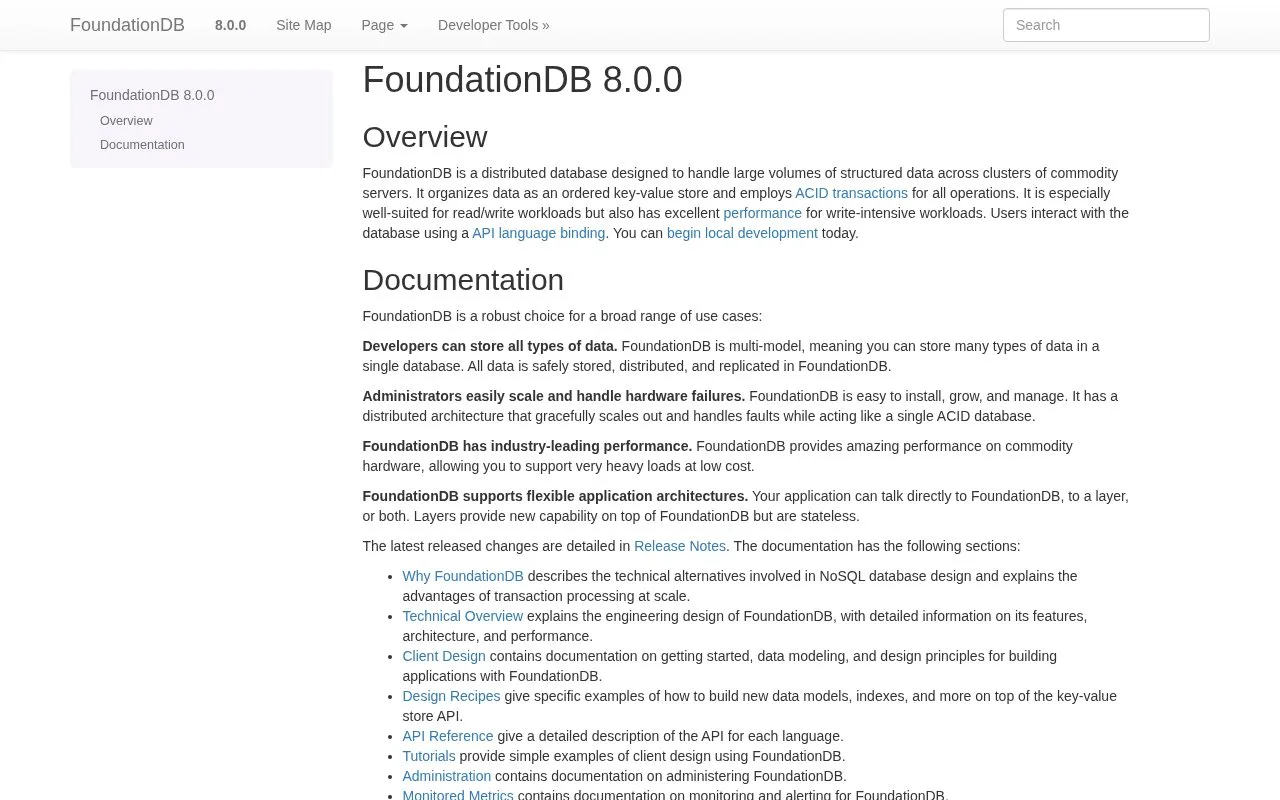
FoundationDB is a distributed database that stores structured data as ordered key-value pairs and provides ACID transactions. Applications access it through language bindings rather than a hosted dashboard or conventional table editor. The design makes it a building block for software that needs transactional key-range operations across a cluster, while leaving the application to define its own data model.
Try a local client-server loop
The FoundationDB local-development guide describes installing the package and binaries needed for both a client and a local development server, then checking the database status. In Python, the documented first steps are to import fdb, select the API version before using the rest of the binding, and open the database through its default cluster file. A small scheduling example can then store a course or reservation record under an ordered key and retrieve it in a transaction. The API docs explain key/value reads and writes; this is a programmatic workflow rather than a point-and-click database console.
FoundationDB's central guarantee is transactional: the project describes ACID transactions across the ordered key-value store. That is useful when application code needs consistent updates to multiple keys. It also means developers should understand the transaction API and retry behavior before making it the persistence layer for a service.
FoundationDB is a low-level database substrate, not a ready-made relational schema. Teams typically design key layouts and any higher-level data model in their application or an additional layer. The project is distributed under Apache License 2.0; this record covers the database project, not a cloud-hosted service.
Strengths
- The ordered key-value model supports transactional reads and writes across structured data.
- The documented local package includes binaries for a client and local development server.
- Python documentation shows the API-version selection and database-open workflow explicitly.
Watch out for
- Applications work through language bindings and key-value transactions, so a relational schema and query layer are not supplied as the primary interface.
- A local development server and compatible client binding must be installed before the documented application workflow can run.
Best for
- Building a custom storage layer that needs ordered keys and ACID transactions
- Developers evaluating distributed transactional key-value storage with a local test instance
Sources
- FoundationDB 8.0.0 documentation (Oct 25, 2026)
- Local Development | FoundationDB 8.0.0 documentation (Oct 25, 2026)
- apple/foundationdb (Oct 25, 2026)
- Apache License 2.0 (Oct 25, 2026)
- Python API | FoundationDB 8.0.0 documentation (Oct 25, 2026)
- Class Scheduling | FoundationDB 8.0.0 documentation (Oct 25, 2026)