
What it does
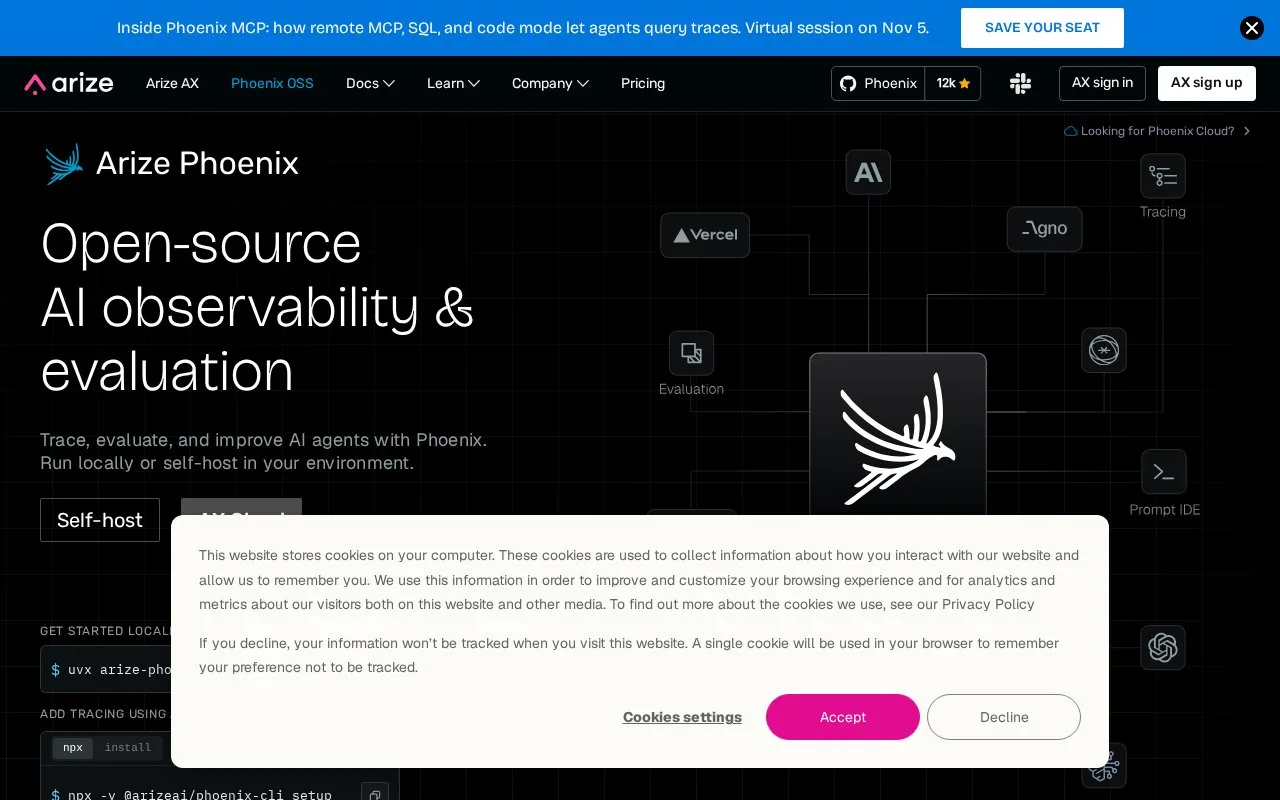
Arize Phoenix is an observability and evaluation tool for AI applications. It accepts traces from instrumented model calls and provides a UI for debugging and iteration. The official guides show starting Phoenix locally or on your own infrastructure, then sending a trace from Python or TypeScript. Phoenix is separate from Arize AX, the vendor's managed AI engineering platform; its repository uses Elastic License 2.0, whose restrictions should be reviewed before offering Phoenix as a hosted service.
The official start guide runs Phoenix locally, in a container, or on infrastructure you control. One documented Docker example exposes a UI on port 6006 and an OTLP receiver on port 4317. The tracing tutorial then sends a model call from Python or TypeScript to a running Phoenix instance; its OpenAI example requires an API key, and the guide notes that an existing application can be instrumented as well. These are documented instructions, not commands or API calls executed for this listing.
A practical first use is to trace one representative model request and inspect the spans around it, then add evaluation or dataset workflows only when the trace points to a concrete question. Phoenix provides the diagnostic interface, while the application still owns its model code and instrumented data. Treat traces as potentially sensitive because they can contain inputs and outputs from AI calls.
The Phoenix repository's license is Elastic License 2.0 (ELv2), not an unrestricted permissive license. Its terms restrict offering the software to third parties as a hosted or managed service. The Arize pricing page opened for this research covers Arize AX, a separate managed product, and does not establish a Phoenix-specific price. Review the license and service boundary before deploying Phoenix for external users.
Strengths
- The official quick start supports local, container, and self-managed ways to start a Phoenix instance.
- The tracing tutorial demonstrates sending a model call from Python or TypeScript to the UI and OTLP receiver.
- The project is aimed specifically at debugging and iterating on AI applications.
Watch out for
- The application must be instrumented and send traces to a running Phoenix service.
- ELv2 restricts providing Phoenix to third parties as a hosted or managed service.
Best for
- AI application developers who need to inspect model-call traces and iterate on behavior.
- Teams wanting a local or self-managed trace UI during development.
- Operators who can review ELv2 terms and keep any deployment within the permitted service model.
Sources
- Phoenix Documentation (Oct 25, 2026)
- Start Phoenix (Oct 25, 2026)
- Observe: Trace a model call and send it to Phoenix (Oct 25, 2026)
- Arize-ai/phoenix (Oct 25, 2026)
- Elastic License 2.0 (Oct 25, 2026)
- Arize AX Pricing (Oct 25, 2026)