
What it does
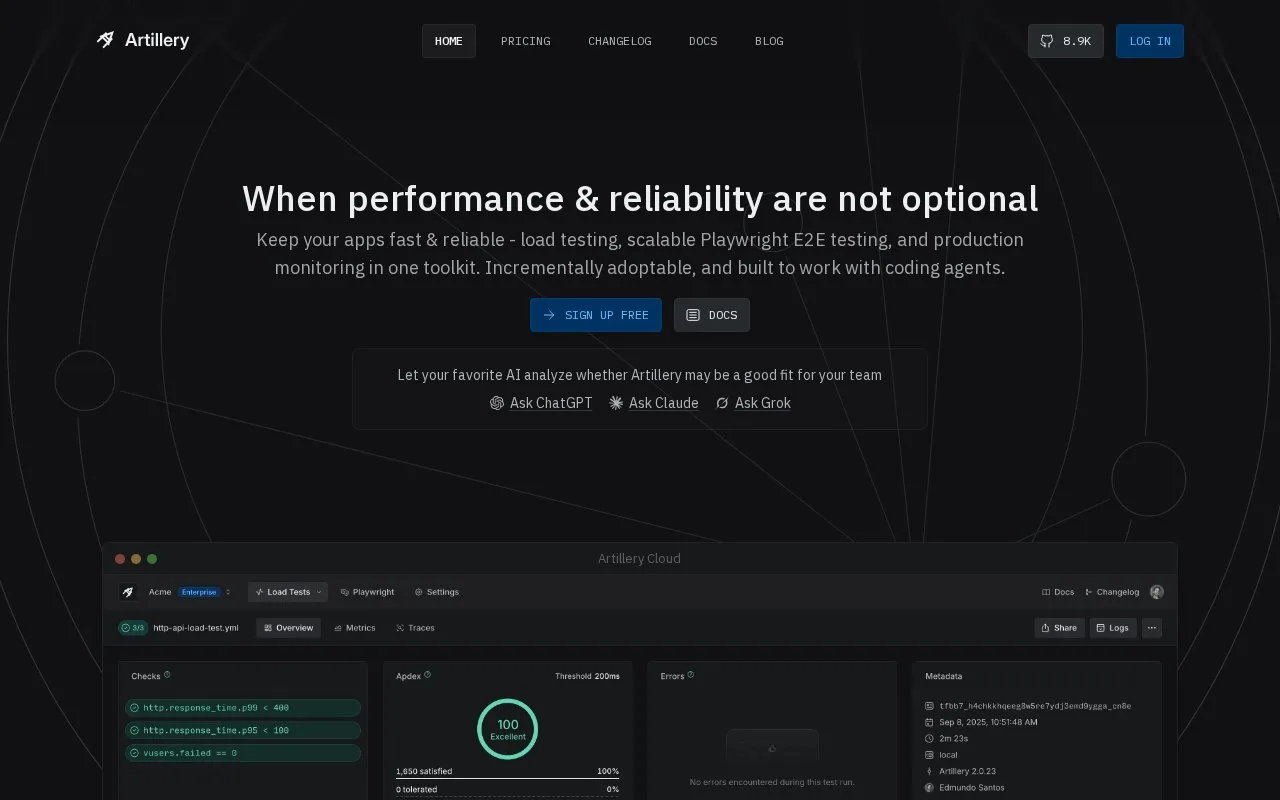
Artillery combines a local test runner with an optional cloud reporting and distributed-execution service. Its test scripts describe a target and user flows, with documented engines for HTTP, WebSocket, Socket.IO, and Playwright-based browser tests. The product also offers cloud reports, CI integrations, and distributed load tests on Artillery-managed or customer-controlled AWS and Azure infrastructure. The tester supplies the target application or API, a realistic scenario, and any required test data or credentials.
Shape the traffic before scaling it
Artillery's first-test guide starts with an API endpoint and a YAML script. The example sets a target URL, defines warm-up and ramp-up phases with arrival rates, and describes virtual users requesting several paths in sequence. A project can write scripts in the documented YAML DSL or use JavaScript or TypeScript. For a useful test of your own service, replace the example target with a staging endpoint, model the traffic pattern you want to investigate, and provide authentication and data setup if the endpoint requires them.
The CLI runs load scenarios and emits results; Artillery Cloud adds a shared dashboard, reports, collaboration, and distributed execution. The product site also describes reusing Playwright tests for browser-based end-to-end testing, so this listing is for Artillery's testing platform rather than the Playwright framework itself. Its monitoring and synthetic-check features are listed as coming soon on the product page and are not treated here as available capabilities.
A free Cloud tier is listed alongside paid Team and Business subscriptions. The official pricing page applies report-volume, retention, team-size, and distributed-worker limits by tier; it says users create a free Cloud subscription with a GitHub account. Local CLI testing and cloud account features should not be conflated. The official repository says most code is MPL 2.0, while some Azure-specific modules use BSL 1.1; it states that Azure evaluation and proof-of-concept use is permitted, but commercial or production use requires a commercial license. Check the exact module before distribution or Azure deployment. No load test or product command was run for this record.
Strengths
- One script format can describe staged arrival rates and multi-request user flows for load testing.
- Documented engines cover HTTP, WebSocket, Socket.IO, and Playwright browser scenarios.
- Cloud reporting integrates with CI providers and can run distributed tests on Artillery's or the customer's cloud infrastructure.
Watch out for
- Cloud plans have report-volume, retention, team-size, and distributed-worker limits; local CLI use and Cloud entitlements are separate.
- Some Azure-specific modules use BSL 1.1, and commercial or production use on Azure requires a commercial license.
Best for
- Load testing an API with staged traffic and sequential virtual-user behavior
- Teams coordinating load tests or Playwright end-to-end reports through CI and a shared dashboard
Sources
- Artillery · Full-stack performance & reliability testing (Oct 25, 2026)
- Run Your First Artillery Test · Artillery (Oct 25, 2026)
- Pricing · Artillery (Oct 25, 2026)
- GitHub - artilleryio/artillery: The complete load testing platform (Oct 25, 2026)
- artillery/LICENSE.txt at main · artilleryio/artillery · GitHub (Oct 25, 2026)
- artillery/LICENSE-BSL.txt at main · artilleryio/artillery · GitHub (Oct 25, 2026)