
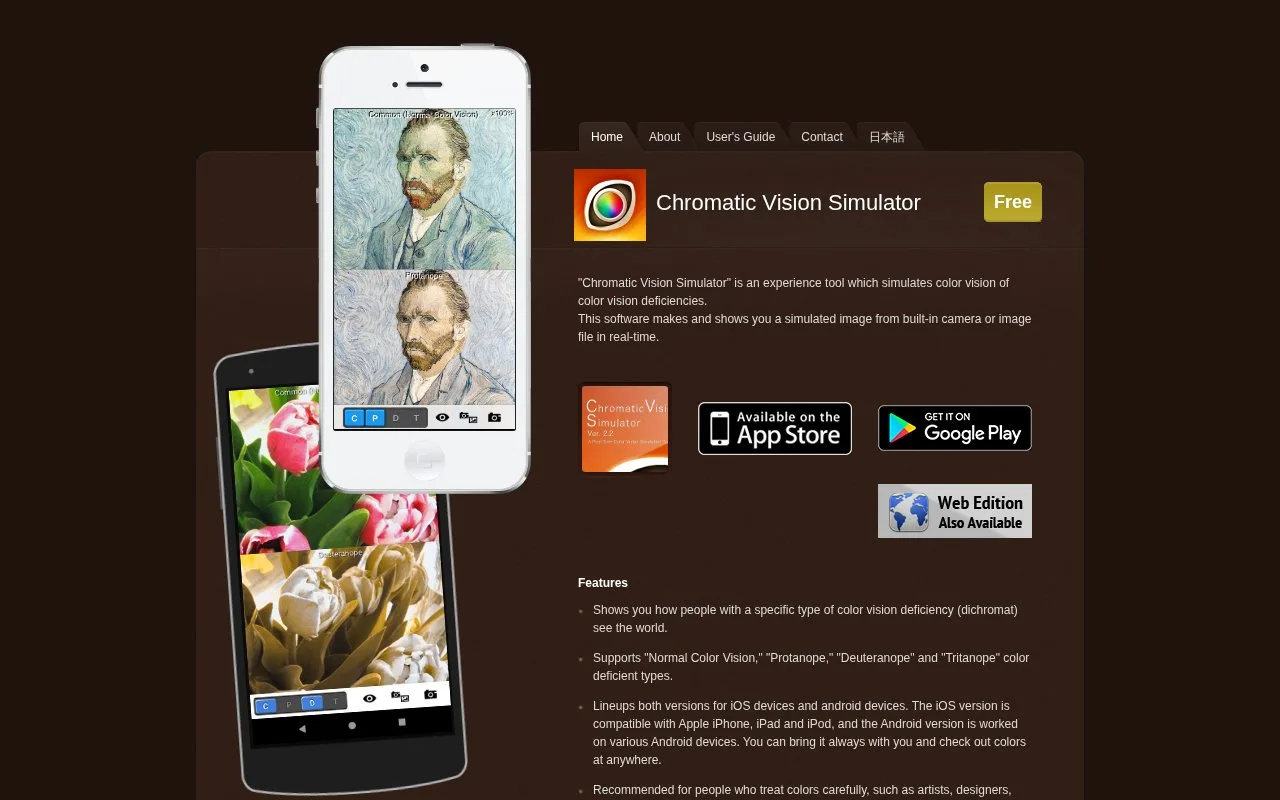
What it does
Chromatic Vision Simulator previews colour-vision differences using camera input or an image file. Kazunori Asada’s free application offers simultaneous comparisons on Android, iOS and the web.
On mobile, select C for the original image or P, D and T for simulations of red-, green- and blue-blind vision. Up to four views can appear together. The camera can face either direction, and a saved photo can replace the live view. Pinch to enlarge the mobile image up to five times, then save a combined comparison marked with the view letters. Saving requires access to the photo library.
The web edition has single, split and four-part layouts, plus mirror and quarter-turn rotation controls. It requires WebGL graphics support; camera input also requires WebRTC, the browser technology used to access a camera.
The intensity slider blends the original image with a simulation of complete loss of one colour-sensing channel. It does not model milder colour-vision differences. The predicted views also cannot account for every individual’s perception.
The Android 3.0 source code is published under MIT, allowing modification and redistribution while retaining its copyright and licence notice. That source-code grant is separate from the iOS and web editions.
Strengths
- Camera and saved-image inputs cover physical materials and digital artwork.
- Combined saved comparisons identify each view with its type letter.
Watch out for
- The intensity blend is not a model of milder colour-vision differences.
- Browser camera use requires WebRTC as well as WebGL graphics support.
Best for
- Designers comparing colour-dependent details on signs, charts and packaging.
Sources
- Chromatic Vision Simulator > Home (Oct 28, 2026)
- Chromatic Vision Simulator > About (Oct 28, 2026)
- Chromatic Vision Simulator > How to use (Oct 28, 2026)
- Chromatic Vision Simulator (Oct 28, 2026)
- GitHub - asada0/ChromaticVisionSimulator - GitHub (Oct 28, 2026)
- ChromaticVisionSimulator/LICENSE.txt at master - asada0/ChromaticVisionSimulator - GitHub (Oct 28, 2026)