
What it does
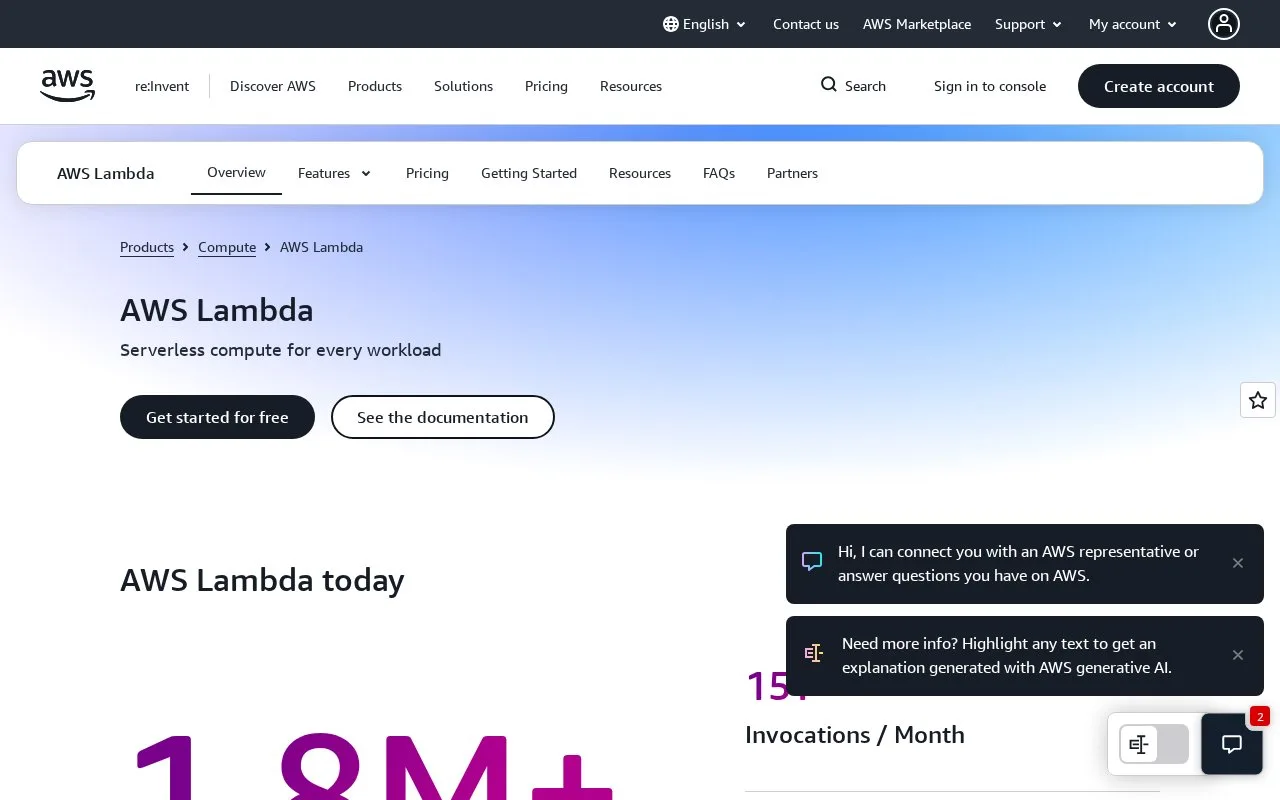
AWS Lambda is a managed compute service for code that runs when invoked rather than on a continuously maintained server. Its current product lineup includes Event Functions for event-driven work, Web Functions for HTTP frameworks, and MicroVMs for isolated stateful sandboxes. Lambda connects with AWS event sources and can also be used as a backend for web applications and APIs. Teams choose the runtime and deployment form, configure permissions and resource limits, then use AWS-managed infrastructure to execute and scale the workload.
A first function is an event handler, not a full server
The AWS getting-started guide creates a Node.js or Python function in the Lambda console. It begins with a function name and runtime, then shows the handler receiving a JSON event and returning a result. The guide's example replaces the generated code, deploys it, creates a test event, and inspects the response and invocation logs. For compiled languages, the deployment package is prepared on a local build machine rather than edited directly in the console.
That workflow suits short jobs triggered by a queue, storage event, schedule, or another AWS service. A web application can instead use Lambda Web Functions to run an HTTP framework, while Lambda MicroVMs target workloads that need stronger isolation and retained state. These are different execution modes within the current Lambda product, so compare their runtime and billing characteristics before designing around one.
AWS charges Event Functions by requests and execution duration, with memory affecting compute use. The pricing page lists monthly free allowances for requests and GB-seconds, while other modes and optional capacity features have their own meters. An AWS account and an execution role are part of the documented setup; the role controls which other AWS resources a function may access. No function or account was created for this listing.
Strengths
- The service supports event-driven functions, HTTP-framework workloads, and isolated MicroVMs under one product family.
- The console tutorial covers deployment, JSON test events, returned output, and CloudWatch invocation logs.
- AWS lists a monthly free allowance for Event Function requests and compute duration, followed by usage-based billing.
Watch out for
- A function's execution role and AWS service permissions must be configured for access to other resources.
- Billing depends on execution form, requests, allocated memory, duration, and optional features rather than one fixed server price.
Best for
- Event-triggered jobs and service integrations that should scale without a dedicated application server.
- HTTP backends that can use Lambda Web Functions instead of managing a server fleet.
- Isolated, on-demand code execution where MicroVM lifecycle and state controls are useful.
Sources
- Serverless Computing - AWS Lambda - Amazon Web Services (Oct 25, 2026)
- Create your first Lambda function - AWS Lambda (Oct 25, 2026)
- AWS Lambda Pricing (Oct 25, 2026)