What it does
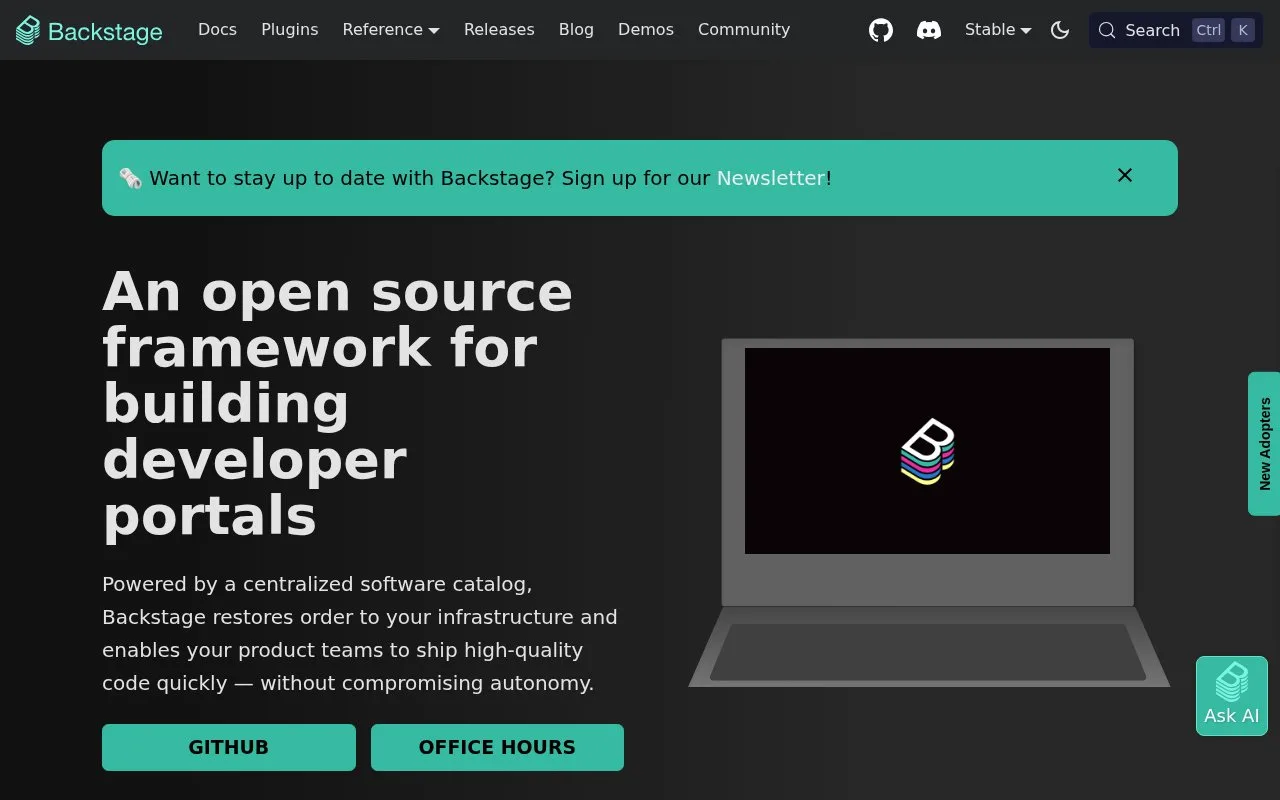
Backstage is an open-source framework for creating a developer portal. Its Software Catalog collects metadata from YAML descriptors stored with software and presents services, websites, libraries, data pipelines, teams, and related entities in one place. Teams can start from a standalone application and extend it with catalog integrations and plugins; it suits organizations that want a portal they can shape around their own engineering systems.
The official standalone-installation guide creates a new Backstage application with npx @backstage/create-app@latest. After choosing the app directory, the guide starts the frontend and backend together with yarn start. A useful first project is a small catalog entry for one service. Backstage recommends a YAML entity descriptor, commonly named catalog-info.yaml, stored alongside the service's code. The catalog can then ingest the descriptor and present ownership and metadata in the portal. Start with a single component and its responsible team before importing every repository; clean ownership fields are more valuable than a large catalog of incomplete records.
Backstage is an Apache-2.0-licensed framework, not a hosted portal that arrives preconfigured for an organization. A team needs to operate the app and decide which plugins, identity integrations, and catalog sources fit its environment. The Backstage project is distinct from third-party or commercial services built around it.
Strengths
- The create-app guide provides a documented path to a standalone portal application.
- Catalog entities can be described in YAML kept together with the software they represent.
- The catalog model covers services, websites, libraries, APIs, teams, and other engineering entities.
Watch out for
- Backstage is a framework to configure and operate, so an organization must own its app, integrations, and catalog hygiene.
- The value of the catalog depends on maintaining useful ownership and metadata rather than importing repositories without context.
Best for
- Engineering organizations building an internal developer portal.
- Teams that want searchable service ownership and software metadata alongside existing repositories.
- Organizations prepared to configure and maintain a portal application and its integrations.
Sources
- Backstage Software Catalog and Developer Platform (Oct 25, 2026)
- Creating your first Backstage app (Oct 25, 2026)
- Backstage Software Catalog (Oct 25, 2026)
- Descriptor Format of Catalog Entities (Oct 25, 2026)
- backstage/backstage (Oct 25, 2026)
- Apache License 2.0 (Oct 25, 2026)
- Standalone Installation (Oct 25, 2026)