
What it does
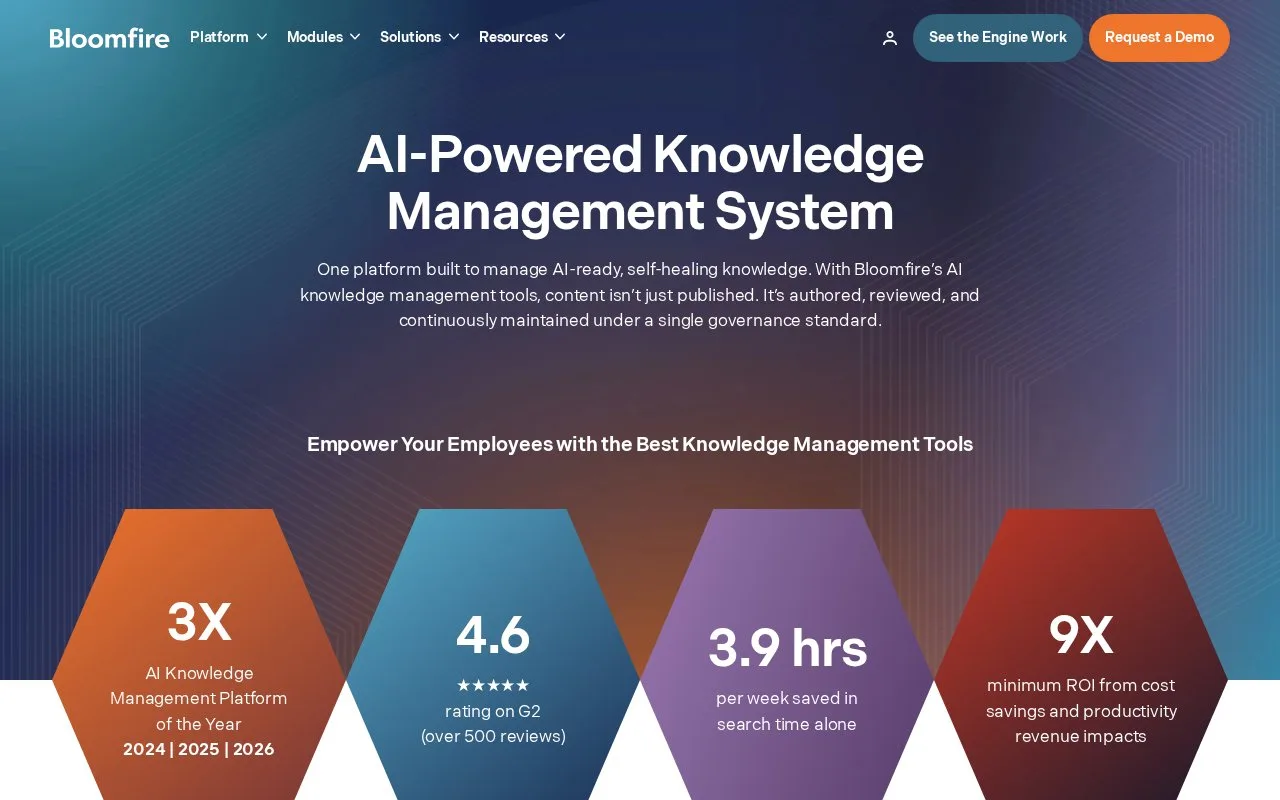
Bloomfire's knowledge-management application is presented as a way to author, curate, search, and engage with enterprise knowledge from different sources. Its product page lists natural-language retrieval, summarization, moderation workflows, and a knowledge-base health capability. It is oriented toward organizations managing a large, shared body of internal information rather than a small personal notebook.
Treat knowledge as a maintained collection
A large support or research team could use Bloomfire to collect material from its information sources, author and curate a shared library, and use search to retrieve it. The product page describes conversational AI for natural-language search, retrieval, analysis, and summarization; it also names moderation workflows and a knowledge-base health capability. Those functions position the product around managing the lifecycle and discoverability of enterprise knowledge, not just storing documents.
Because the system is presented as enterprise infrastructure, prospective buyers should check which connectors, governance controls, and usage measures are included in their proposed deployment. The page's AI claims are vendor descriptions, not results of a test on a company's content. Pricing, user access, and connector behavior were not verified, and no source library was connected.
Strengths
- The product combines authoring and curation with search, engagement, and knowledge analytics.
- The vendor documents moderation workflows and a knowledge-base health capability.
Best for
- Large organizations that need to curate and retrieve shared enterprise knowledge across sources
Sources
- AI Knowledge Management | Bloomfire (Oct 25, 2026)