
What it does
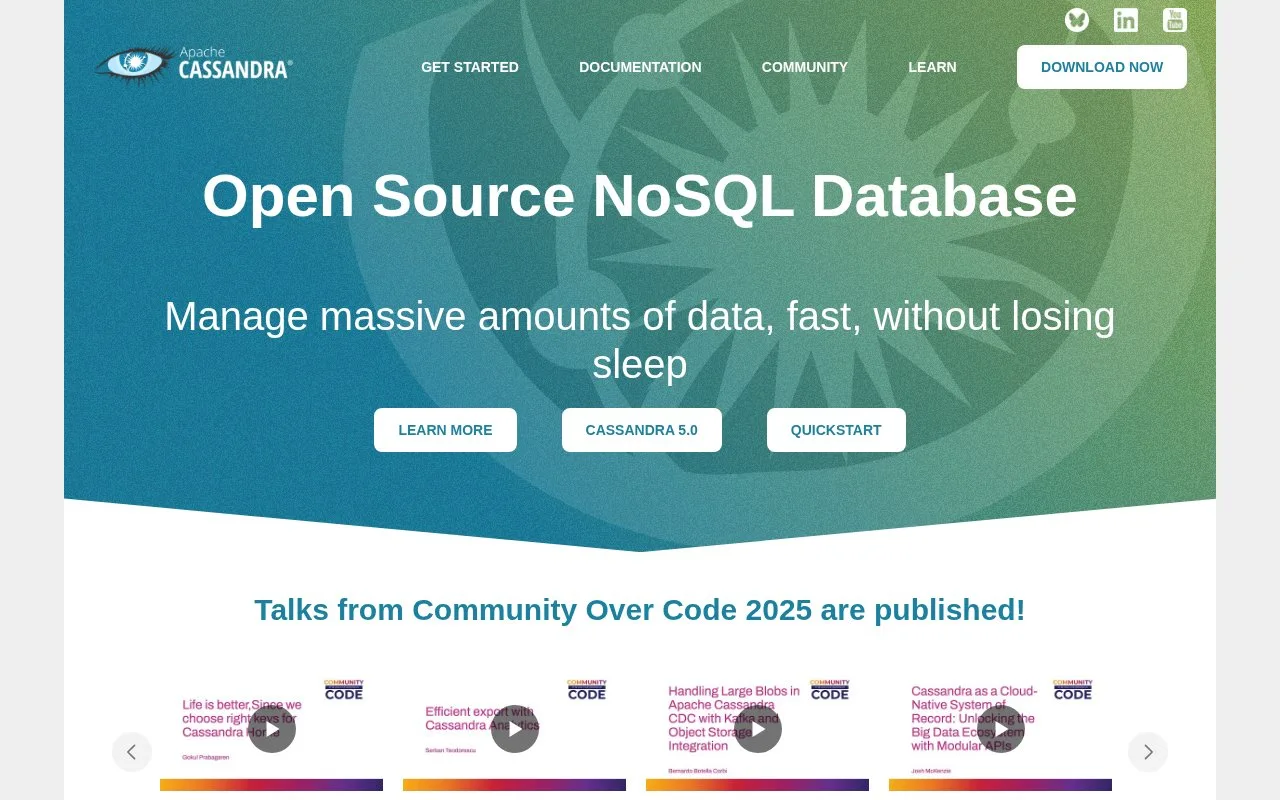
Apache Cassandra is an open-source partitioned row-store database. Its data is organized into tables with primary keys, and Cassandra distributes partitions across machines as a cluster changes. CQL provides a SQL-like interface; the official getting-started docs cover installation, configuration, inserting and querying data, and client drivers.
Cassandra is a good fit when an application can define its access patterns around partition keys and the team is prepared to operate database nodes. The official repository README makes the first self-managed step concrete: a one-node instance and the CQL shell, while the docs expose the broader data-modeling and production topics. Plan the schema around the application's queries rather than treating it like an ad-hoc relational database.
Strengths
- The project documents a self-managed installation path and lists drivers for many languages.
- The repository describes distributing partitions as machines are added or removed.
Watch out for
- The documented install is self-managed, so operators own deployment and cluster operations.
- The partition-key and primary-key model calls for deliberate schema and query planning.
Best for
- Teams building distributed applications around known, partition-key-oriented query patterns.
- Operators who want an open-source database they can run and manage on their own infrastructure.
Sources
- Apache Cassandra | Apache Cassandra Documentation (Oct 25, 2026)
- Getting Started | Apache Cassandra Documentation (Oct 25, 2026)
- Apache Cassandra (Oct 25, 2026)
- cassandra/LICENSE.txt at trunk · apache/cassandra · GitHub (Oct 25, 2026)