
What it does
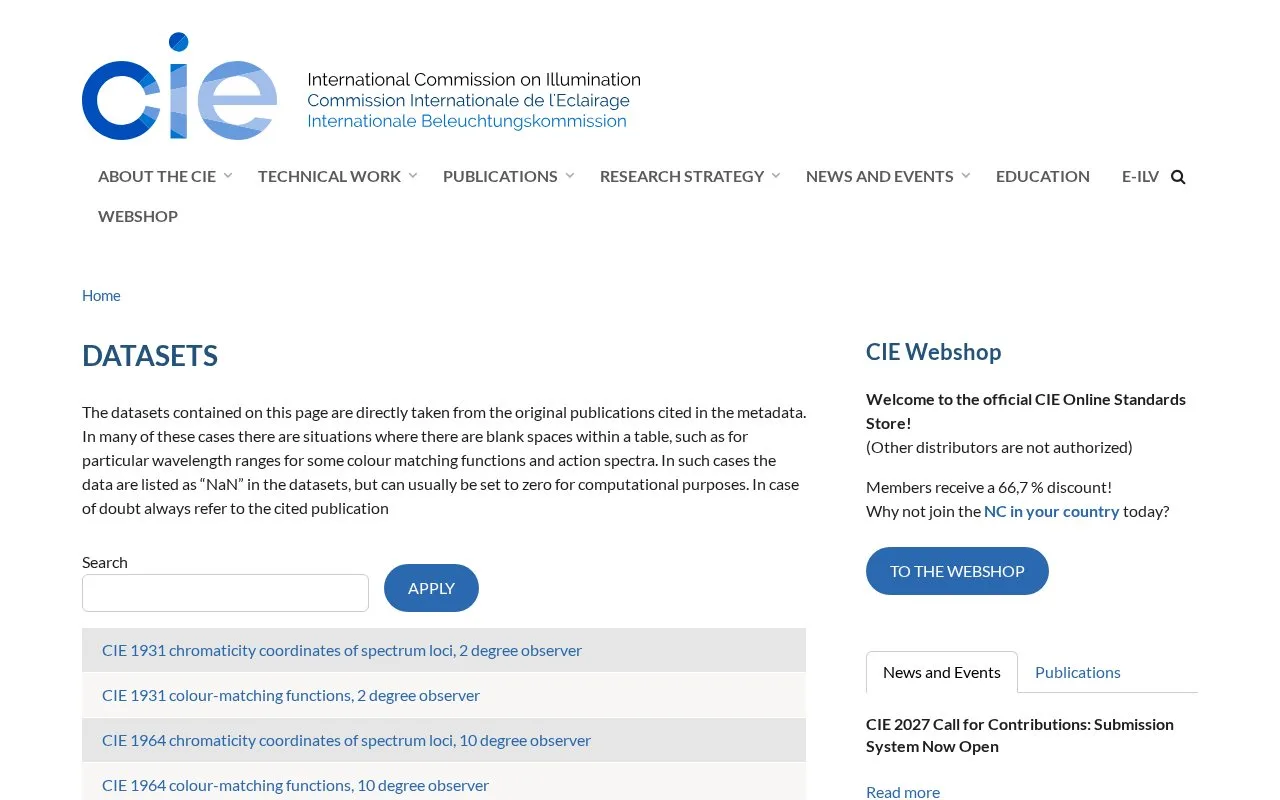
The International Commission on Illumination publishes numerical tables from its technical publications. The catalogue covers standard observers, colour-matching functions, illuminant spectra and related photometric data, with individual dataset pages.
Choose the observer and spectral reference before downloading. The catalogue distinguishes 2-degree and 10-degree observers, as well as daylight, fluorescent and LED spectra. Those choices describe different reference data and should remain attached to the calculation.
The CIE 1931 2-degree colour-matching table illustrates the handoff: a CSV file is paired with JSON metadata, a DOI, citation text and checksums. Its metadata specifies wavelengths from 360 to 830 nm in 1 nm steps, identifies each column, and records linear interpolation with zero extrapolation. It also supplies a sample-row check and column totals for validating a downloaded copy.
That particular dataset carries CC BY-SA 4.0. Sharing requires credit, the licence link and change notices; shared adaptations must use the same or a compatible licence. Check each dataset’s own metadata rather than extending one table’s terms to the entire catalogue.
Some tables use NaN for missing entries. CIE says these can often be set to zero for computation, but directs uncertain cases back to the cited publication. Keep the CSV and metadata together so the reference choice, numerical handling and provenance remain traceable.
Strengths
- Numerical files are paired with machine-readable metadata and stable citations.
- The sampled table includes checksums and additional numerical validation checks.
Watch out for
- Missing entries can require interpretation from the cited technical publication.
- The sampled table’s shared adaptations carry attribution and ShareAlike conditions.
Best for
- Developers and scientists implementing reproducible colour calculations.
Sources
- Datasets | CIE (Oct 28, 2026)
- CIE 1931 colour-matching functions, 2 degree observer | CIE (Oct 28, 2026)
- CIE_xyz_1931_2deg.csv metadata (Oct 28, 2026)
- Legal Code - Attribution-ShareAlike 4.0 International - Creative Commons (Oct 28, 2026)