
What it does
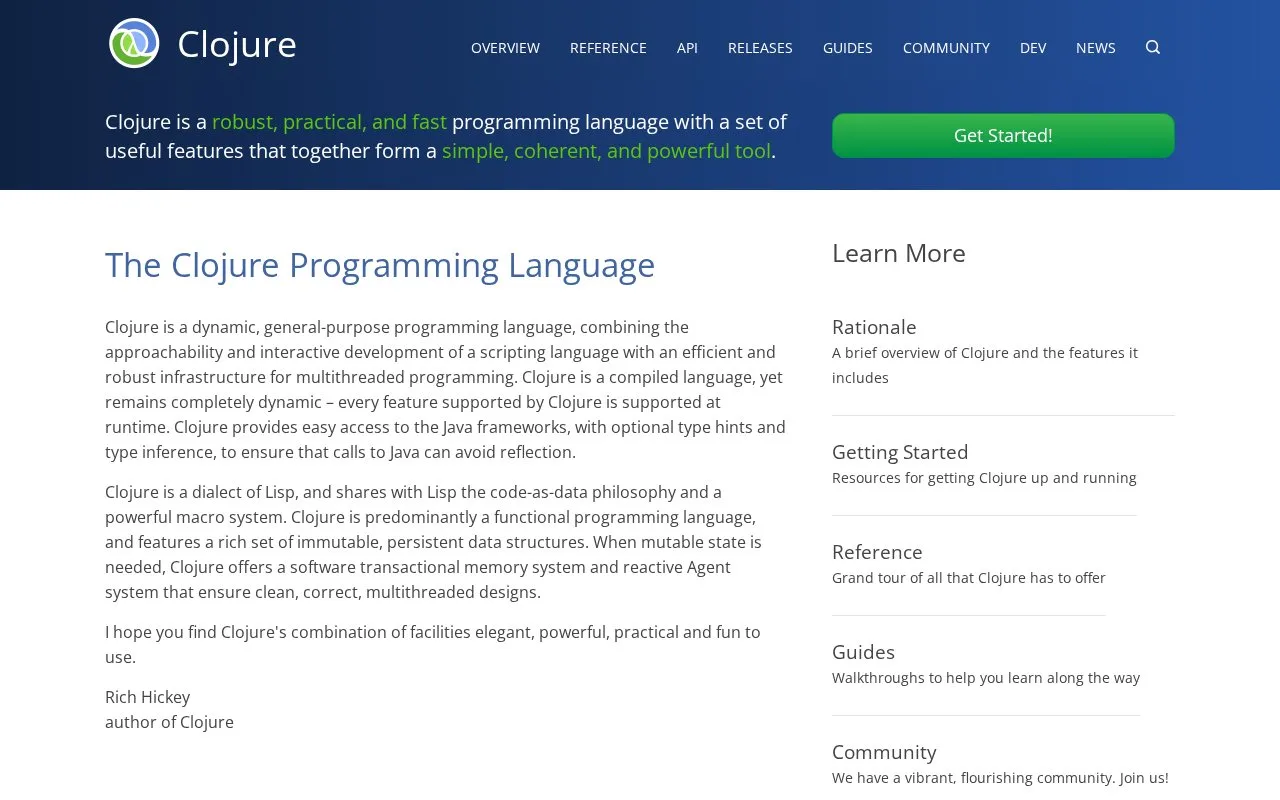
Clojure is a dynamic language designed around interactive programming. The official setup uses the Clojure CLI to start a REPL, load the language and JVM libraries, and work with code while a program is running. That makes it suited to teams that want an interactive feedback loop and access to Java libraries. The official Clojure implementation is distributed under the Eclipse Public License 1.0.
Clojure's getting-started guide frames the work around an editor and a running REPL. A sensible first task is to install the Clojure CLI, start a REPL, and evaluate a small function before turning it into a project. The clojure and clj commands can download the language and JVM-based libraries; the installation guide explains the CLI and its dependency configuration. These are documented setup steps, not commands run for this listing.
The interactive loop is useful when exploring data transformations or building a service incrementally: evaluate a function, inspect its result, then keep working in the same process. The JVM ecosystem also means that projects can use Java libraries, but newcomers need an installed Java runtime and should understand the build and dependency conventions used by their project.
Clojure is distinct from ClojureScript, which targets JavaScript environments, and from hosted products built around the language. The official license page identifies the language distribution as EPL 1.0. No separate commercial price or hosted tier was established from the opened Clojure sources.
Strengths
- The official guide centers an interactive REPL workflow rather than requiring a full application before experimentation.
- The CLI can retrieve Clojure and JVM libraries for a project.
- The official project publishes an Eclipse Public License 1.0 for the language distribution.
Watch out for
- A working setup requires the command-line tools and a compatible Java environment.
- The REPL and dependency workflow may be unfamiliar to developers used to compile-and-run-only workflows.
- The record covers Clojure itself, not ClojureScript or a commercial hosted service.
Best for
- Developers who value interactive exploration while building programs.
- JVM projects that want Clojure syntax and access to Java libraries.
- Teams comfortable with REPL-based development and explicit dependency configuration.
Sources
- Clojure (Oct 25, 2026)
- Getting Started (Oct 25, 2026)
- Install Clojure (Oct 25, 2026)
- License (Oct 25, 2026)
- Clojure source repository (Oct 25, 2026)