
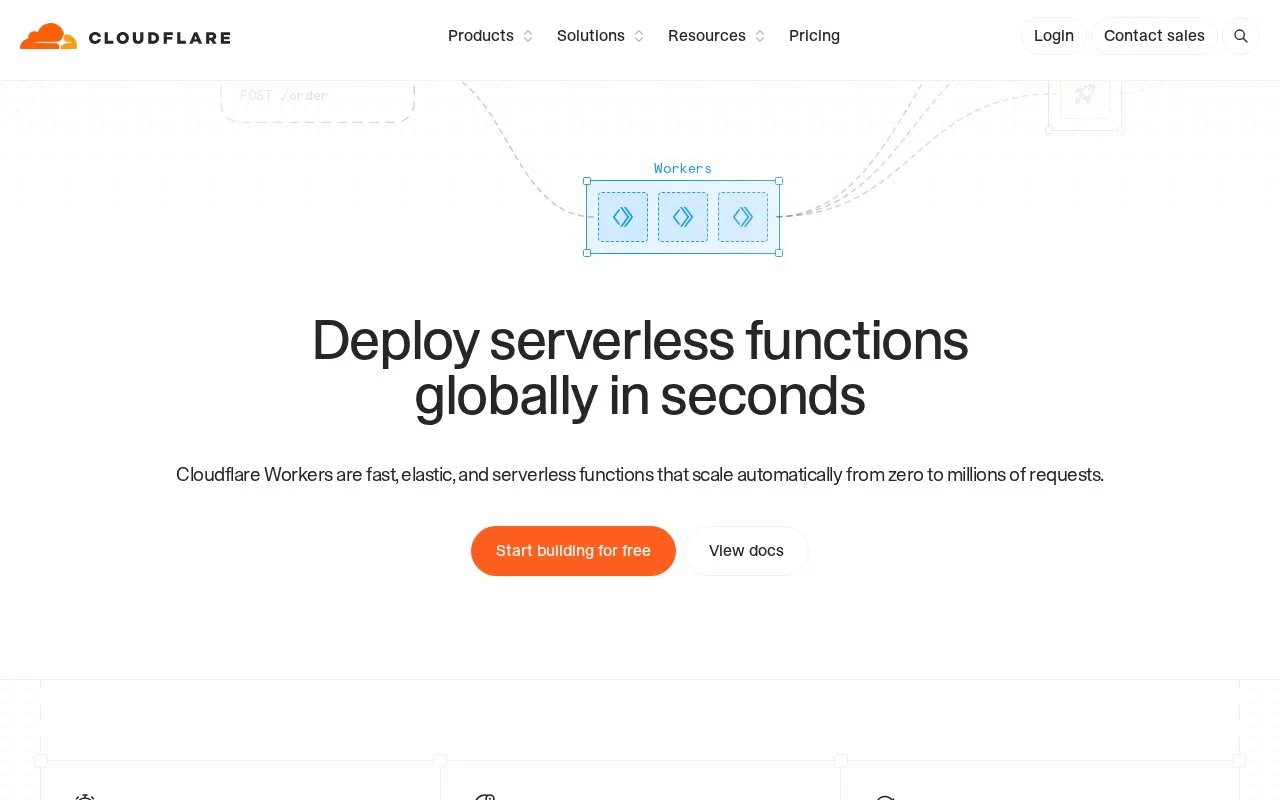
What it does
Cloudflare Workers runs application code on Cloudflare's edge network and scales without provisioning virtual machines. A Worker can handle an HTTP request, expose an API, serve a full-stack application, or respond to scheduled and queued work. Developers can start a project with Cloudflare's create-cloudflare tooling, iterate locally with Wrangler, and deploy to a workers.dev subdomain or custom domain. The product has a request and CPU-time billing model rather than a fixed server size.
Build locally, then publish the Worker
The official getting-started guide requires a Cloudflare account and Node.js. It uses npm create cloudflare@latest -- my-first-worker to create a project, then npx wrangler dev to run the Worker locally. After editing the generated handler, npx wrangler deploy publishes it to a workers.dev subdomain or a configured custom domain. Wrangler prompts for Cloudflare sign-in on first use. These commands are documented examples, not commands run for this listing.
Workers is useful when the hosting unit is request-handling code rather than a machine: for example, an API that validates a request, reads a bound database, and returns a response close to its users. The platform's product page also describes bindings for data and storage, and scheduled or queued tasks. The product is separate from Cloudflare Pages, which is already listed for static-site hosting; Workers is the runtime for executable edge logic and full-stack application behavior.
The pricing page lists a free allowance and charges for requests and CPU time beyond it. Cloudflare's product page describes paying for execution time rather than idle time spent waiting on I/O. That is a different cost model from a VPS, and it makes request volume, CPU use, and attached products important inputs when estimating a production application.
Strengths
- Wrangler supports local development and deployment to a workers.dev subdomain or custom domain.
- The product supports JavaScript, TypeScript, Python, and Rust workloads on the edge network.
- The pricing model separates requests and CPU time rather than charging for idle I/O wait.
Watch out for
- The documented first-project workflow requires Node.js and a Cloudflare account, even when the application code uses another supported language.
- Costs depend on request volume and CPU use, with separate usage rules for connected platform products.
Best for
- Serving an API or request handler near users without managing virtual machines
- Adding edge logic such as authentication, routing, or caching in front of an application
- Deploying a full-stack web application that uses Cloudflare storage or data bindings
Sources
- Cloudflare Workers - Global Serverless Functions Platform (Oct 25, 2026)
- Get started - CLI · Cloudflare Workers docs (Oct 25, 2026)
- Pricing (Oct 25, 2026)