
What it does
Convex combines a document database with backend functions, sync, search, and file storage. Its database stores JSON-like documents in tables and exposes reads and writes through JavaScript query and mutation functions rather than SQL. Schemas are optional, while indexes and typed identifiers support more structured models as an application grows.
Put the data model beside the functions
A new Convex deployment starts without tables. In the documented model, a table appears when the application inserts its first document, so a small prototype can begin without a separate schema migration. A team can add a schema as the model becomes more specific, then define indexes for common lookups. Reads and writes live in JavaScript query and mutation functions, which keeps the data-access layer close to the backend code.
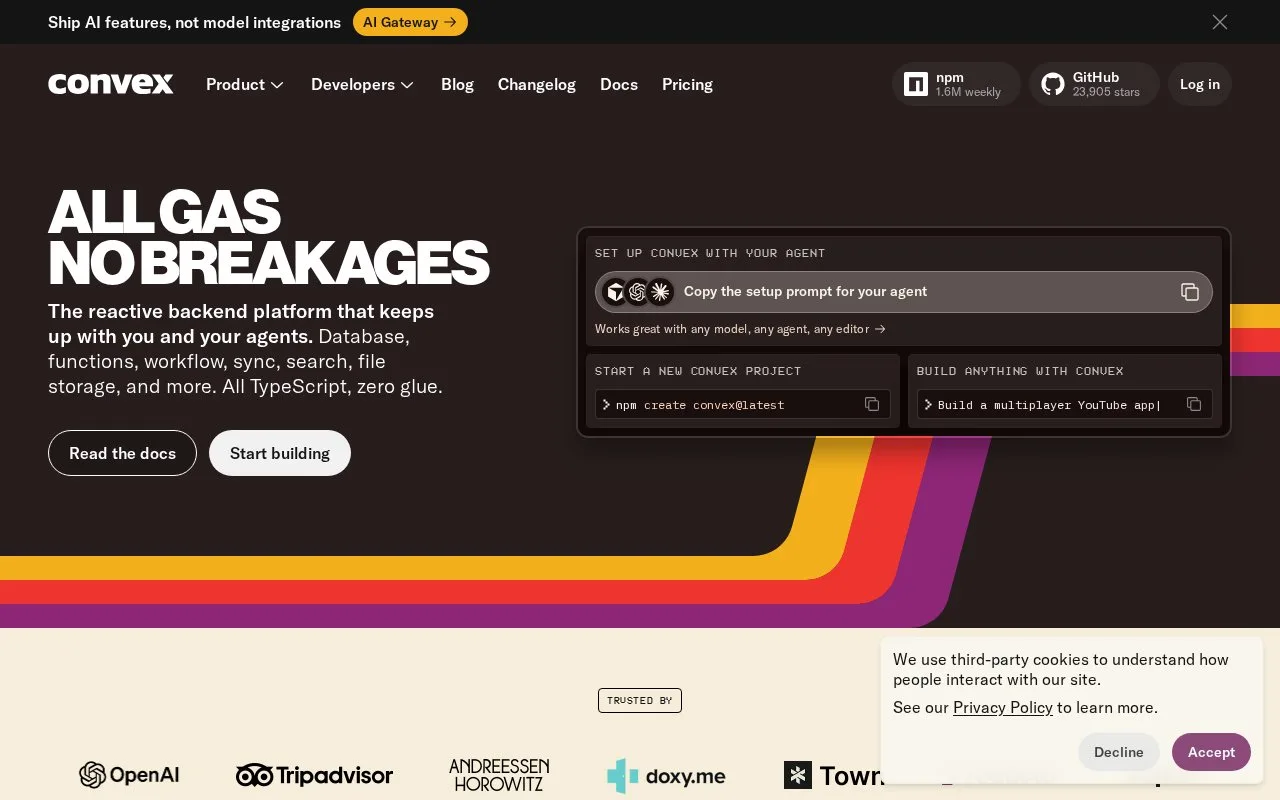
Convex's reactive backend platform is designed to keep connected clients current as data changes. Its quickstarts guide developers through creating a project and adding database-backed functions; the platform also includes features such as search and file storage. This workflow is attractive to TypeScript teams that want an integrated backend, but it is not a drop-in SQL database. Applications with an existing SQL-centered model need to assess the query and transaction changes before adopting it.
Strengths
- The database is exposed through JavaScript query and mutation functions, with no SQL setup required.
- Optional schemas, indexes, document IDs, and pagination support increasingly structured applications.
- The database is integrated with reactive updates and other backend capabilities.
Watch out for
- Database reads and writes use Convex JavaScript functions rather than SQL, so SQL-centric applications may need to adapt their data-access layer.
- The database is part of Convex's broader reactive backend platform, not a separately operated database service.
Best for
- TypeScript applications that need database changes reflected in connected clients
- Teams that prefer JavaScript query and mutation functions over writing SQL
- Applications that benefit from a database integrated with backend functions, search, and file storage
Sources
- Convex | All gas, no breakages (Oct 26, 2026)
- Database | Convex Developer Hub (Oct 26, 2026)
- Choose Your Plan (Oct 26, 2026)
- Quickstarts | Convex Developer Hub (Oct 26, 2026)