
What it does
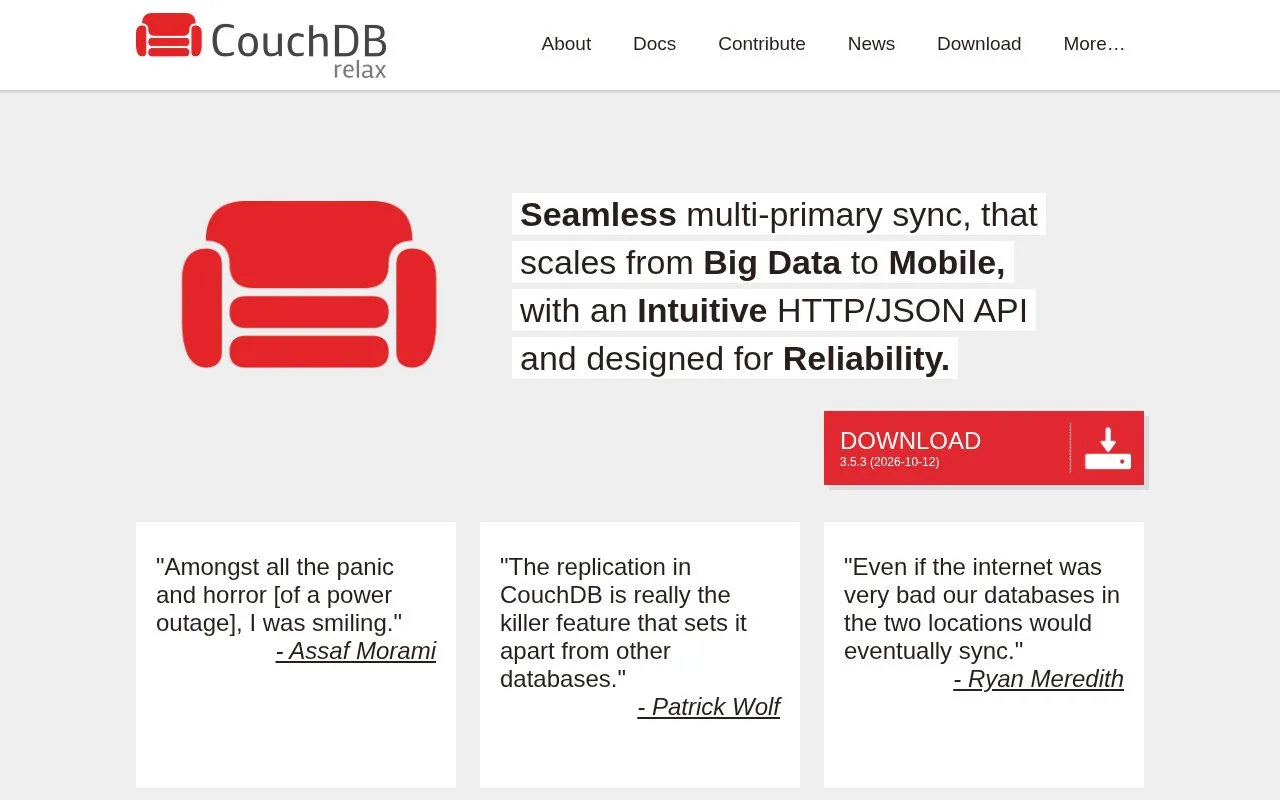
Apache CouchDB is a document database built around JSON storage and an HTTP API. Its replication protocol can synchronize data among server clusters, phones, and browsers, making it a candidate for applications that must keep working through intermittent connectivity. The project can run as a single-node database or as a cluster managed by the operator.
CouchDB's getting-started guide shows a useful first loop in Fauxton: create a database, add a document, run a Mango query, and trigger replication to another database. This makes it possible to explore the data model through a web console before connecting an application through CouchDB's HTTP/JSON API.
The design is especially relevant when replicas need to exchange changes after being offline. That convenience comes with eventual consistency and conflict handling to understand; the docs describe automatic conflict detection rather than presenting replicas as one instantly synchronized database. Replication can take time on larger databases, and the tutorial warns to keep the browser open during a Fauxton replication job or use a client that can maintain its long-running connection. CouchDB is Apache-licensed software for self-managed deployment, so the operator remains responsible for installation and cluster care.
Strengths
- The HTTP/JSON interface works with tools and applications that can make HTTP requests and handle JSON.
- The documented Fauxton tutorial covers document creation, Mango querying, and database replication.
- The project supports both a single-node setup and clustered deployments without changing the API.
Watch out for
- CouchDB uses eventual consistency across distributed replicas, so applications must account for conflict handling.
- The operator installs and maintains the database; long-running replication needs a client connection that remains open.
Best for
- Offline-first or intermittently connected applications that need to synchronize JSON documents.
- Teams that want to run a document database themselves and can plan around replicated data and conflicts.
Sources
- Apache CouchDB (Oct 25, 2026)
- 1.6. Getting Started — Apache CouchDB 3.5 Documentation (Oct 25, 2026)
- Apache License, Version 2.0 (Oct 25, 2026)