
What it does
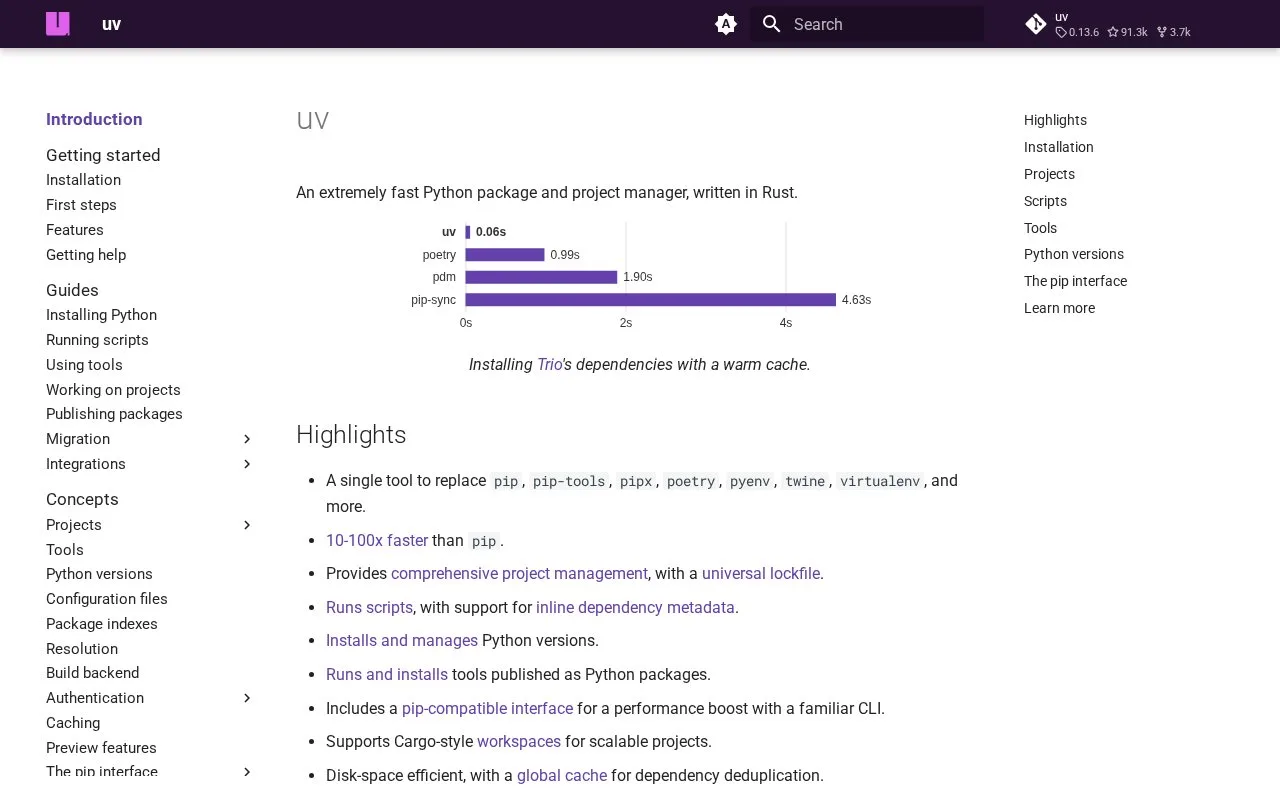
uv is an Astral Python package and project manager written in Rust. It can initialize projects, manage dependencies, create a virtual environment, install Python versions, and run project commands. The project guide centers on `pyproject.toml` and a generated `uv.lock` file, so the selected dependency set can be synchronized for later runs.
A documented first project uses uv init to create a starter layout, then uv run to execute its entry point. Add dependencies with uv add; project commands create or update the environment and lockfile as needed. This gives a newcomer a clear path from an empty folder to a runnable Python project without separately wiring together a package installer and virtual-environment tool.
The README presents uv as a single tool for several Python packaging workflows, while the project guide uses pyproject.toml and uv.lock as the central project files. Teams adopting it in an existing repository should check how their current dependency metadata and lockfile fit that workflow. The project is MIT-licensed.
Strengths
- Combines Python project setup, package management, virtual environments, Python installation, and command execution.
- The project guide documents a generated `pyproject.toml`, `.venv`, and `uv.lock` workflow.
- The official repository uses the MIT License.
Watch out for
- Existing projects may need to align their dependency workflow and lockfile with uv’s `pyproject.toml` and `uv.lock` conventions.
Best for
- Python developers who want one CLI for project setup, dependencies, environments, and command execution.
- Teams standardizing lockfile-based Python project workflows.
Sources
- uv | Astral Docs (Oct 25, 2026)
- Working on projects | uv (Oct 25, 2026)
- README.md | astral-sh/uv (Oct 25, 2026)
- LICENSE-MIT | astral-sh/uv (Oct 25, 2026)