
What it does
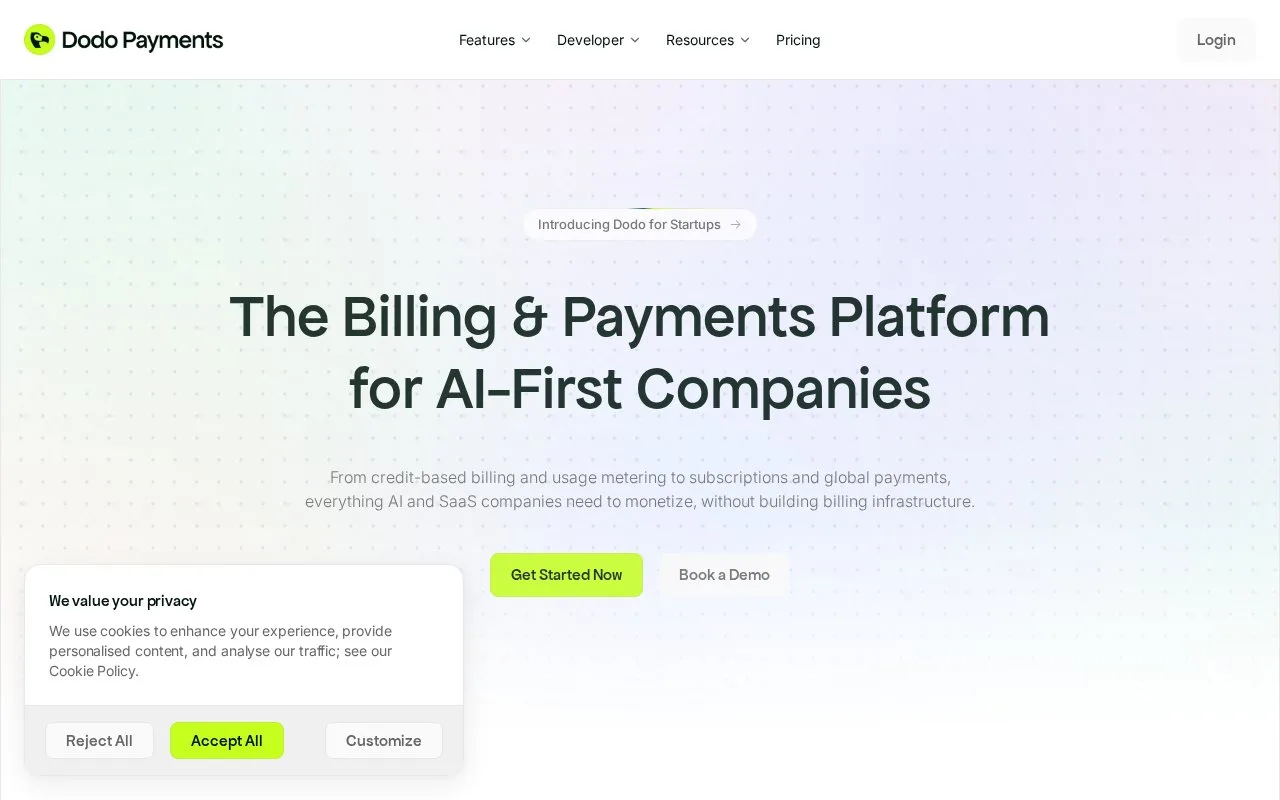
Dodo Payments handles payment collection and billing for software and digital products, including subscriptions, metered usage and prepaid credits. Developers can combine a base charge with usage or let customers buy a balance to spend in the product. Its APIs, framework adapters and billing components support integration, while seller verification and payout rules determine account access. Live payment collection requires verification and carries transaction fees.
Dodo Payments is useful when a flat subscription does not fully describe what a customer buys. An application might include a monthly allowance, sell extra credits and charge for additional usage. Dodo also provides storefronts, license keys and digital delivery. The company says its merchant-of-record service handles transaction taxes.
To define a credit balance, open Products > Credits > Create Credit. Choose a custom unit or a currency-based credit and set its precision carefully: the decimal precision cannot be changed later. Expiry, rollover and overage settings determine how that balance behaves.
Attach credits to a single-payment product to grant them at purchase. For a metered product, choose Bill usage in Credits and set Meter units per credit. For example, 1,000 API calls could consume one credit. Dodo's guide distinguishes this from money-based metering: the monetary free-usage threshold does not apply when every unit is deducted from a credit balance.
Collection fees and settlements
Standard has no monthly platform charge. The main published transaction charges are:
| Payment or billing type | Charge |
|---|---|
| Domestic US cards and wallets | 4% plus 40 cents |
| Cards and alternative methods outside the US | Add 1.5% |
| Subscriptions, add-ons and usage billing | Add 0.5% |
| PayPal or buy-now-pay-later methods | Add 3% |
| US ACH or Eurozone SEPA direct debit, one-time payments only | 1.5%, capped at $15 or €15; replaces the card fee |
ACH is the US bank-debit route; SEPA is the Single Euro Payments Area bank-debit route. The listed direct-debit prices carry neither the international nor subscription surcharge. Refunds, disputes and some payout methods have separate charges.
The usual payout schedule is twice monthly. The minimum threshold is USD 50, and Settings > Payouts lets you raise it. A $5 fee applies below $1,000 or its GBP/EUR equivalent. The dashboard separates available funds, incoming funds and reserves, which helps explain why total sales may differ from the next bank transfer.
Before live collection, submit product information, identity details, any required business documents and bank information. Slovenia appears in the accepted-country list. Eligibility depends on the country issuing the verified identity document; a registered business also needs eligible incorporation and owner/director documentation. A supported residence alone does not settle eligibility.
Dashboard apps are available for iOS, Android, Windows, Mac and Linux as well as the web.
Strengths
- Credit expiry, rollover and overage controls support different prepaid offers.
- Metered usage can consume custom credits instead of becoming a separate cash charge.
- Framework adapters and billing components help connect payment features to an application.
Watch out for
- Credit-unit decimal precision cannot be changed after creation.
- International payments, recurring billing and some methods add to the base fee.
- Seller identity and business-country checks can restrict who may activate an account.
Best for
- Software teams combining subscription and usage charges
- Applications selling prepaid usage credits
- Digital-product businesses needing payment and delivery tools
Sources
- Dodo Payments billing, payment and developer overview (Oct 27, 2026)
- Dodo Payments Standard pricing and additional fees (Oct 27, 2026)
- Dodo credit-based billing setup (Oct 27, 2026)
- Dodo accepted countries and identity-document rules (Oct 27, 2026)
- Dodo verification process (Oct 27, 2026)
- Dodo payout schedule, thresholds and fees (Oct 27, 2026)
- Dodo dashboard apps (Oct 27, 2026)