
What it does
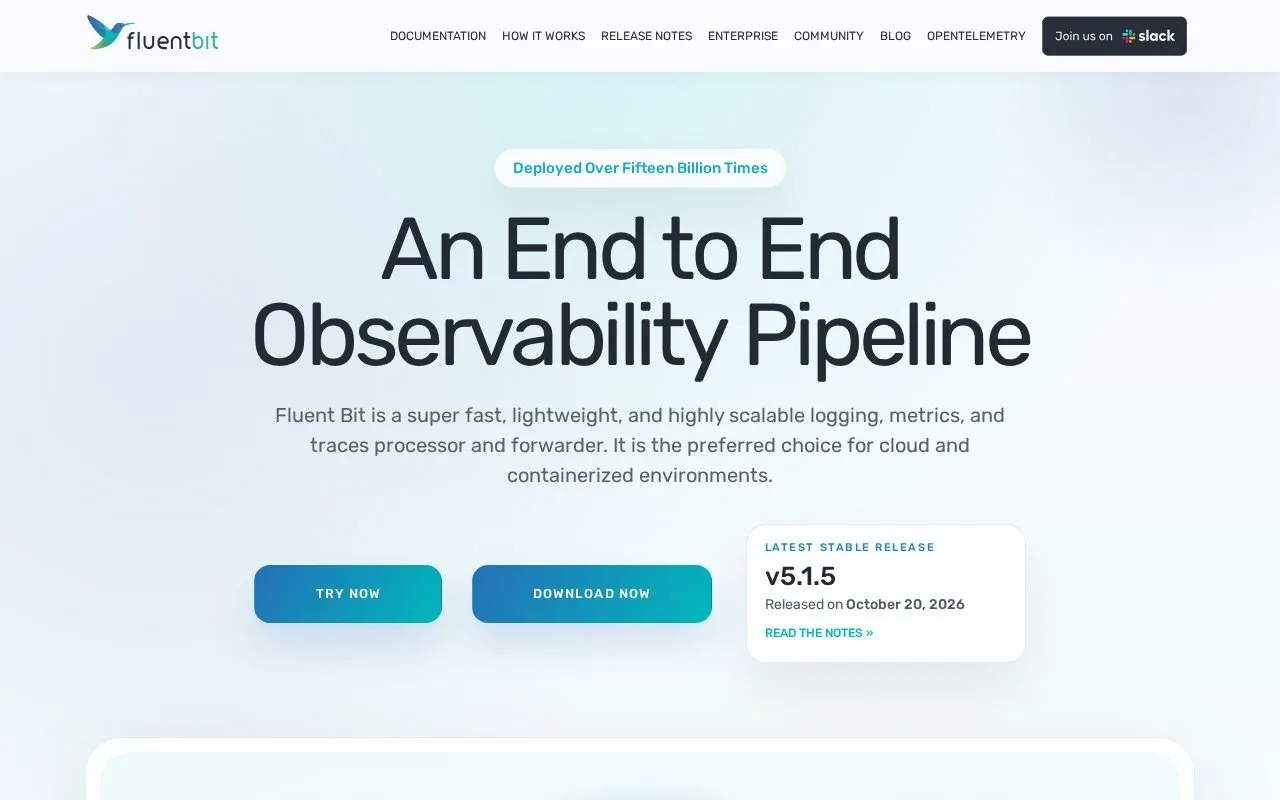
Fluent Bit is a portable telemetry agent that receives logs, metrics, and traces, processes or filters records, and forwards them to configured destinations. Its input, parser, processor, filter, buffer, and output components form a configurable data pipeline, with OpenTelemetry support and plugins for common sources and destinations. It is a collection and routing layer rather than the long-term storage or analysis interface where a team investigates all of its telemetry.
Connect an input to an output
A useful first step is to decide which source to collect and where its events should go. Fluent Bit's configuration links inputs, parsers or filters, and outputs; for example, the official local-testing guide documents a dummy input sent to Elasticsearch. That example runs the agent and destination with Docker Compose, so it can teach the shape of a pipeline without implying that a production deployment should use the same setup. Another team might use an existing log input, normalize the fields, and forward the result to its own backend.
The components matter because Fluent Bit moves data rather than explaining it. Inputs determine what is collected, processors or filters can parse or reshape records, and outputs route them to a destination. Local inspection or alerting happens in the configured backend, not in a Fluent Bit dashboard. The upstream manual documents buffering, routing, TLS, monitoring metrics, and stream processing, as well as OpenTelemetry-compatible metrics and ingestion/delivery.
The official manual describes Fluent Bit as a CNCF project under the Fluent organization and identifies Apache License 2.0. Installation and configuration therefore remain with the operator, while exact behavior depends on the selected plugins and their settings. This record makes no workload-specific performance claim and does not assume a separate hosted-service price.
Strengths
- The input, filter, and output architecture can connect different telemetry sources and destinations.
- The official manual documents local Docker Compose pipeline examples and data parsing, routing, buffering, and stream-processing capabilities.
- Supports OpenTelemetry-compatible telemetry and exposes internal monitoring metrics.
Watch out for
- A collection pipeline must be configured with the right inputs, parsers, filters, and outputs for the source and destination.
- Fluent Bit forwards telemetry; teams still need a backend to store, search, visualize, or alert on the data.
Best for
- Collecting and forwarding application or infrastructure logs from hosts and container environments.
- Transforming or routing telemetry before it reaches a storage or observability backend.
- Teams that want an agent for logs, metrics, and traces across multiple operating systems.
Sources
- Fluent Bit (Oct 25, 2026)
- Fluent Bit documentation (Oct 25, 2026)
- Run a logging pipeline locally | Fluent Bit: Official Manual (Oct 25, 2026)
- fluent-bit/LICENSE at master · fluent/fluent-bit · GitHub (Oct 25, 2026)