
What it does
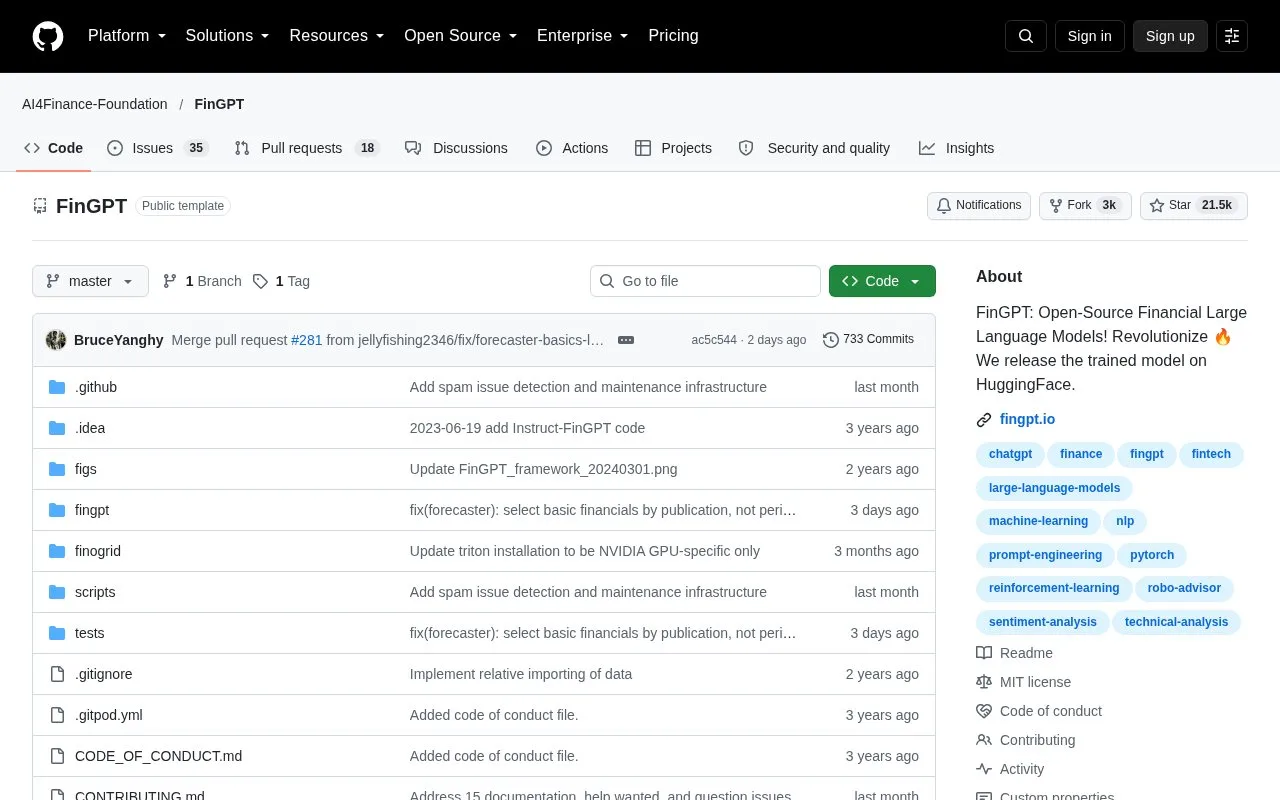
FinGPT is an MIT-licensed financial language-model research project. It provides sentiment analysis, forecasting, benchmarking and model fine-tuning examples. Developers can use local models or connect a cloud model provider, with hardware and account requirements depending on that choice.
FinGPT provides several research components rather than a single finished investing app. Choose the sentiment notebooks to evaluate financial text, or the Forecaster example to work with a stock ticker and date. The sample interface adds controls for the number of weeks and whether to include basic financial information, then returns a text result.
A local setup uses a Python environment and the component's dependencies. The setup guide distinguishes inference from training: cloud model calls do not need a local GPU, while fine-tuning has much heavier hardware requirements. Local model access can also involve accepting a model provider's terms or using an access token.
The code is free under MIT terms. Cloud inference, rented hardware and external data are separate services with their own terms. There is no single FinGPT subscription covering those resources. Windows and Mac users should read the platform notes before installation because some acceleration packages have limited support.
For a practical starting point, use a supplied benchmark or demo notebook and inspect its inputs and model choice. A generated forecast remains model output that needs evaluation; the project is aimed at developers and researchers who can examine that process.
Strengths
- Includes distinct sentiment, forecasting and benchmarking examples
- Supports local-model and cloud-provider approaches
- Provides notebooks for model fine-tuning
Watch out for
- Training and local inference can require substantial computing resources
- Acceleration dependencies have platform-specific limitations
Best for
- Developers researching language models for financial text
- Researchers benchmarking sentiment or forecast outputs
Sources
- FinGPT components and research examples (Oct 27, 2026)
- FinGPT setup, component controls and hardware requirements (Oct 27, 2026)
- FinGPT MIT license (Oct 27, 2026)