
What it does
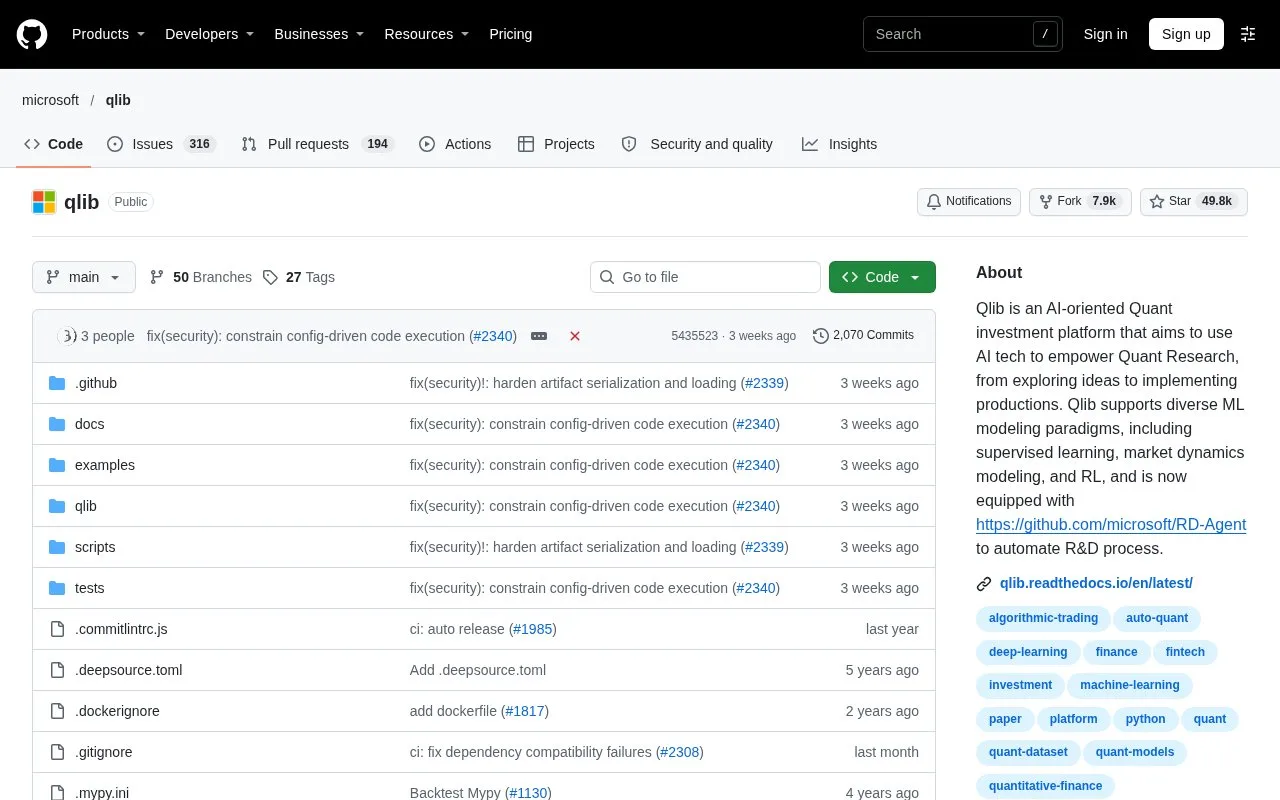
Qlib is a quantitative-research platform for financial datasets, machine-learning models and investment-strategy experiments. Its configuration-driven workflow connects training, prediction, portfolio simulation and saved experiment results. The MIT-licensed Python package is free to install.
Qlib groups data preparation, model research and portfolio evaluation in one framework. An experiment configuration records the dataset location and region, training and validation periods, test period, model and requested outputs. This makes the assumptions behind a run easier to preserve and compare.
The workflow guide uses qrun with a configuration file. After defining the data handler and model, choose a portfolio strategy and backtest settings, including dates, benchmark, starting capital and transaction-cost assumptions. Recorder components save predictions and analysis artifacts. Reports can distinguish results before and after costs. The data region must match the dataset; changing a region label does not convert the underlying market data.
Install the public package with pip install pyqlib; local experiments do not require a Qlib account. Data preparation is a separate step. The repository currently says its official dataset downloads are temporarily disabled and points to a community alternative, so arrange a suitable dataset before relying on the quick-start download route.
Source-branch behavior can also differ from a packaged release, including changes to artifact loading. Keep the installed version, dataset configuration and evaluation periods with a result when reproducing an older experiment.
Strengths
- Keeps training, prediction and portfolio evaluation in one configurable workflow
- Exposes benchmark, period and transaction-cost assumptions
- Saves experiment artifacts for later inspection and comparison
Watch out for
- The official dataset download service is currently marked temporarily unavailable
- Unreleased source changes can differ from the packaged release
Best for
- Technical teams running reproducible financial machine-learning experiments
- Researchers connecting model predictions with portfolio simulations
Sources
- Qlib installation, dataset notice and release differences (Oct 27, 2026)
- Qlib workflow configuration and experiment records (Oct 27, 2026)
- Qlib MIT licence (Oct 27, 2026)