
What it does
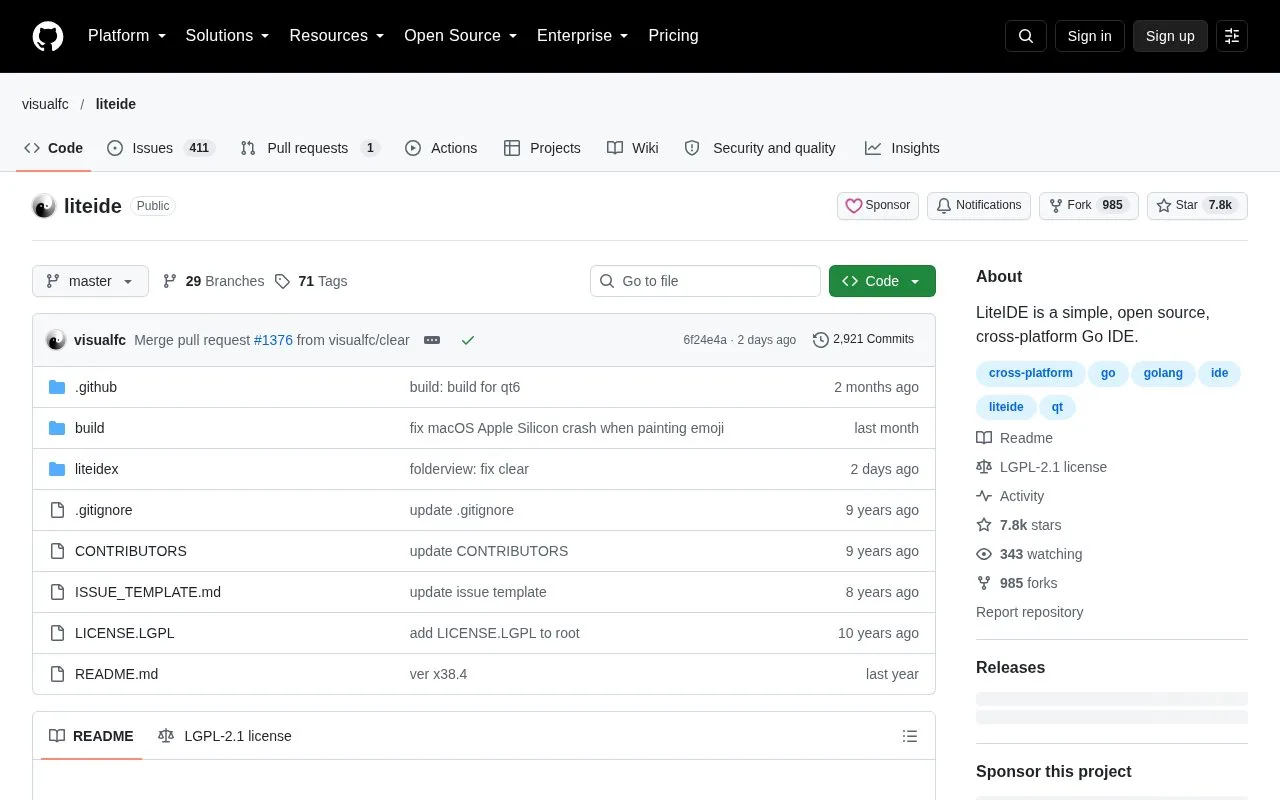
LiteIDE is a desktop IDE focused on Go rather than a general-purpose multi-language environment. Its editor is paired with Go-oriented navigation and completion, build commands, environment management, a terminal, and tools for running and debugging Go tests. The environment selector lets developers choose build variables for the host or a cross-compilation target. The project publishes binaries and source, while building the IDE itself requires a separate Qt development setup.
Start with the Go toolchain
LiteIDE's setup guide says to install Go before using the IDE. After opening a project, select its build environment from the toolbar. Each environment carries variables such as GOROOT, GOOS and GOARCH; this lets a developer switch from the host defaults to another operating-system or architecture target before building. The feature guide also describes using the environment settings to configure cross-compilation. The README lists code completion, package and symbol navigation, an integrated terminal, standard Go build and test tools, and debugger integrations.
For example, a Go developer could select a Linux target environment while editing on Windows and build the project with that target's variables. This is an illustrative use of the documented controls, not a test performed for this listing. A prebuilt archive is the simpler installation route; compiling LiteIDE from source requires Qt dependencies in addition to Go.
Check the Go version fit
The changelog dates version X38.4 to 2025-05-20 and says it added Go 1.24 support. The README's feature list still describes earlier explicit Go support through 1.21, so check current release notes against the toolchain you plan to use rather than assuming all newer Go versions are covered. The repository publishes the IDE under LGPL 2.1 terms.
Strengths
- The editor combines Go code completion, symbol navigation, package browsing and debugger integrations in a Go-focused workspace.
- Selectable build environments expose variables such as GOOS and GOARCH for switching targets and configuring cross-compilation.
- The README documents use of standard Go tools for building and testing projects from the IDE.
Watch out for
- LiteIDE is specifically focused on Go, so it is not a general-purpose IDE for unrelated language stacks.
- Building the IDE from source requires a separate Qt development environment.
Best for
- Go developers who want source editing, build and test tools, and debugging in one desktop IDE.
- Go projects that need repeatable environment selection for cross-compilation targets.
- Users willing to verify the IDE's documented Go compatibility against a current toolchain.
Sources
- LiteIDE X (Oct 25, 2026)
- Installing LiteIDE (Oct 25, 2026)
- LiteIDE Feature Guide (Oct 25, 2026)
- LiteIDE X Version (Oct 25, 2026)
- GNU Lesser General Public License Version 2.1 (Oct 25, 2026)