
What it does
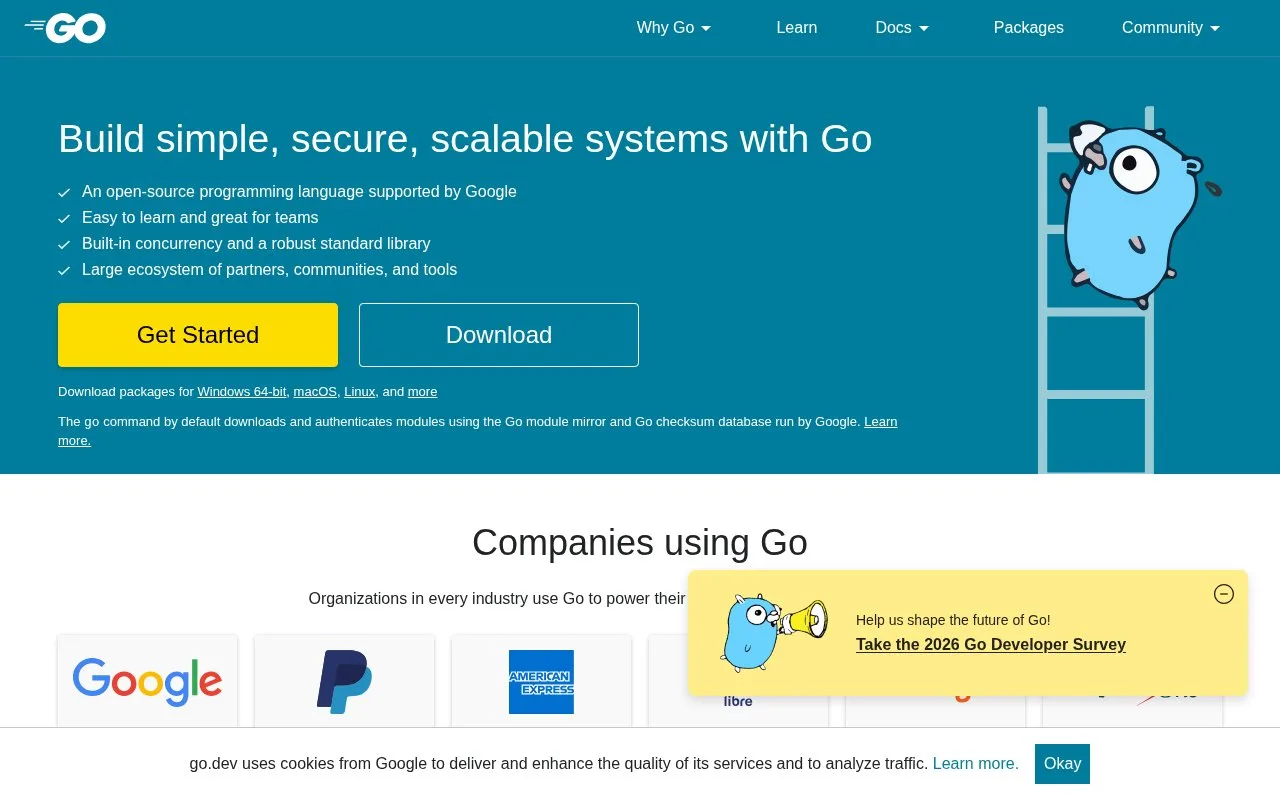
Go pairs a programming language with a compiler, standard library, and command-line tools for building and running software. The official tutorial introduces a module with `go mod init`, a small `main` package, and `go run .`. Its source repository is distributed under a BSD-style license.
A first Go project can follow the official tutorial's small-program path: create a directory, initialize a module with a path that can remain stable if the code will be shared, add a main.go file, then use go run . to build and launch the package. The module file records dependency information as the project grows; the standard toolchain also provides commands beyond go run. Go is a language and build toolchain, not an IDE or hosted code service. It is a reasonable fit for a command-line program, server, or reusable package when a team wants the language, module workflow, and standard library together. New users should read the language tutorial and then the reference documentation for the specific packages their program needs. The official repository carries a BSD-style license.
Strengths
- The official tutorial connects module initialization, a minimal program, and the `go run` workflow.
- A standard toolchain and library are included with the language project.
- The source repository uses a permissive BSD-style license.
Watch out for
- Projects intended for reuse need a stable module path and a dependency policy as they grow.
- The language and toolchain do not include a graphical editor or hosted collaboration service.
Best for
- Developers creating command-line tools, services, or reusable Go modules.
- Teams that want an official language tutorial and a standard command-line build workflow.
Sources
- The Go Programming Language (Oct 25, 2026)
- Tutorial: Get started with Go (Oct 25, 2026)
- LICENSE - go - Git at Google (Oct 25, 2026)