
What it does
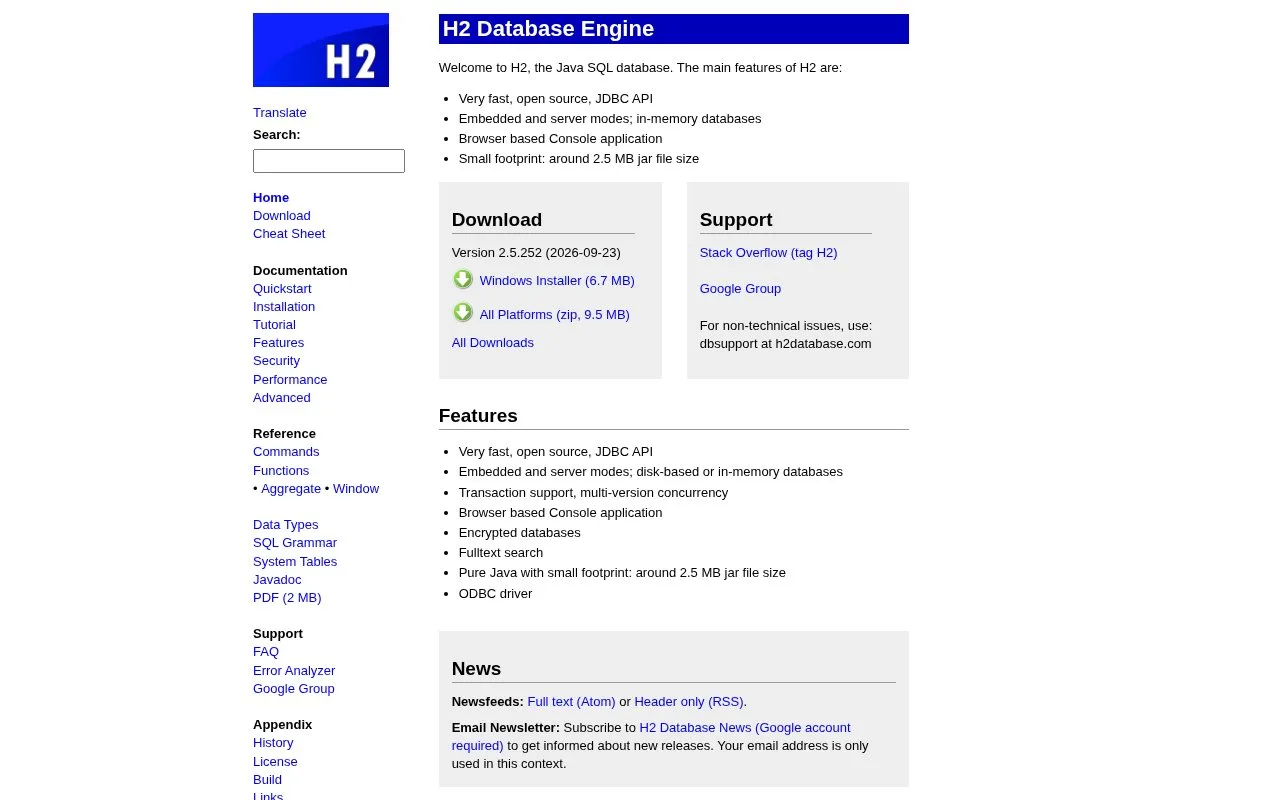
H2 is a Java SQL database engine that supports embedded and server modes, disk-based or in-memory databases, and a browser-based Console application. Its quickstart introduces the JDBC driver and a database URL, so a Java program can connect to a local database without a separate server process in embedded mode. The project also documents transactions, multi-version concurrency, encrypted databases, and full-text search. H2 is an engine and development utility, not a managed database service.
A local JDBC database in a few setup choices
The H2 quickstart asks you to add the H2 JAR to the application's classpath, use org.h2.Driver, and choose a JDBC URL. For example, jdbc:h2:~/test opens a database named test in the user's home directory; this is a documented illustrative URL, not a connection made for this listing. The quickstart also introduces the web Console for accessing a database through a browser.
Choose the mode to match the task. Embedded mode is convenient for a small Java application or test fixture, while server mode exposes a database to client connections. The project also supports in-memory databases for temporary work and disk-based storage when data should persist. Make the URL and persistence choice explicit so a development database does not accidentally become a shared service.
H2 is pure Java and includes its JDBC API, but the reader needs a compatible Java setup and must select the right mode for the application. It is useful for Java development and local data workflows; it is not a substitute for operating a production database service without evaluating deployment, security, and durability requirements. H2 is dual-licensed under MPL 2.0 or EPL 1.0.
Strengths
- Supports embedded and client/server modes, as well as disk-based and in-memory databases.
- The official quickstart gives a concrete JDBC driver and URL for the first connection.
- A browser-based Console is included for database access.
Watch out for
- Java applications need the H2 driver and an appropriate JDBC URL; embedded and server modes are configured differently.
- A local development engine does not provide the managed operations of a database hosting service.
Best for
- Java applications that need an embedded SQL database or a local test database
- Trying database behavior in a disk-based, in-memory, or client/server setup
Sources
- H2 Database Engine home (Oct 25, 2026)
- H2 Quickstart (Oct 25, 2026)
- H2 license summary and FAQ (Oct 25, 2026)
- H2 Database Engine repository (Oct 25, 2026)