What it does
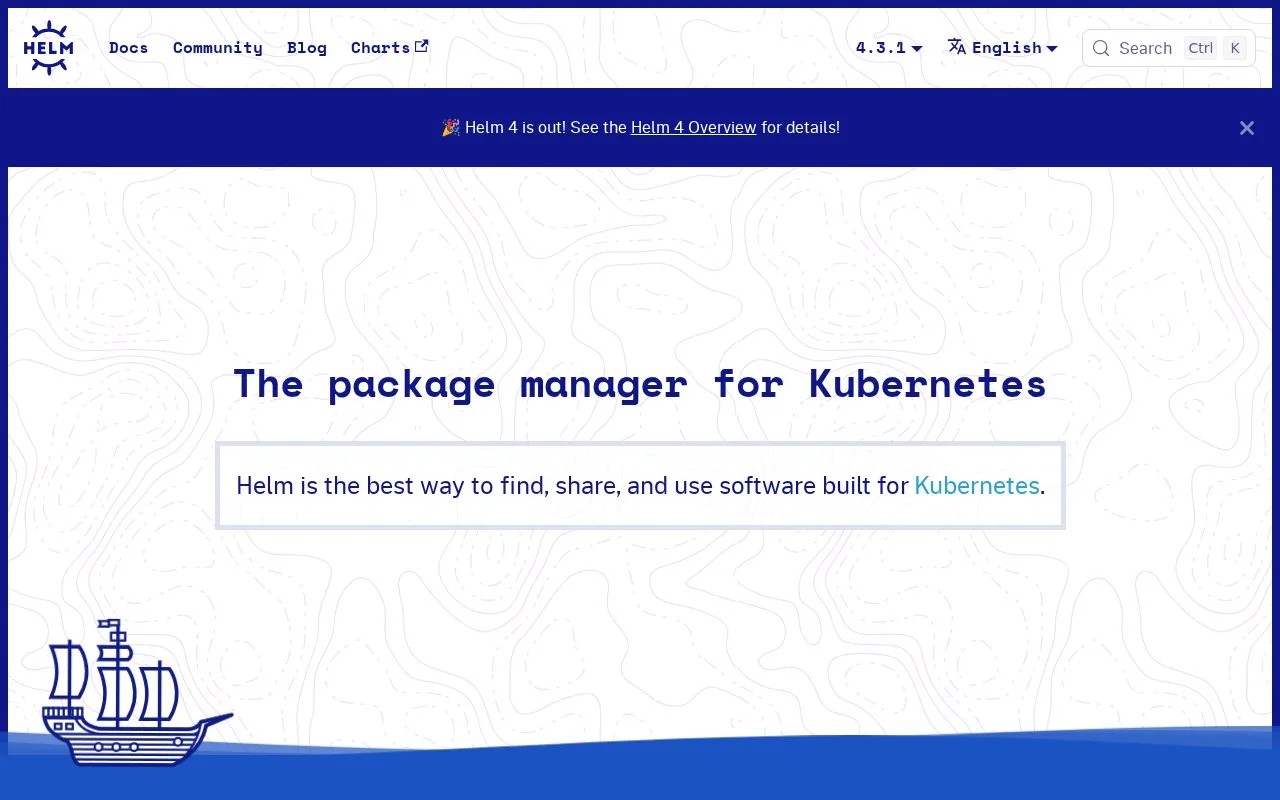
Helm is the Kubernetes package manager. A chart groups Kubernetes resource templates and default configuration so an application can be installed or upgraded as a release. Users provide a working Kubernetes context and choose a chart from a repository or OCI registry; chart values customize the resources for an environment. Helm is useful for packaging repeatable deployments, while the cluster still runs and operates the resulting workloads.
Install a chart into a known cluster
The Helm quick start lists access to a Kubernetes cluster as a prerequisite, along with installing Helm and deciding which security settings apply. Its current example installs a chart from an OCI registry with helm install, after which Helm reports the release name, namespace, status, and revision. For a real service, first inspect the chart's values and resource templates, select the right namespace and cluster context, and provide only the configuration the chart expects. These are documented examples; no cluster or Helm command was used for this listing.
Charts make deployments reusable: a maintainer can package templates and default values, while each environment supplies its own settings. A team can then treat a release as an installed instance of that chart and revise it as the chart or configuration changes. This is different from a GitOps controller: Helm provides the chart and release operations, while tools such as Argo CD or Flux can continuously reconcile desired state using charts.
Helm is Apache License 2.0 software. It does not provide a Kubernetes cluster, choose safe values for a chart, or replace the need to inspect the permissions and objects a chart will install.
Strengths
- Charts package Kubernetes resource templates with values that can be adjusted for different deployments.
- The quick start shows an OCI chart installation and returns release status and revision information.
- Helm provides repeatable chart and release operations that can be used by other deployment workflows.
Watch out for
- Users need a Kubernetes cluster and must review chart resources, configuration, and security settings before installation.
- Helm manages Kubernetes application releases but does not supply or operate the cluster itself.
Best for
- Teams packaging and installing applications on Kubernetes using reusable charts
- Platform engineers standardizing chart configuration across development and deployment environments
Sources
- Helm (Oct 25, 2026)
- Quickstart Guide | Helm (Oct 25, 2026)
- Charts | Helm (Oct 25, 2026)
- helm/helm (Oct 25, 2026)
- Apache License 2.0 | helm/helm (Oct 25, 2026)