
What it does
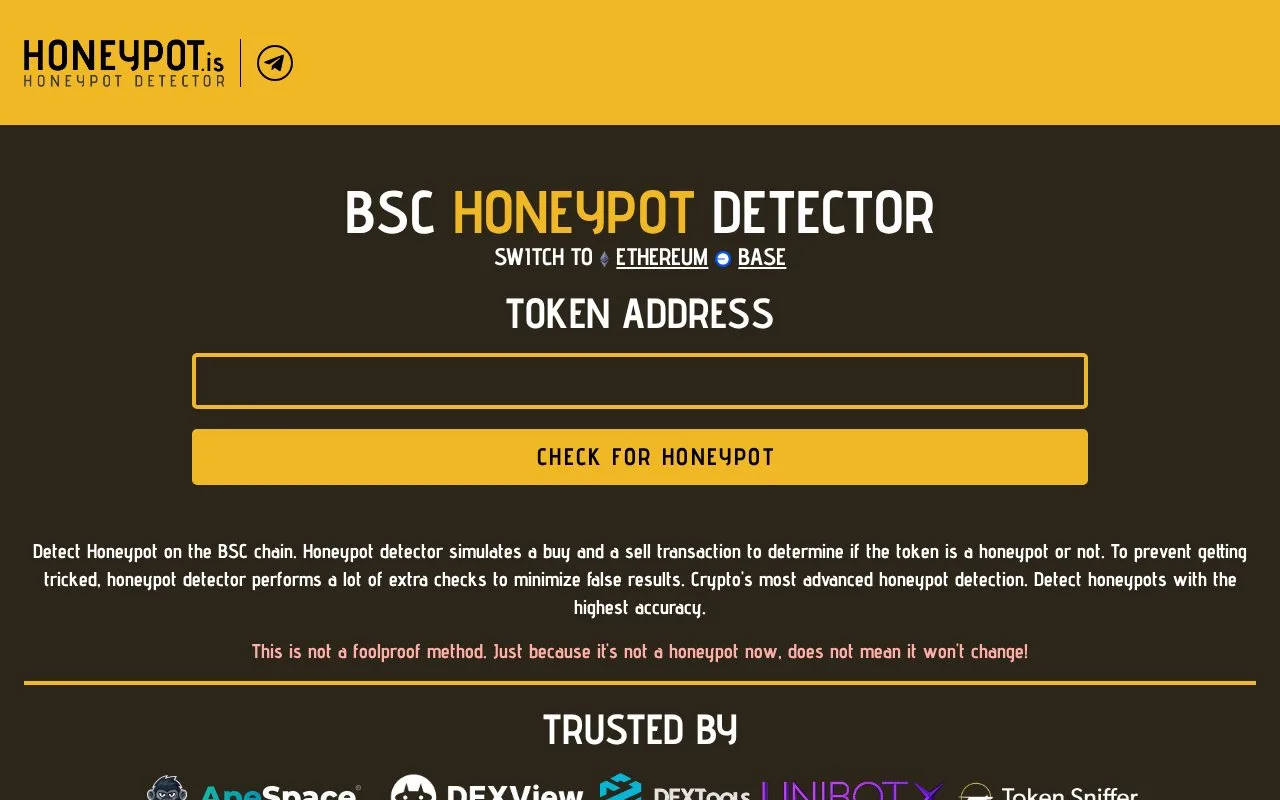
Honeypot.is simulates buying and selling a token to identify tokens that can be bought but cannot be sold normally. Its public checker requires a contract address, while current API access for other software does not require an account key.
Choose Ethereum, BNB Smart Chain or Base, enter the token contract and select Check for honeypot. The service runs a simulation; it does not ask you to buy the token to perform the check. Coverage is limited to supported exchanges built around Uniswap V2 or V3-style pools.
A successful simulation and a safe investment are different conclusions. Honeypot.is explicitly warns that its method is imperfect and that token behavior can change later. Keep the chain and exact contract with any result you save or share, since a similar name on another network describes another asset.
Developers can also provide a particular pool and chain to the API. Without those choices, it selects a suitable market using liquidity. Inspect simulationSuccess before using the detailed simulation result: a failed run has an error message, and the honeypot verdict may be absent. An unknown risk result is not a low-risk result.
The response can include estimated token taxes and detected maximum trade amounts. Holder analysis counts the wallets examined, which is different from the token’s total holder count. These distinctions matter when presenting the result in another tool.
The current documentation says authentication is not required and that Premium or Pro plans are not yet available. Its API terms still restrict resale, third-party provision and competing products, so unauthenticated access does not grant unrestricted reuse.
Strengths
- A specific pool can be selected instead of relying on automatic market choice
- Results separate simulation completion from the honeypot assessment
Watch out for
- Supported chains and pool designs limit which tokens can be checked
- A token can change behavior after a successful simulation
Best for
- Token researchers checking present buy-and-sell restrictions
- Developers distinguishing failed simulations from usable results
Sources
- Honeypot.is contract-address checker and explicit detection limitation (Oct 27, 2026)
- Honeypot.is current API access without authentication (Oct 27, 2026)
- Honeypot.is chain and pair controls, simulation outcomes and unknown results (Oct 27, 2026)
- Honeypot.is supported chains and exchange families (Oct 27, 2026)
- Honeypot.is proposed Premium plans remain unavailable (Oct 27, 2026)
- Honeypot.is API restrictions on resale and third-party use (Oct 27, 2026)