
What it does
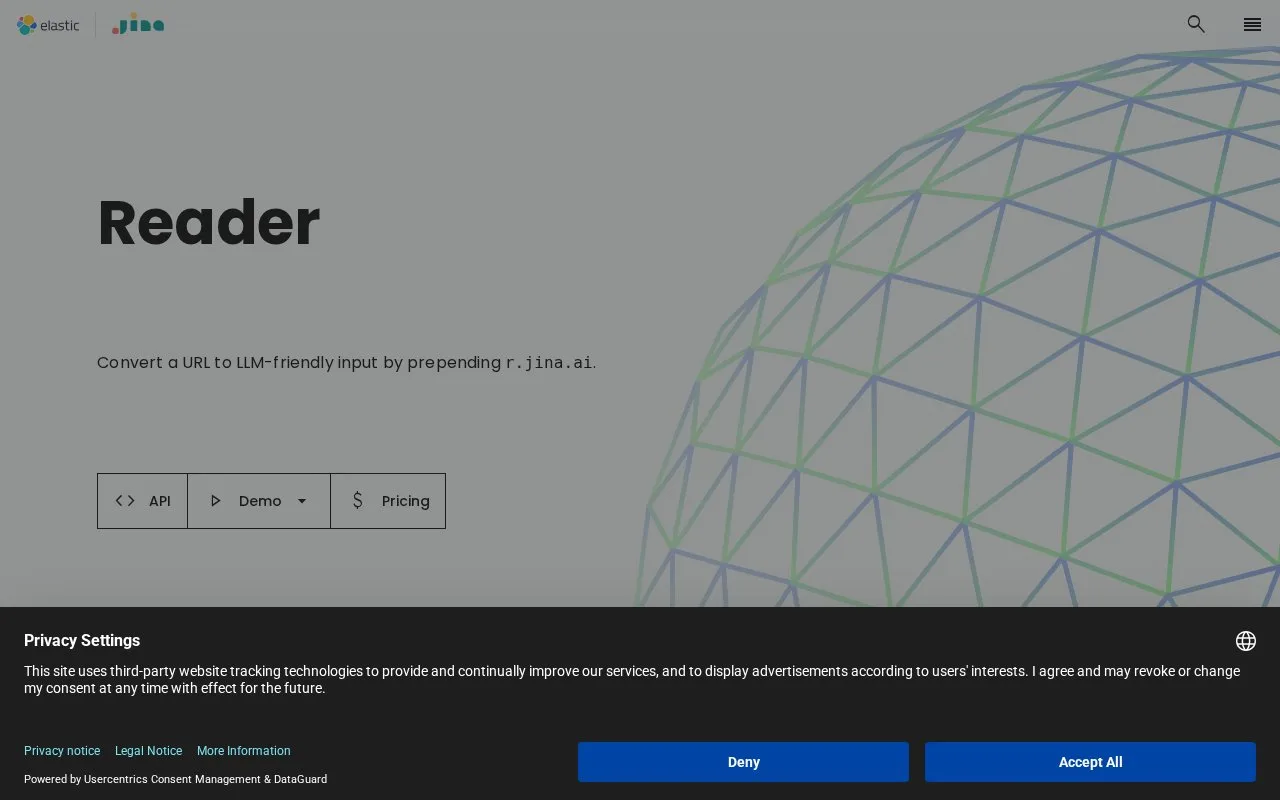
Jina AI Reader API fetches a supplied webpage and returns its content in a form intended for downstream tools, including Markdown and JSON. The API exposes options for choosing a browser engine, selecting page elements, waiting for dynamic content, and controlling output details. Reader is a service endpoint rather than a client for sending arbitrary API requests; Jina presents web search, embeddings, and reranking as separate APIs.
Start with a URL you already have
Reader is useful when an application knows which page to process but wants cleaner text than a full HTML document. The simplest documented path is to send a page URL to the Reader endpoint, which returns extracted content. For JSON output, the API reference documents the Accept header; the response includes the content and page metadata. Optional controls such as a CSS target selector, a selector to remove, or a wait-for selector can narrow extraction when a site has navigation or client-rendered content. These are published request options, not a call made for this listing.
The Reader page describes a keyless request tier and a higher rate limit for an API key. The selected browser engine affects quality, speed, completeness, and accessibility, so compare its output on the pages your application needs rather than assuming every source behaves the same way. Reader starts with a known URL; use Jina's separate Search API when the job is to discover pages. Paid usage is available, but exact Reader rates and a projected bill were not established from the accessed material.
Strengths
- A URL can be converted to Markdown or JSON without building a separate page-extraction pipeline.
- Selectors and browser-engine options let a developer adjust what content is returned.
- The product page describes a keyless tier, with an API key available for higher request limits.
Watch out for
- Reader processes a supplied URL; finding candidate pages is a separate Search API workflow.
- The documentation says engine selection affects output quality, speed, completeness, and accessibility, so extraction results can vary by source.
Best for
- Preparing known webpages as text or Markdown for downstream language-model prompts
- Extracting selected article sections instead of passing full-page navigation to another system
- Applications that need a hosted page-reading endpoint rather than a general API client
Sources
- Reader API - Jina AI (Oct 25, 2026)
- Meta-Prompt | Jina AI Search Foundation API Guide (Oct 25, 2026)