
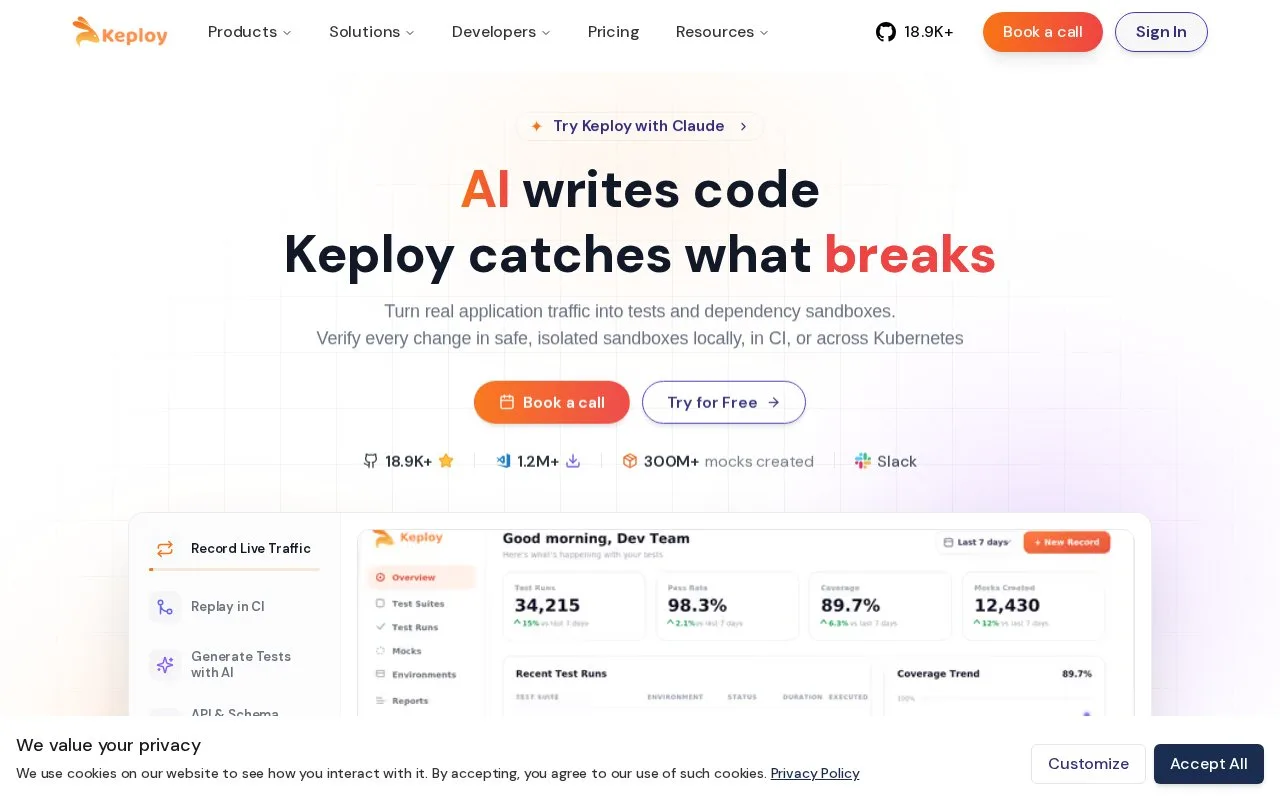
What it does
Keploy turns representative API requests and dependency interactions into replayable tests and mocks. Developers can record traffic from a running application with the local CLI, or use the hosted generation workflow with OpenAPI, Postman, cURL examples, or an endpoint. The resulting test cases can be edited and replayed locally or in CI, making Keploy useful for backend teams that want regression coverage based on real request flows rather than hand-written mocks alone.
Choose a starting point
Keploy's Playground is free forever; Pro is listed at US$19 per user monthly plus additional usage, with an included usage credit. It offers two practical routes. For traffic-based testing, start the application in record mode, send representative API requests, and let the CLI capture incoming requests and outgoing dependency calls. It turns those interactions into test cases and data mocks that can be replayed against a later build. On Linux, the documented native path uses elevated privileges for traffic capture; Docker is another documented setup, with a network connecting the application container and Keploy.
The hosted AI generation workflow instead takes an OpenAPI schema, Postman collection, working cURL examples, or an endpoint. Add authentication inputs when the API requires them, then review the generated connected flows and editable YAML tests before running them. For example, a developer might supply a login request followed by create-and-read calls for one resource, so the output checks a flow rather than a single isolated response.
Keploy is most useful when the supplied traffic or schema reflects the behavior the team cares about. Generated cases and mocks still need review, especially around sensitive or unstable data. Native macOS and Windows capture supports a narrower set of application languages than Linux or Docker, so check the documented platform matrix before choosing an installation. The local record-and-replay core is Apache-2.0 licensed, while hosted features have separate plan limits.
Strengths
- Captures real API and dependency interactions to produce replayable regression tests and data mocks.
- Offers a second path that generates API cases from OpenAPI, Postman, cURL examples, or an endpoint.
- The official repository and license establish an Apache-2.0 local record-and-replay core.
Watch out for
- Native Linux recording needs the documented elevated capture setup, while the Docker route needs a network shared with the application.
- Native macOS and Windows capture supports fewer application language stacks than the Linux or Docker workflow.
- Hosted test generation and execution have plan and usage limits; the Pro tier adds usage beyond its included credit.
Best for
- Backend developers creating integration and API regression cases from real request flows
- Teams that need to replay dependencies such as databases or external APIs in CI
- API teams with OpenAPI or Postman specifications that want generated connected test flows
Sources
- Keploy: AI Code Verification with Production Traffic Digital Twins (Oct 25, 2026)
- What is Keploy? | Keploy Docs (Oct 25, 2026)
- AI-Powered API Test Generation | Keploy Docs (Oct 25, 2026)
- Linux Installation | Keploy Docs (Oct 25, 2026)
- Pricing | Keploy — Free Playground + Pro & Enterprise Plans (Oct 25, 2026)
- keploy/keploy repository (Oct 25, 2026)
- Apache License 2.0 | keploy/keploy (Oct 25, 2026)