
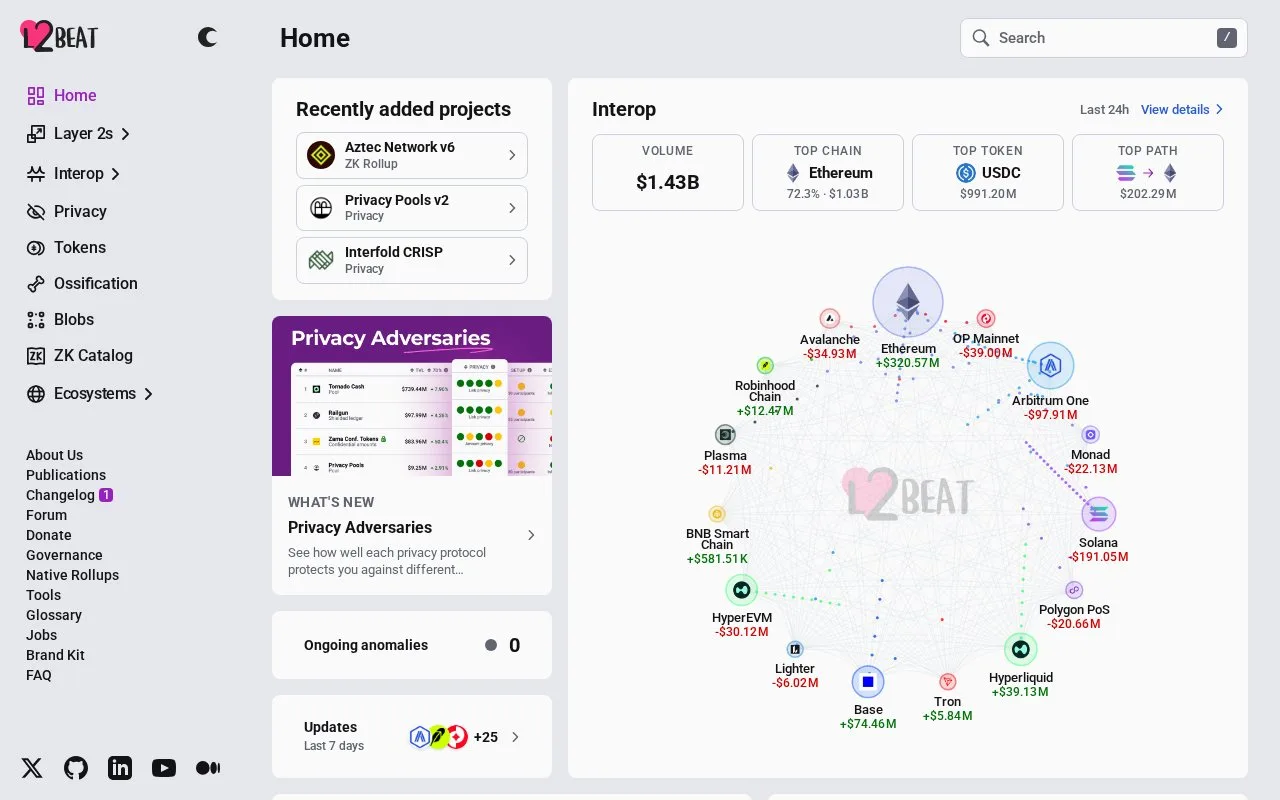
What it does
L2BEAT presents public data and technical assessments of Ethereum scaling networks and cross-chain protocols. Its tables cover activity, value secured, costs and the assumptions behind each project's design. You can browse the comparisons without an account, then open the project and methodology pages for more detail.
Compare designs alongside activity
The Layer 2s summary separates Rollups, Validiums & Optimiums and other projects. It places each project's proof system and Stage beside value and activity measures, with separate sections for risk analysis, liveness and costs. Liveness describes whether a system continues posting or processing the information it needs.
Choose a project from the table, or use Compare to examine projects together. The Risk Analysis sections break out state validation, data availability and sequencing, rather than treating every scaling network as the same design.
Understand the labels
L2BEAT's Total Value Secured includes canonically bridged, externally bridged and natively minted assets. It is broader than a measure of funds used in individual decentralized-finance applications, so totals from those two measures may differ.
L2BEAT says its Stages do not measure project security. It also states that it does not perform a security audit of each L2. Its assessments describe the team's analysis and assumptions; a high Stage or a large value total is not a promise about the safety of funds.
The FAQ links the methodology forum and explains how to obtain plain-Markdown versions of project pages for further reading.
Strengths
- Separates network designs in the comparison table
- Risk views distinguish validation, data availability and sequencing
- FAQ explains how value secured differs from application-level totals
Watch out for
- L2BEAT says its assessments are not security audits
- Stage labels do not represent a project's security level
Best for
- Developers comparing Ethereum scaling designs
- People checking the assumptions behind a network's published metrics
Sources
- L2BEAT overview (Oct 28, 2026)
- L2BEAT Layer 2 summary (Oct 28, 2026)
- L2BEAT frequently asked questions (Oct 28, 2026)