
What it does
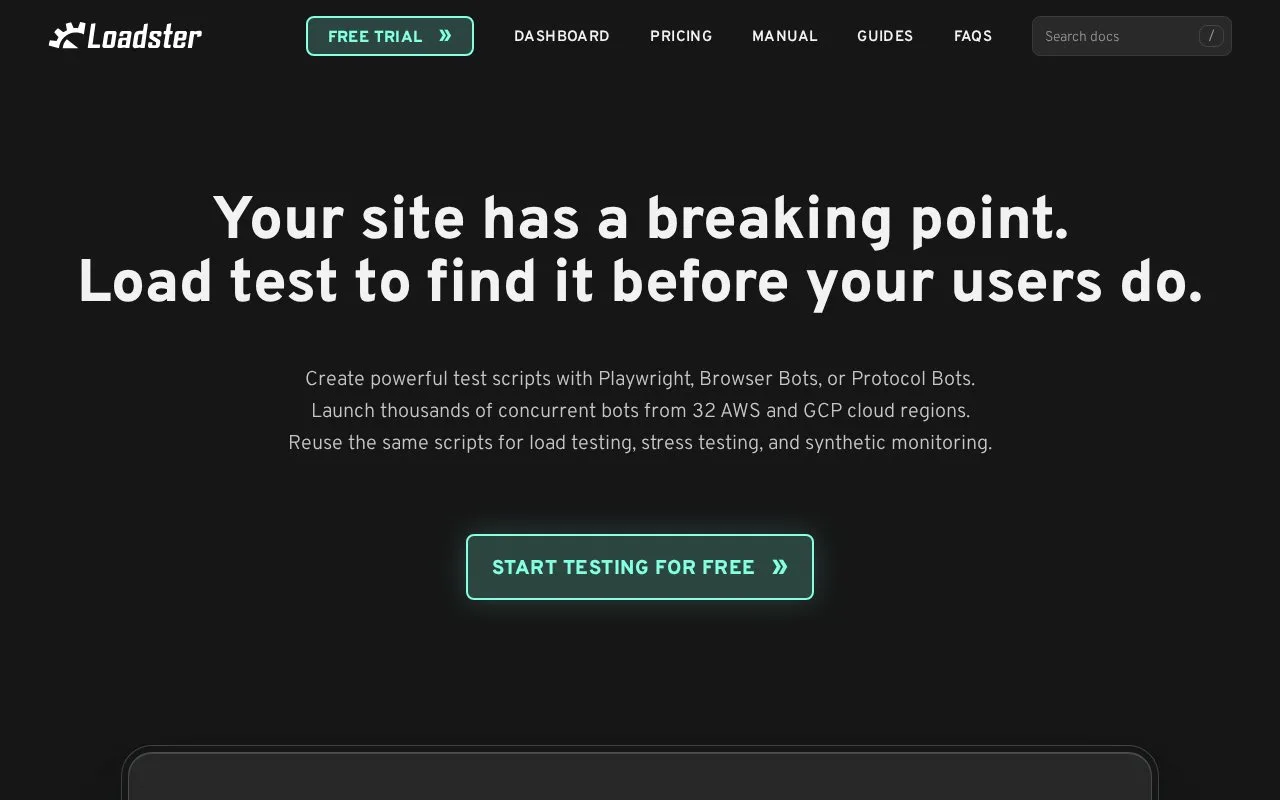
Loadster is a cloud-based performance testing and synthetic monitoring service for websites, web applications, and APIs. It supports visually scripted Browser Bots, HTTP-level Protocol Bots, and existing Playwright Test code. A scenario combines scripts, bot counts, and ramp patterns, then runs from selected cloud regions or self-hosted engines. Results include live metrics and reports; a one-bot monitor can reuse a scripted user journey to check a critical flow on a schedule.
Build a repeatable load scenario
For a first check, start with a URL or a specific user journey you want to exercise. Loadster's manual distinguishes Protocol Bots, which sequence HTTP requests for APIs or simple sites, from Browser Bots, which automate real headless browsers, and Playwright scripts written in JavaScript or TypeScript. The built-in editor can record or modify bot scripts; the manual recommends replaying a script with one bot before scaling it up.
A load-test scenario specifies the bot groups, the script each group runs, and how the groups ramp up and down. Run it from a cloud region and watch live metrics, then use the generated report's graphs and tables to inspect response times and errors. The pricing page says the service also offers a REST API, CLI, and MCP server. For an ongoing check, reuse the script as a monitor; monitoring runs one bot on a schedule instead of simulating a large crowd.
Loadster is a hosted service, so the test target must be reachable from the chosen load generators. The manual describes self-hosted engines as an option for private networks. Usage differs by bot type and plan, and the free tier is a limited starting balance rather than unlimited testing. Choose protocol-level scripts for high-volume API traffic and browser scripts when the user interface itself is part of the behavior under test.
Strengths
- The same service supports protocol-level, real-browser, and Playwright-based performance scripts.
- Scenarios combine bot groups and ramp patterns, with live metrics and post-run reports.
- Scripts can be reused for scheduled synthetic monitoring, and self-hosted engines are available for private networks.
Watch out for
- Load tests need a target URL or scripted journey and must be designed to represent the intended traffic pattern.
- Cloud load testing needs a reachable target; private-network tests require a self-hosted engine.
Best for
- Measuring web application response behavior under simulated concurrent user flows
- Scaling HTTP API performance checks or reusing a critical web journey as a synthetic monitor
Sources
- Loadster — Load Testing & Website Stress Testing Tool (Oct 26, 2026)
- Loadster Manual | Loadster Manual (Oct 26, 2026)
- Load Testing Pricing: Fuel, Team, and Enterprise Plans | Loadster (Oct 26, 2026)