
What it does
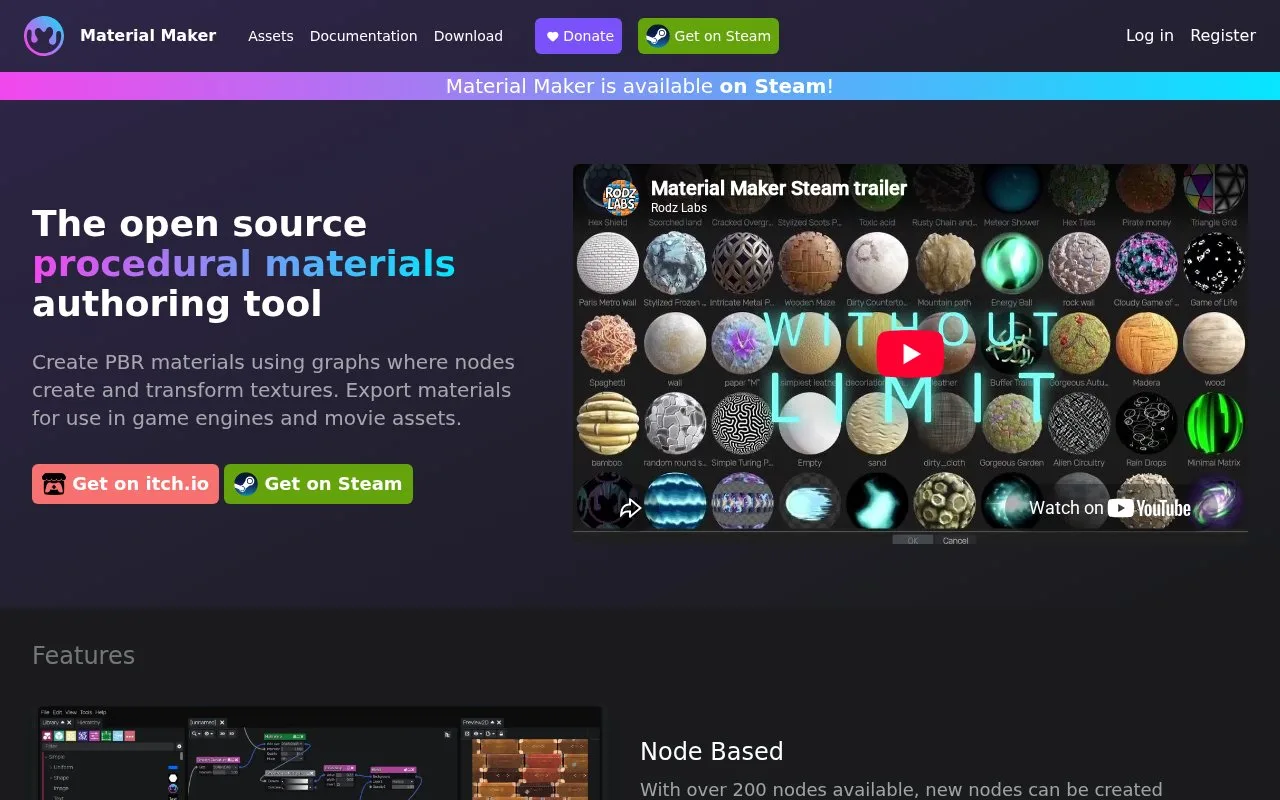
Material Maker builds materials for 3D objects by connecting nodes that create or change textures. It exports maps and material files for game engines and offers a community library of editable examples. The app is open source under the MIT licence, with a free download option for Windows, macOS and Linux.
Each material is a graph of texture operations. You can group existing nodes into a reusable node or write a custom one in GLSL, a shader language. A 3D preview shows the material on a basic shape or an imported OBJ model, while the 2D preview shows individual texture outputs.
Export for the receiving application
- Blender receives PNG or EXR maps. You still assemble the material in Blender's shader editor.
- Godot export includes a .tres material file.
- Unity export includes a .mat file and textures.
- Unreal Engine 5 export produces a Python script, shader and texture files. The manual explains the required Python path setup before running the generated script in Unreal.
Download from the creator's itch.io page. Its donation prompt includes a route to download without paying. The community library includes materials, nodes, brushes and environments for studying or reusing graph techniques.
The model-painting feature is explicitly labelled experimental. It is separate from the main procedural-material workflow.
Strengths
- Both individual textures and a material on a 3D model can be previewed.
- Custom nodes can use grouped operations or shader code.
Watch out for
- Blender exports need material assembly after the maps are generated.
- The 3D painting tool is marked experimental.
Best for
- Game artists building procedural surface materials
- Developers creating reusable texture generators
Sources
- Material Maker (Oct 28, 2026)
- Exporting Materials: Material Maker Manual (Oct 28, 2026)
- Material Maker: Official Repository (Oct 28, 2026)
- Material Maker by RodZilla (Oct 28, 2026)