
What it does
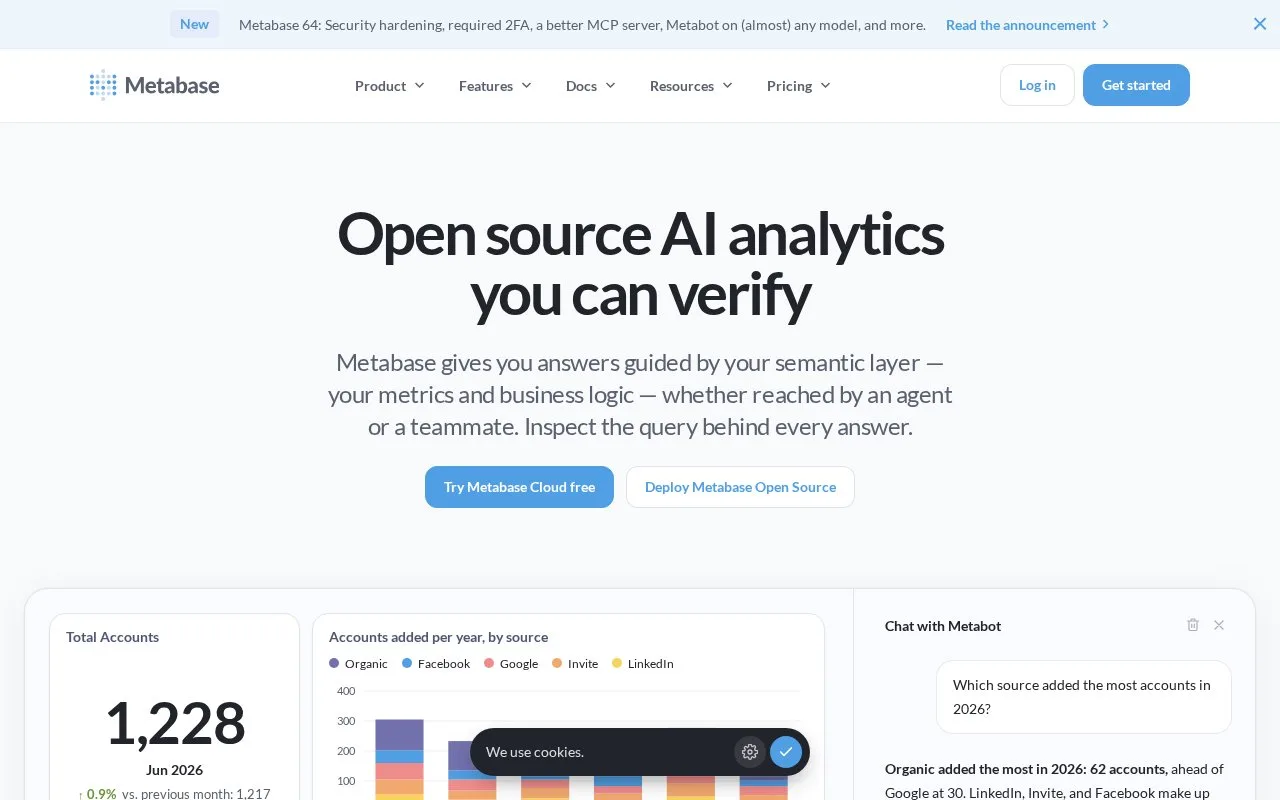
Metabase offers a visual query builder and SQL editor for exploring connected data and creating dashboards. A free self-hosted core is complemented by managed cloud access and paid governance and embedding capabilities.
Metabase makes database questions accessible through a visual query builder as well as SQL. Its free core runs on your own infrastructure; managed hosting and more detailed access controls are paid options.
| Option | Useful distinction |
|---|---|
| Open Source | Self-hosted, with unlimited users, questions and dashboards |
| Starter | Managed hosting with five users included and paid extra seats |
| Pro | Adds row and column permissions, single sign-on and advanced governance; 10 users included |
Starter and Pro offer a 14-day trial. The core outside the repository's enterprise directory uses AGPL licensing; commercial features have separate terms. A hosted trial needs an account, and a self-hosted installation starts by creating its own administrator account and connecting a database.
To make a reusable report, choose + New > Question, select a table or other available data, apply a filter, and choose a summary such as a count or average. Group that result by a relevant dimension, then click Visualize to see a chart. Save the question to a collection if it should be reusable across dashboards. Questions saved only inside a dashboard have a narrower reuse scope.
Hiding a column in chart display settings is not a security control: viewers may be able to show it again. Use the appropriate query and permission settings when restricting access to sensitive fields.
Strengths
- Supports both visual questions and SQL-based analysis.
- Offers self-hosted and managed deployment routes.
Watch out for
- Advanced row and column permissions and multi-tenant features require paid plans.
Best for
- Teams turning existing database questions into repeat reports
Sources
- Metabase plans (Oct 27, 2026)
- Metabase core and enterprise licensing (Oct 27, 2026)
- Initial Metabase setup (Oct 27, 2026)
- Questions and reusable reports (Oct 27, 2026)
- Metabase query builder (Oct 27, 2026)
- Metabase hosted trial registration (Oct 27, 2026)
- Open source AI analytics you can verify | Metabase (Oct 25, 2026)