
What it does
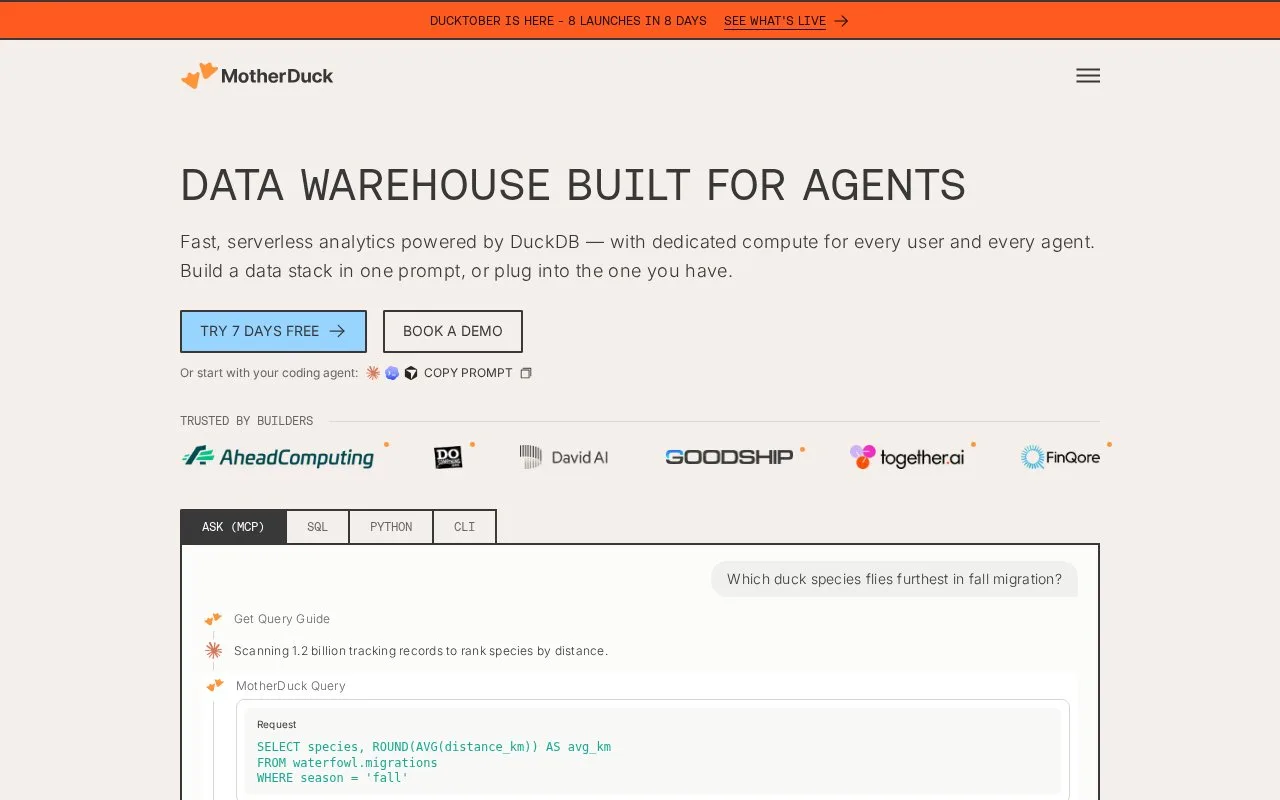
MotherDuck takes the DuckDB analytical database into a managed cloud service. Users can query shared data, upload their own files, connect through language clients, and share databases or visualizations with colleagues. The documentation's tutorial moves from a first SQL query to loading and sharing data, then building a Dive dashboard or scheduling a Flight pipeline. That makes MotherDuck more than a database engine download: it supplies hosted compute and team collaboration for analytical work, while its single-region organizations and usage-based compute model matter when planning deployment and cost.
From a query to a shared dataset
MotherDuck's tutorial is organized around a concrete learning path: query a public dataset, load your own data, share a database with teammates, then create a Dive visualization or a scheduled Flight. The prerequisite is a MotherDuck account and basic SQL knowledge. You can follow queries in the docs, use the MotherDuck web UI, or connect with a DuckDB client such as Python, Java, or the DuckDB CLI. The product is a managed cloud warehouse built on DuckDB, so this workflow does not require you to operate the warehouse servers.
A realistic example is a data analyst loading a CSV, checking it with SQL, and sharing a named database with the team before turning a useful query into an interactive Dive. For repeatable ingestion or transformation, the product documentation points to Flights, which run scheduled Python jobs on MotherDuck compute.
Choose it for managed analytics, not local storage
MotherDuck offers a Lite tier with a monthly storage and Pulse-compute allowance, and paid tiers add capacity and other features. Usage can also depend on instance type, storage, users, and scheduled jobs, so a free tier does not mean every workload is free. The pricing page describes the service as cloud-only and scopes each organization to one cloud region. Teams that need an on-premises warehouse or several regions in a single organization should account for that boundary.
MotherDuck is powered by DuckDB but is a separate hosted service. The existing DuckDB engine can also run locally; this listing covers the cloud warehouse and its team-facing features, not a second name for the local database engine.
Strengths
- Provides a managed DuckDB-based warehouse with a browser UI and clients for several programming languages.
- Its learning path covers querying, loading data, database sharing, visualizations, and scheduled Python work.
- The Lite tier includes monthly storage and compute allowances without requiring a credit card to sign up.
Watch out for
- MotherDuck is a managed cloud service and does not offer an on-premises version.
- An organization is scoped to one cloud region, and compute or storage beyond included allowances can add usage charges.
Best for
- Teams that want to query and share analytical data without managing a warehouse server
- DuckDB users who want to move selected analysis from local development into a hosted team environment
- Data teams building scheduled Python transformations or shareable visualizations
Sources
- MotherDuck | The Cloud Data Warehouse Built on DuckDB (Oct 25, 2026)
- Getting Started | MotherDuck Docs (Oct 25, 2026)
- MotherDuck Tutorial | MotherDuck Docs (Oct 25, 2026)
- MotherDuck: Pricing - Get Started (Oct 25, 2026)