
What it does
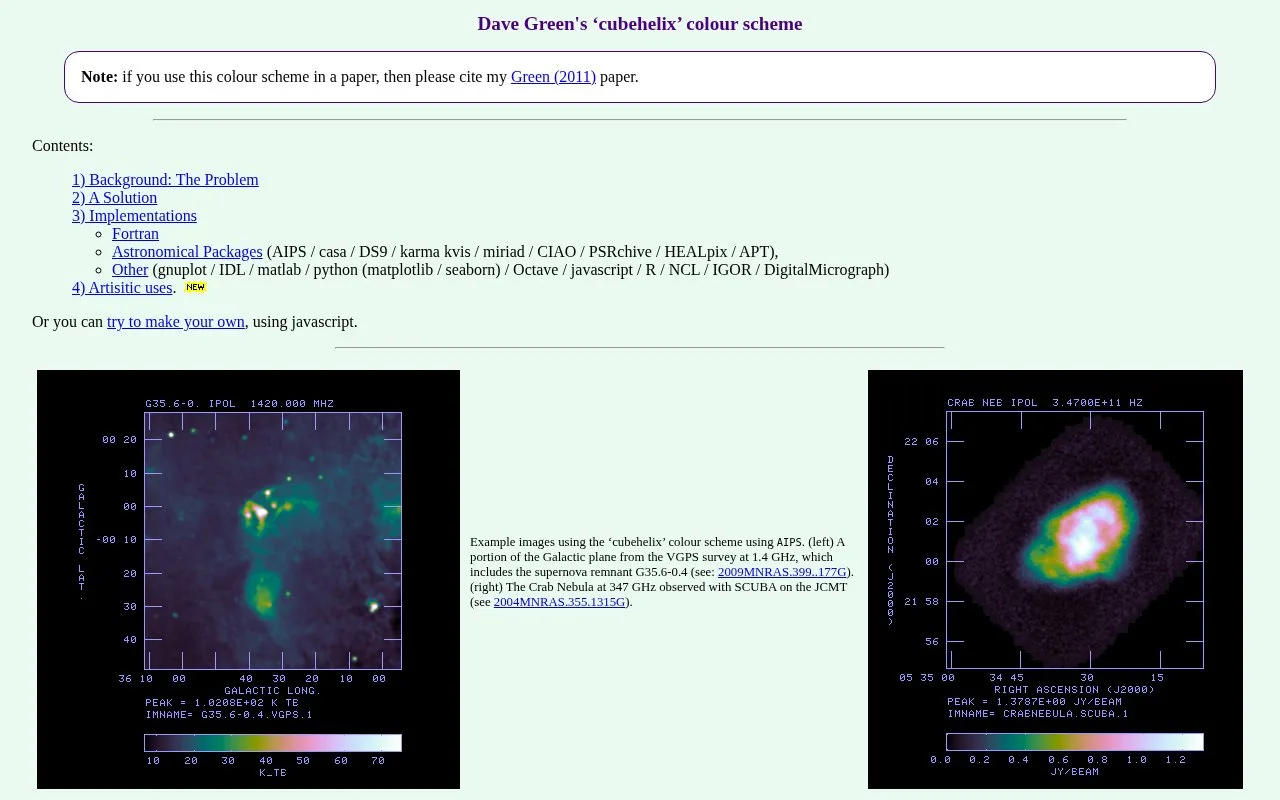
Dave Green’s cubehelix resource explains and generates colour scales for intensity images. Start colour, rotations, hue strength and gamma change a scale designed around ordered brightness. The downloadable Fortran implementation is released into the public domain under the Unlicense.
The generator previews presets or custom parameters, then writes a lookup table into a new tab for copying or saving. Output choices include decimal RGB values, hexadecimal RGB and formats for astronomy viewers. Direction can run from black to white or the reverse. The kvis format uses a fixed 200 levels and needs conversion to binary.
Hue controls colour strength. Values above 1 can push RGB channels beyond their valid range, causing clipping near the ends of the scale. Gamma changes the emphasis on low or high intensities.
The downloadable Fortran implementation returns RGB arrays and counts values clipped low or high. That implementation is released into the public domain under the Unlicense. Green requests citation of the accompanying paper when cubehelix is used in a publication.
Strengths
- The generator exports text lookup tables for several scientific workflows.
- The Fortran routine reports how many values needed clipping.
Watch out for
- Hue strength above 1 can cause RGB clipping.
- The kvis output has a fixed 200 levels and needs binary conversion.
Best for
- Scientific intensity images requiring an ordered brightness scale.
Sources
- Dave Green’s cubehelix page (Oct 28, 2026)
- cubehelix colour scheme generator (Oct 28, 2026)
- cubehelix Fortran implementation (cubhlx.f) (Oct 28, 2026)
- cubehelix licence (Unlicense) (Oct 28, 2026)