
What it does
Open-Meteo's Weather Forecast API returns weather-model data for geographic coordinates. Its documentation lets developers select location, forecast length, model, and variables, then copy a generated API URL or choose an example client language. The service combines forecasts from national weather agencies, and its default best-match option selects a suitable model for a location. The open-access tier is for non-commercial use; commercial access uses a separate subscription endpoint and API key.
Build a location-specific forecast URL
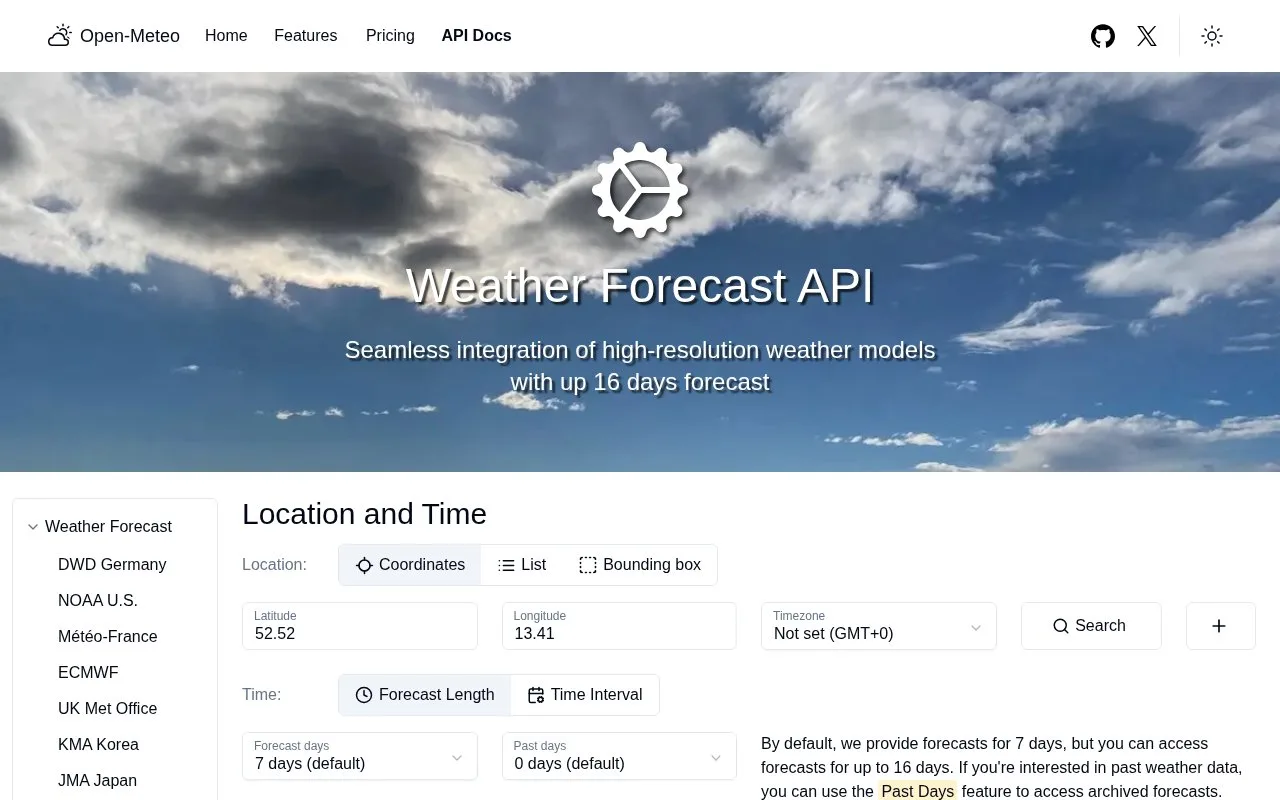
A useful first task is to request hourly temperature and precipitation for one location, then use the returned time series in a small forecast panel. In the official documentation, choose coordinates, a forecast length, and the variables your interface needs; the page generates an API URL that can be copied into an application. The API supports current conditions as well as hourly and daily values, and the forecast can extend up to sixteen days. The generated URL and client options are documentation examples, not a request sent for this listing.
Open-Meteo draws on models from multiple national meteorological services. Its best_match choice selects a model appropriate to the supplied location, while other options let a developer choose among named models. That gives a simple integration a useful starting point without requiring the application to combine separate agency APIs itself. Check each variable's time resolution and geographic coverage in the docs before designing charts; some high-frequency data are limited to specified regions.
Keep access terms in the design
The pricing page distinguishes the public API for non-commercial use from a paid customer API for commercial use. The public tier has published call limits and no uptime guarantee. Commercial subscriptions provide an API key and dedicated endpoint, with a monthly call budget; the fetched pricing page did not expose a stable dollar amount, so no price is quoted here. Attribution is required for the underlying weather data under its stated CC BY 4.0 license. The free API is therefore useful for prototypes and eligible non-commercial projects, but a revenue-generating service should resolve commercial licensing before integrating it.
Strengths
- The API combines weather model data from many national services and offers a best-match model selection for coordinates.
- Developers can select current, hourly, and daily weather variables and copy a generated API URL from the documentation.
- The documentation covers forecast, historical, marine, air-quality, elevation, and other weather-data endpoints.
Watch out for
- The public tier is limited to non-commercial use and has request limits with no uptime guarantee.
- Commercial use requires a subscription and customer endpoint.
- Some 15-minute forecast variables are available only in Central Europe and North America, with other regions using interpolated hourly data.
Best for
- Adding location-based forecast data to a non-commercial application or prototype
- Building a weather panel that selects variables and forecast length by coordinate
- Comparing or integrating weather data from multiple national model providers
Sources
- Docs | Open-Meteo.com (Oct 25, 2026)
- Pricing | Open-Meteo.com (Oct 25, 2026)