
What it does
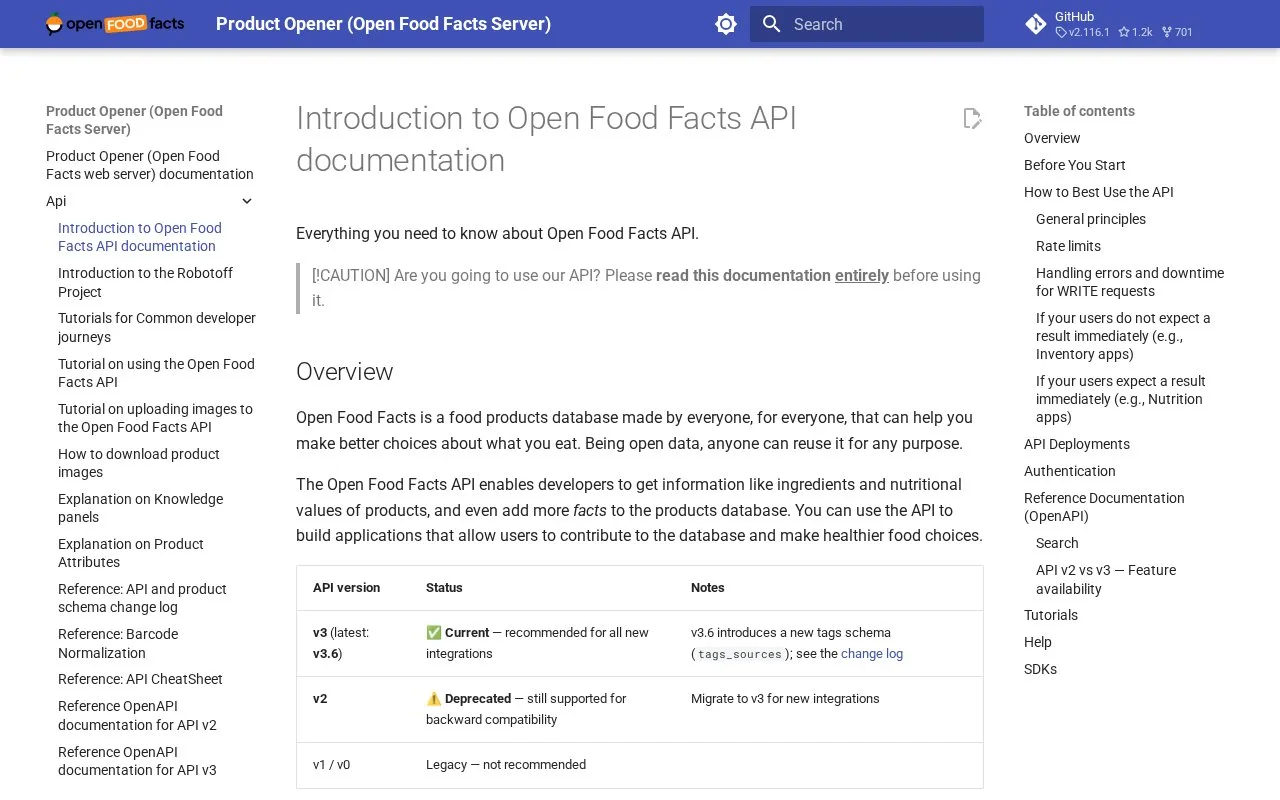
Open Food Facts API connects apps to a community-built food-product database. A barcode lookup can return fields such as ingredients, nutrition, additives, and product labels, while search endpoints support filtered discovery. Read requests do not need account authentication, but clients must identify themselves with a custom User-Agent; writes require credentials. The database is open data with attribution and share-alike conditions, and its community-supplied records are not guaranteed to be complete or correct.
Make barcode lookup the default
For a product-scanning app, the simplest path is to normalize the barcode and request that product's record. Open Food Facts' tutorial uses barcode 3017624010701 as an example and shows how a client can display nutrition and ingredient information after the lookup. New integrations should follow the documented v3 API; the docs identify v3.6 as current and mark v2 as deprecated but still supported for compatibility.
A read request does not need account authentication, but the API asks every client to send a descriptive User-Agent with an app name, version, and contact detail. That lets the service distinguish a real application from an unidentified crawler. Search is useful for a user-driven lookup, such as finding products in a category, but it is not a bulk-export mechanism. The docs publish limits of 15 product reads per minute and 10 search requests per minute per IP; for larger data needs they direct developers to CSV or JSONL exports.
Treat the dataset as contributed data
The database is assembled from user contributions, so an app should avoid presenting every field as verified fact. The API documentation explicitly warns that records may be inaccurate, incomplete, or unreliable. If your app lets users add or edit products, those write operations require account credentials and should be queued and retried carefully when the service is unavailable.
The database is under the Open Database License, individual contents under the Database Contents License, and images have a separate Creative Commons license. Attribution and share-alike obligations can apply to reuse, so read the current terms before embedding data in a commercial product. This is an API and dataset listing, not the consumer scanning app.
Strengths
- A barcode endpoint makes product details useful in nutrition, inventory, and shopping applications.
- Read lookups need no account authentication when the client supplies the requested User-Agent.
- Official docs include v3 references, tutorials, usage limits, and bulk data export guidance.
Watch out for
- Search and product reads have strict per-IP limits; the API is not intended for bulk extraction or typeahead traffic.
- Community-entered fields are not guaranteed accurate, complete, or reliable.
- Database, individual content, and product images have different reuse terms; attribution and share-alike duties need review.
Best for
- Mobile barcode scanners that display ingredients and nutrition data.
- Food inventory tools that need to look up a limited number of product records.
- Applications that can attribute and comply with the database's open-data terms.
Sources
- Introduction to Open Food Facts API documentation - Product Opener (Open Food Facts Server) (Oct 26, 2026)
- Comparing sodas - Product Opener (Open Food Facts Server) (Oct 26, 2026)
- Data | Open Food Facts (Oct 26, 2026)
- License - be on the legal side - Product Opener (Open Food Facts Server) (Oct 26, 2026)