What it does
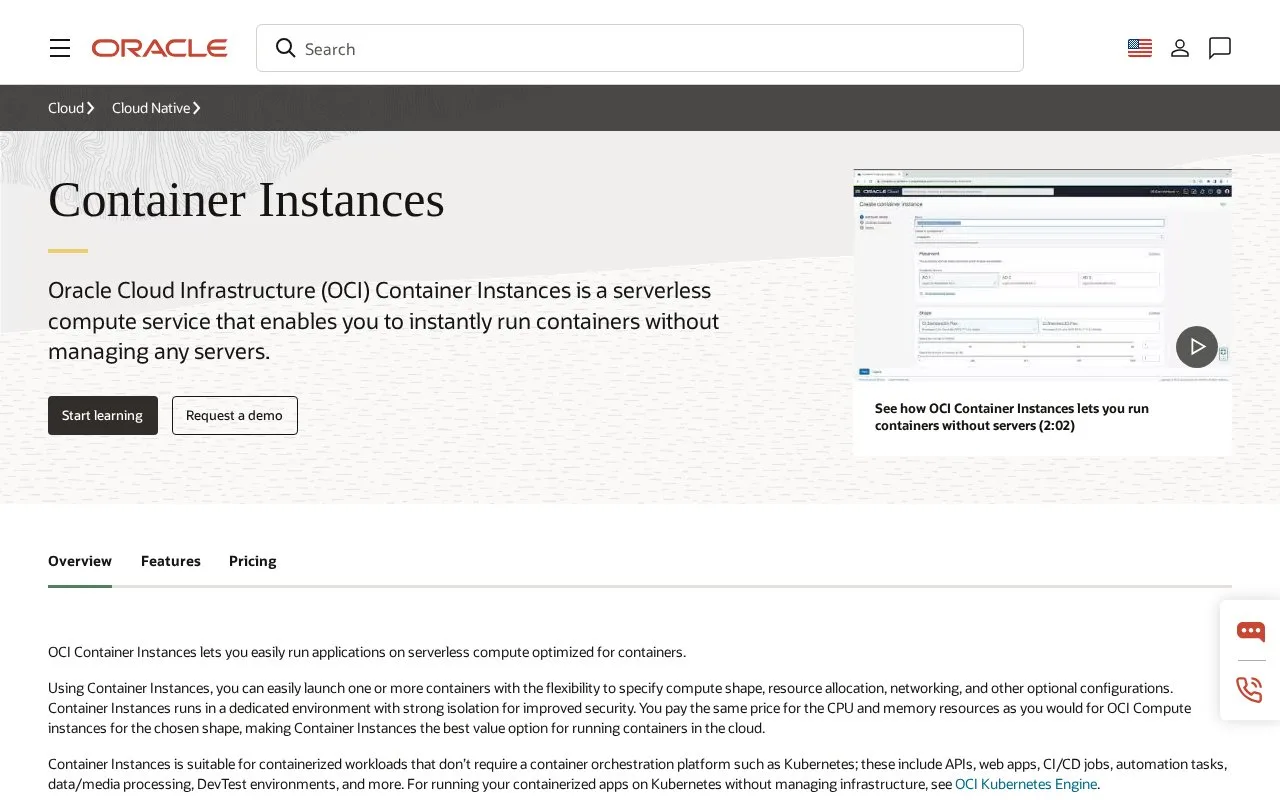
Oracle Cloud Infrastructure Container Instances is a managed compute service for starting one or more containers in an isolated OCI environment. A container instance can combine several containers, configurable OCPU and memory resources, a virtual cloud network, and optional file or ephemeral storage. The service is aimed at container workloads that do not need Kubernetes orchestration, such as APIs, web applications, CI jobs, or data processing. OCI provides console, CLI, SDK, and REST API management paths.
Assemble a container instance around its network and workload
In the OCI console, choose a compartment and availability domain, select a flexible shape, and set the OCPU and memory allocation. Then connect a VCN and subnet, configure security rules for the application's ports, and choose container images from OCI Container Registry or an external registry. The creation guide also covers environment variables, startup commands, restart behavior, and file, empty-directory, or configuration-file volumes. Up to 60 containers can be placed in one instance.
This is useful when an application already ships as containers but does not need Kubernetes scheduling or cluster management. For example, a small API and a sidecar can share an instance, network, and storage without setting up an orchestrator. The instance has VM-like isolation, while OCI manages the underlying compute environment.
The pricing page says Container Instances use the same CPU and memory prices as the chosen OCI Compute shape, billed by resource units. An Ampere A1 allowance is listed for paid tenancies and is shared across several OCI compute products, including Container Instances. Include any additional storage and network resources in a workload estimate. IAM permissions, a reachable image registry, and deliberate VCN/subnet rules are part of setup. No OCI tenancy or container instance was created for this listing.
Strengths
- Supports up to 60 containers in one instance, with configurable CPU, memory, networking, and storage.
- Offers a managed alternative for container workloads that do not require a Kubernetes cluster.
- Can be managed through the OCI console, CLI, SDKs, or documented REST API.
Watch out for
- The operator must provide a suitable VCN and subnet, allow application traffic, and ensure the chosen registry is reachable from that network.
- Compute is billed using the selected OCI shape's CPU and memory rates, while storage and network resources can add separate charges.
Best for
- Running small containerized APIs or web applications on OCI without Kubernetes cluster administration.
- Placing closely related containers in one managed compute instance.
- Container-based CI jobs, automation tasks, or development environments tied to OCI networking.
Sources
- Container Instances | Oracle (Oct 26, 2026)
- Creating a Container Instance (Oct 26, 2026)
- Cloud Price List | Oracle (Oct 26, 2026)
- Container Instances (Oct 26, 2026)