What it does
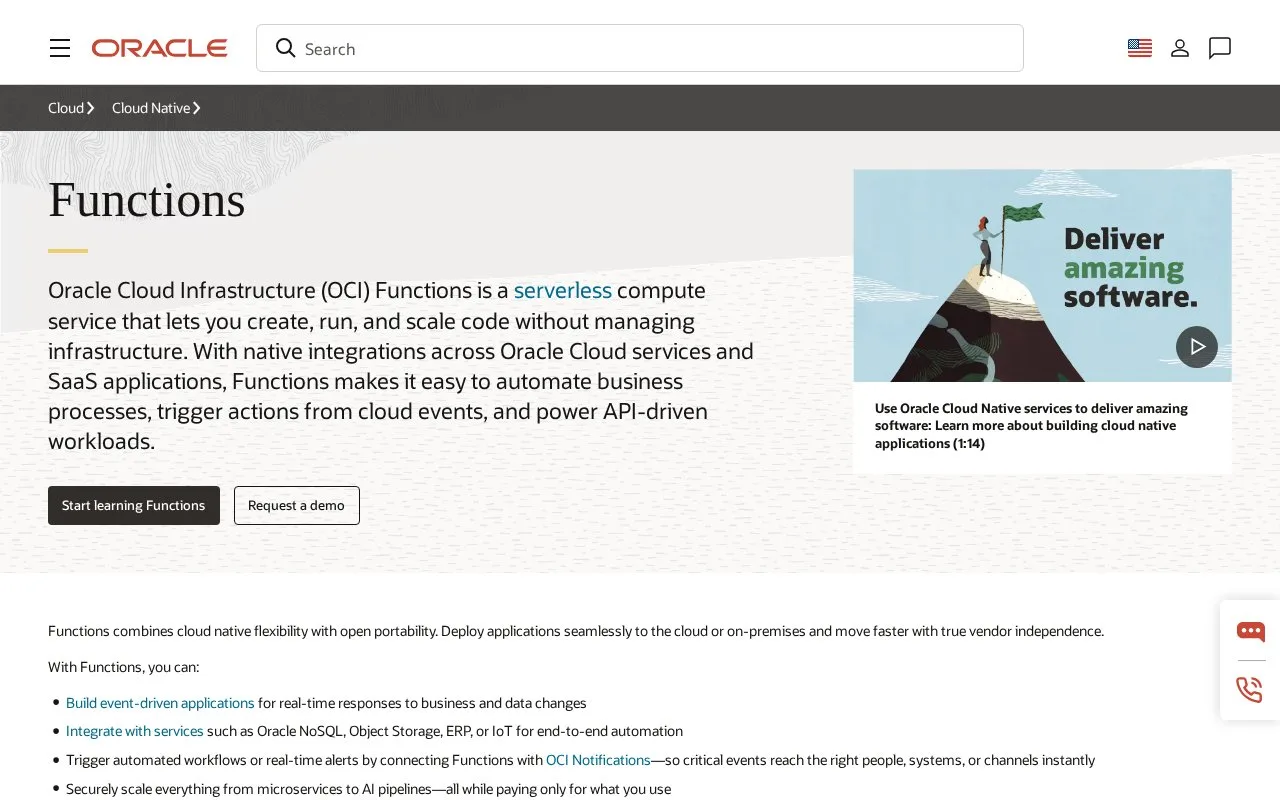
OCI Functions is Oracle's managed functions-as-a-service product, built on the Fn Project engine. It runs supported-language code or container-image functions without requiring users to provision and patch servers. A function can be invoked directly or in response to an OCI event, and developers can work through the browser console, OCI CLI, REST API, and SDKs. Code-only functions avoid a separate image build for supported runtimes; image-based functions provide control over the container and operating-system packages.
Choose the simpler runtime or bring your own image
Oracle documents two deployment forms. For code-only functions, provide an archive and select a managed runtime; Oracle publishes compatible runtime updates, while the developer chooses when to move a function to a newer version. For image-based functions, provide or build a container that includes the code and runtime. The latter is useful when native libraries, operating-system packages, or a custom build pipeline matter.
A practical first task is to create an application and function, select a runtime or image, and then invoke the function directly or connect it to an OCI event source. The Functions console includes an editor, and the service can also be managed through the CLI or signed REST requests. Oracle's docs identify IAM policies as a prerequisite for using the console, API, or SDK.
The price list describes a pay-as-you-go model with monthly no-charge invocation and execution-time allowances. Overages are metered separately, and unused provisioned concurrency has its own charge. The documented request and response payload ceiling is 6 MB, a concrete constraint to account for when functions exchange larger objects. The service itself is distinct from the open-source Fn platform that can also be run outside OCI.
Strengths
- Supported-language code can be packaged by the service without requiring the user to build and publish a container image.
- Image-based functions allow control over the base image, system packages, runtime, and image pipeline.
- The service supports console, CLI, REST API, and SDK access, with a monthly free allowance listed for invocations and execution time.
Watch out for
- Function request and response payloads are limited to 6 MB.
- An OCI administrator must grant the required IAM policies before a user can manage functions.
Best for
- Event-driven Oracle Cloud workloads that should not require VM provisioning or patch maintenance.
- Developers who want either managed language runtimes or control of a function container image.
- Automating OCI services through direct function invocation or event triggers.
Sources
- Cloud Functions | Oracle (Oct 25, 2026)
- Overview of Functions (Oct 25, 2026)
- Cloud Price List | Oracle (Oct 25, 2026)