
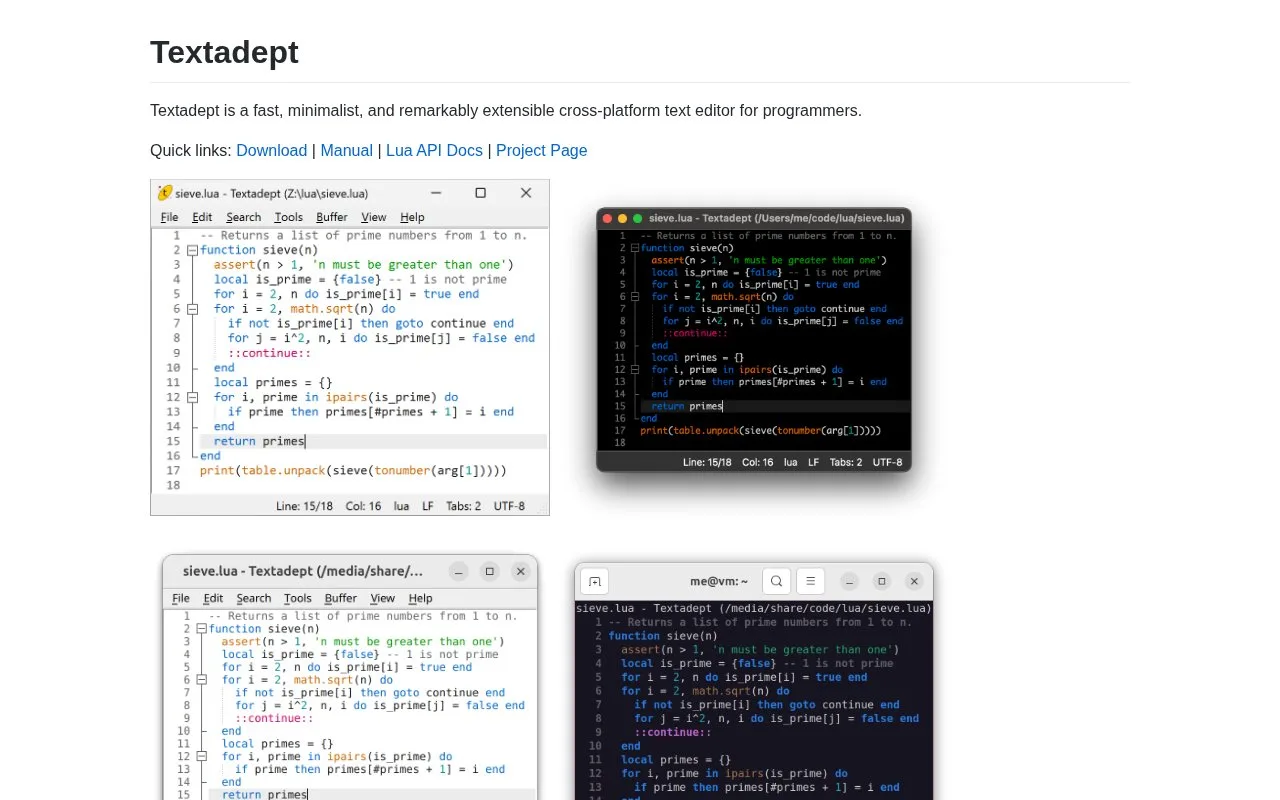
What it does
Textadept is a cross-platform text editor for programmers, available as a graphical desktop application and a terminal interface. Its built-in features include syntax support for more than 100 languages, multiple carets, split views, and shell-command integration for running, building, or testing code. Users can extend the editor with Lua modules and settings. Prebuilt archives are self-contained, so Textadept is a fit for developers who want an adaptable editor without a larger IDE project model.
Textadept is useful when you need the same editor in a desktop window and a terminal session. Download the archive for your operating system, unpack it, and start the graphical or terminal executable. The manual covers working with files and projects, configuring key bindings, and using the built-in find-and-replace pane. A developer can then invoke a shell command from the editor to run or test the current project. Those are documented capabilities, not a session performed for this listing.
Make the editor yours with Lua
Textadept keeps its default interface small, but its Lua API allows users to customize and extend editor behavior. Its manual separates buffers from views, which is useful when arranging split views around one or more files. A project can also use multiple carets and selections for repeated edits. For users who do not want to customize, the site lists syntax support for more than 100 programming languages and prebuilt binaries for Windows, macOS, and Linux.
The homepage lists a stable 13.0 release and a 13.1 beta, and says the archives need no installation. On Linux, the graphical build needs Qt 5 or GTK 3; the terminal build needs ncurses. The project repository's LICENSE file uses the MIT License. This is an editor and scripting environment, not a full IDE service that provisions a build environment for a project.
Strengths
- Provides both GUI and terminal interfaces across Windows, macOS, Linux, and BSD.
- The editor can invoke shell commands for running, building, and testing code, while Lua modules provide customization.
- The official project publishes prebuilt binaries and source under the MIT License.
Watch out for
- The Linux GUI requires Qt 5 or GTK 3, while its terminal version requires ncurses.
- Textadept is a text editor rather than a project-provisioning IDE; users supply their own toolchains and shell commands.
Best for
- Programmers who want one lightweight editor available in both GUI and terminal form
- Users who want to automate or customize an editor with Lua
- Developers who need split views, multiple selections, and shell-command integration
Sources
- Textadept (Oct 25, 2026)
- Textadept 13.1 beta Manual (Oct 25, 2026)
- The MIT License (Oct 25, 2026)