
What it does
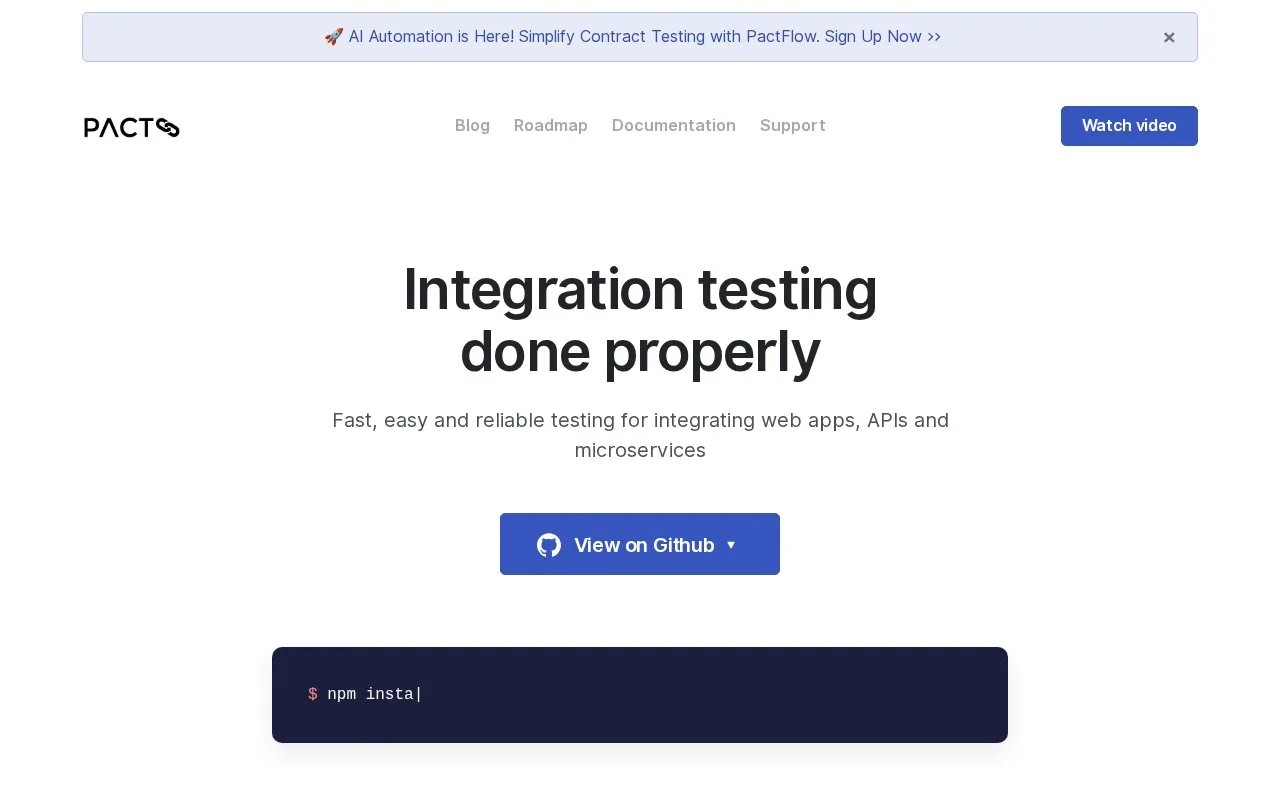
Pact is a code-first contract-testing framework for HTTP and message integrations. A consumer test records the interactions a client expects, and provider verification replays those interactions against the provider implementation to check that the responses still match. Pact focuses on compatibility at the boundary between applications, not on visual UI behavior or all business logic inside either service.
Pact is most useful when two teams need to change services independently without relying on a large end-to-end environment for every compatibility check. Start with one integration boundary, such as an order client calling an order API. In the consumer project, write a contract test around the client request and the response handling it depends on; a successful run produces a pact file describing those interactions.
The provider side then loads that pact and verifies it against the provider application. The official guide says to configure the pact file location, prepare data for the provider states, and configure the service application that will receive the replayed requests. This means the user supplies both sides of the integration, the consumer expectations, provider implementation, and the state data needed to exercise each interaction. A Pact Broker can share pact files and verification results across CI projects, but the tests themselves run in the consumer and provider projects.
Keep the boundary narrow: Pact's testing-scope guide recommends testing the client component's request creation and response handling, not using pact tests as a substitute for UI checks or business-logic coverage. Pact is available through language-specific implementations rather than one universal binary, so teams should choose the implementation matching their stack and review that implementation's requirements. The official site lists JavaScript, JVM, .NET, Go, Python, Swift/Objective-C, Ruby, PHP, and C++ options.
Strengths
- Consumer and provider verification focus checks on integration contracts without requiring the entire system to be deployed together for each test.
- The official site lists implementations for several programming language ecosystems.
- Pact Broker can publish and share contracts and verification results between consumer and provider build pipelines.
Watch out for
- A contract check requires a consumer test, a provider application, and provider-state data; the tool does not supply those application behaviors.
- Pact is not intended to test particular UI behavior or all business logic, according to its testing-scope guidance.
- Teams must select a language-specific implementation; there is no single implementation workflow covering every stack.
Best for
- Microservice teams that release consumers and providers independently and need compatibility checks at API boundaries
- API client developers checking that requests and expected responses remain compatible with a provider
Sources
- Pact | Microservices testing made easy (Oct 25, 2026)
- Introduction | Pact Docs (Oct 25, 2026)
- Conceptual Overview | Pact Docs (Oct 25, 2026)
- Testing scope | Pact Docs (Oct 25, 2026)
- Verifying Pacts | Pact Docs (Oct 25, 2026)
- Overview | Pact Broker Docs (Oct 25, 2026)