
What it does
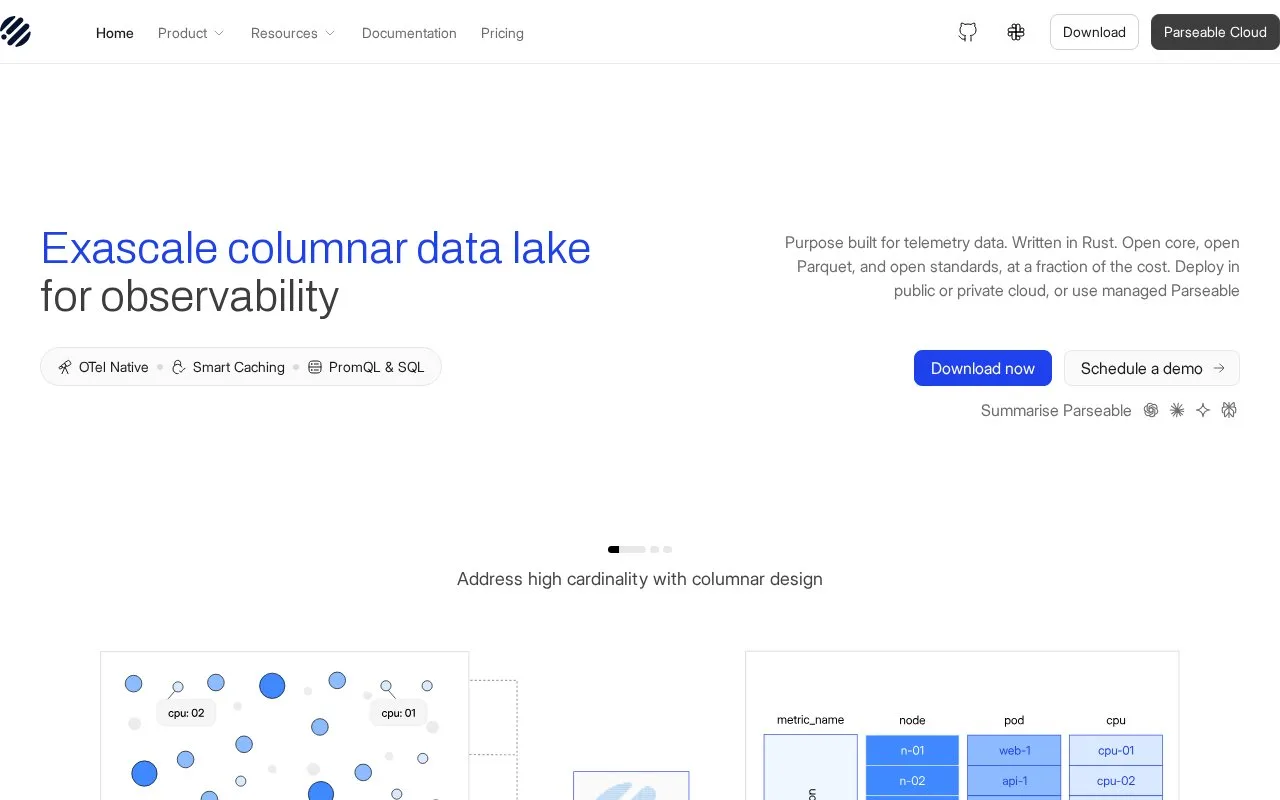
Parseable is an observability data platform for logs, metrics, and traces. Its columnar data-lake architecture supports queries with SQL and PromQL, plus dashboards, threshold alerts, anomaly detection, and application performance monitoring. It can run as a self-hosted open-source installation or as a managed cloud service. The product suits teams that want one telemetry store for queries and alerting, with a choice between managing the deployment and paying for a hosted option.
Try the query workflow on one stream
Parseable's quickstart offers a local binary or Docker route and demonstrates sending a sample event into a stream before opening the browser console. Once data is arriving, the product's SQL and PromQL query paths let an operator search logs or metrics, build a dashboard, and create a threshold alert. For a production rollout, the project documents integrations for OpenTelemetry and other telemetry agents; the repository describes support for logs, metrics, and traces in the same system.
An illustrative first task is to send a small slice of application logs, build a query around an error field, and add a threshold alert for a sustained increase. Start with representative data and retention needs before sending a high-volume stream, because the cloud tier is metered on ingested data. The quickstart's sample event is a documented example, not a result from a live Parseable instance.
The self-hosted OSS edition is free and licensed under AGPLv3. Running it yourself means you own deployment, storage, and upgrades. Parseable Cloud is managed and has a trial, while the pricing page also lists an Enterprise option with custom deployment choices. If a team distributes or modifies the self-hosted software, it should review the AGPL terms against its use case.
Strengths
- Brings logs, metrics, traces, SQL and PromQL queries, dashboards, and alerting into a single observability platform.
- Offers both a free, self-hosted AGPLv3 edition and a managed cloud service.
- The quickstart supports trying the query flow locally before choosing a production deployment.
Watch out for
- Self-hosting leaves deployment and storage operations to the team, while cloud costs depend on ingested telemetry volume.
- The self-hosted repository is AGPLv3 licensed, which may require legal review for some distribution or modification plans.
Best for
- Teams querying logs, metrics, and traces from one observability data store
- Evaluating a self-hosted telemetry platform before moving to a managed cloud service
- Building SQL or PromQL dashboards and threshold alerts over ingested observability data
Sources
- Parseable | Observability infrastructure (Oct 26, 2026)
- Quickstart (Oct 26, 2026)
- Pricing | Parseable (Oct 26, 2026)
- parseablehq/parseable README (Oct 26, 2026)
- Parseable LICENSE (Oct 26, 2026)