
What it does
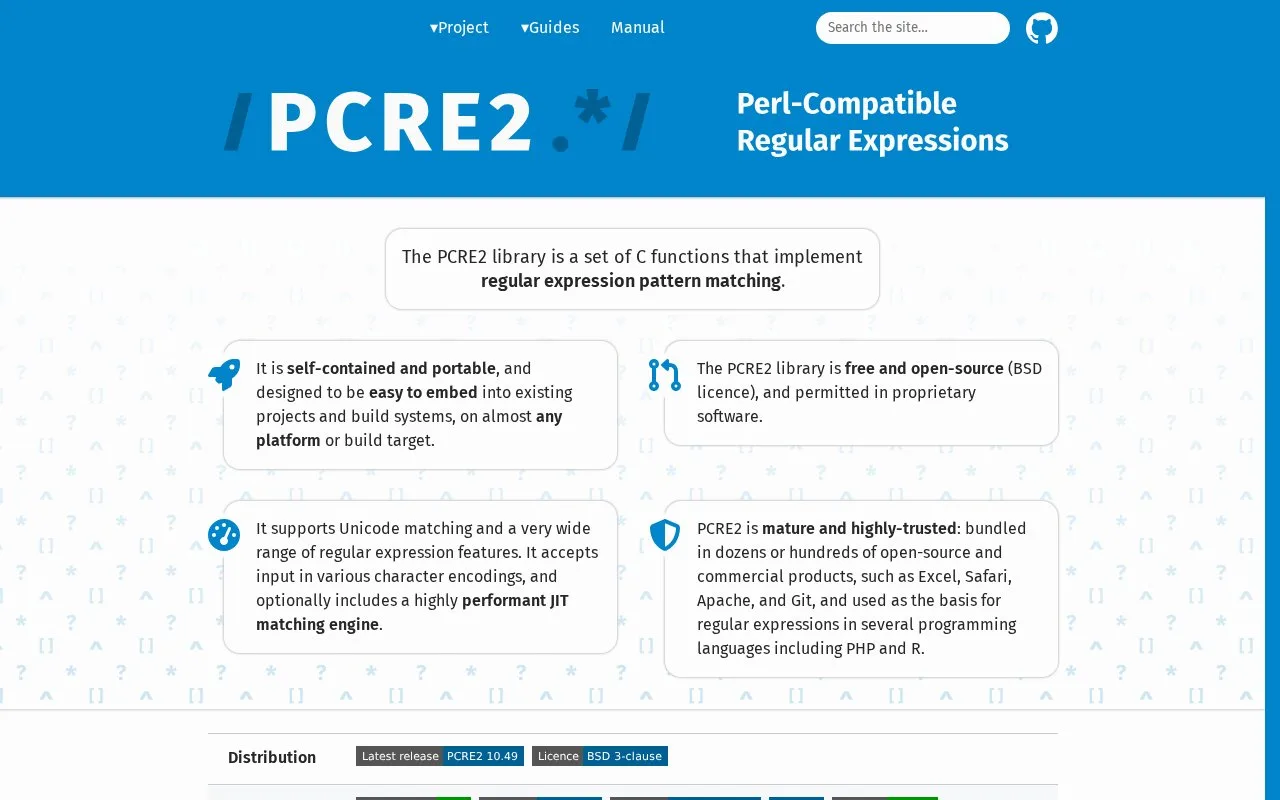
PCRE2 is a C library for compiling and matching regular-expression patterns inside software. Its syntax aims to track Perl-style behavior while documenting its own options and extensions, and the project provides 8-, 16-, and 32-bit code-unit interfaces. Developers can compile a pattern, match it against application input, and inspect captures through the library API. PCRE2 is a software component, not a hosted API or an interactive regex editor.
From pattern text to a match
An application supplies a pattern to pcre2_compile, handles any compilation error and offset, then passes the compiled pattern and subject to pcre2_match. The official API guide documents those calls and the match-data structure used to retrieve captured substrings. This is an integration workflow for developers; it is not a ready-made user interface for testing arbitrary expressions.
Before choosing a build, decide which code-unit width fits the host program’s text representation. The manual covers the pattern syntax and matching options, while the project describes Unicode support and an optional JIT engine. Start with the smallest behavior the application needs, then check the relevant API and pattern documentation for escaping, newline rules, captures, and limits.
PCRE2 is free software under a BSD-3-Clause license with a project-specific exception; its license file states that the optional JIT compiler uses separate two-clause BSD terms. Its syntax is designed to be close to Perl, but callers should still use PCRE2’s own documentation rather than assume another regular-expression engine behaves identically. Integrating it also requires compiling and linking a native library into the application.
Strengths
- Provides a portable C API for compiling patterns and matching application text.
- Documents several code-unit widths and a wide set of Perl-style pattern features.
- An optional JIT matching engine can be included when the build and workload call for it.
Watch out for
- Requires application-level integration rather than offering a standalone visual regex workspace.
- Pattern behavior and build options should be checked against PCRE2 documentation instead of assumed from another engine.
Best for
- Adding regular-expression validation or extraction to a native application
- Applications that need an embeddable regex engine with documented Unicode and matching options
Sources
- PCRE2 project site (Oct 25, 2026)
- PCRE2 pattern syntax manual (Oct 25, 2026)
- PCRE2 API manual (Oct 25, 2026)
- PCRE2 upstream repository (Oct 25, 2026)
- PCRE2 license and JIT terms (Oct 25, 2026)