
What it does
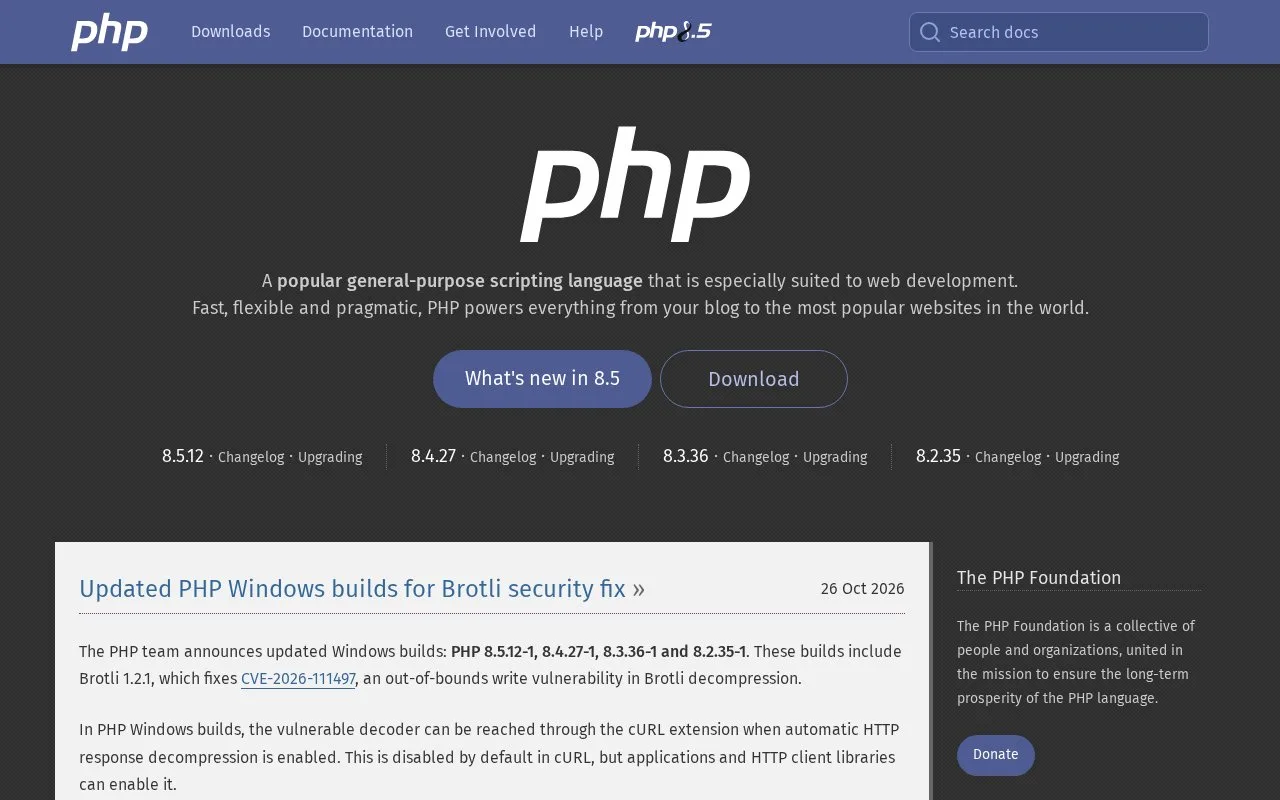
PHP is a general-purpose scripting language with a strong focus on web development. The interpreter can process PHP sections embedded in a page and return output for a web server, and the source project also supports command-line use. The official manual offers a short first-page tutorial, then expands into language syntax, types, functions, and application features. This listing is for the PHP language and interpreter, not a hosting provider or framework.
Put a small dynamic page together
The manual's first-page tutorial shows how PHP code can sit inside a regular HTML page. A sensible first task is to add one short PHP block that prints a greeting or a value, then request that page through a server configured to process PHP. The browser receives the generated page output; it does not execute the PHP source itself. This describes the documented workflow and is not a page served or tested for this listing.
From there, the getting-started guide leads into variables, control structures, functions, and forms. Use a small form or status page as a learning exercise, and validate user-supplied input before using it in a database query or command. PHP can also be used outside a web request, but the main getting-started pages emphasize PHP-enabled pages and server-side work.
The interpreter source is available under a permissive three-clause license in the official repository. PHP's flexible deployment options are not a complete application architecture: the web server, database, dependencies, and hosting environment remain separate choices. Review the source license and any bundled dependency notices when redistributing a runtime build.
Strengths
- A short tutorial demonstrates the core PHP-in-HTML workflow for a dynamic page.
- The language manual moves from a first page into syntax, types, functions, and forms.
- The interpreter source is available under a permissive open-source license.
Watch out for
- A PHP-enabled server or runtime must process a page; opening the source as a static HTML file does not execute its PHP code.
- The language itself does not supply the complete web server, database, or deployment configuration for an application.
Best for
- Server-side web pages that need to generate HTML from application data
- Small command-line or web exercises that help a developer learn the PHP language
Sources
- PHP project and manual home (Oct 25, 2026)
- PHP Getting Started (Oct 25, 2026)
- PHP: Your first PHP-enabled page (Oct 25, 2026)
- PHP interpreter repository (Oct 25, 2026)
- PHP interpreter license (Oct 25, 2026)