
What it does
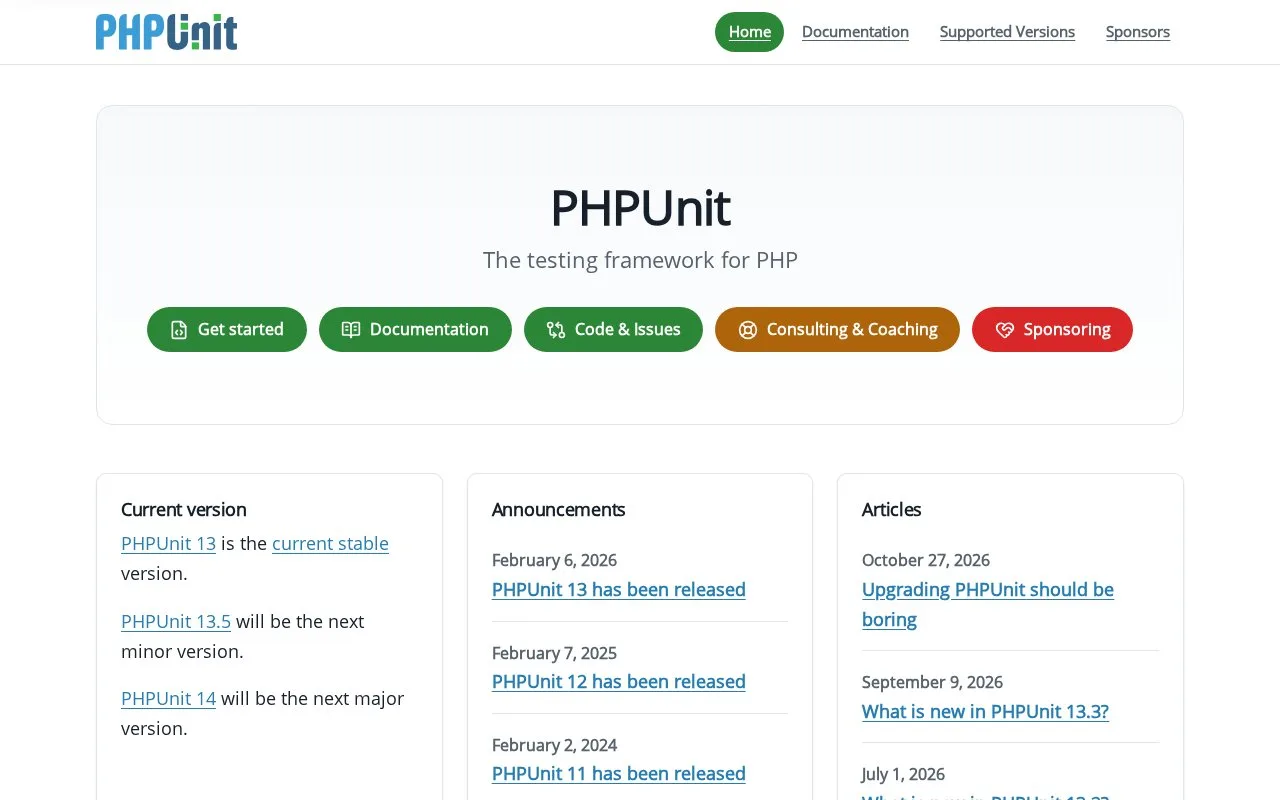
PHPUnit is a test framework for PHP applications. Developers write test classes and methods that exercise their code, assert returned values, and verify expected exceptions or side effects. The current getting-started tutorial covers PHPUnit 13 and assumes PHP 8.4 or 8.5. The project distributes its framework under the BSD 3-Clause License, and it can be installed through Composer or as a PHAR archive.
Test one behavior at a time
The PHPUnit 13 tutorial starts with a small PHP class and a test class that checks both a valid result and an invalid-input exception. For a first task, install PHPUnit through Composer or use the documented PHAR download, create a test for one public behavior, and run the test suite with the PHPUnit command-line tool. That gives a project a repeatable check before its next change.
The manual goes beyond return-value assertions: it documents expected exceptions, side effects, data providers, test dependencies, and skipping tests. These features help organize a larger suite, but the application owner still has to design representative cases and provide any required test data or services.
Check runtime compatibility before following a versioned guide. PHPUnit 13's getting-started tutorial assumes PHP 8.4 or 8.5; older applications may need a compatible PHPUnit release rather than the newest major. The project uses the permissive BSD 3-Clause License. Pest is separately listed in this collection: Pest offers a different syntax while relying on PHPUnit, whereas this entry covers PHPUnit itself and its standard test framework.
Strengths
- Covers ordinary assertions, exception behavior, side effects, data providers, and other suite-management features.
- Offers both Composer and PHAR installation routes in its official getting-started tutorial.
- The official project license is BSD 3-Clause.
Watch out for
- The PHPUnit 13 tutorial assumes PHP 8.4 or 8.5, so older projects must match their runtime to a compatible PHPUnit version.
- The framework runs tests written for the application; teams must provide test fixtures and representative data or services.
Best for
- PHP teams writing repeatable unit and integration-level checks
- Projects that need explicit assertions and exception tests in a standard PHP test framework
- Maintainers who want a versioned test manual alongside the runner
Sources
- PHPUnit (Oct 25, 2026)
- Getting Started with PHPUnit 13 (Oct 25, 2026)
- PHPUnit 13 Manual (Oct 25, 2026)
- sebastianbergmann/phpunit (Oct 25, 2026)
- BSD 3-Clause License (Oct 25, 2026)