
What it does
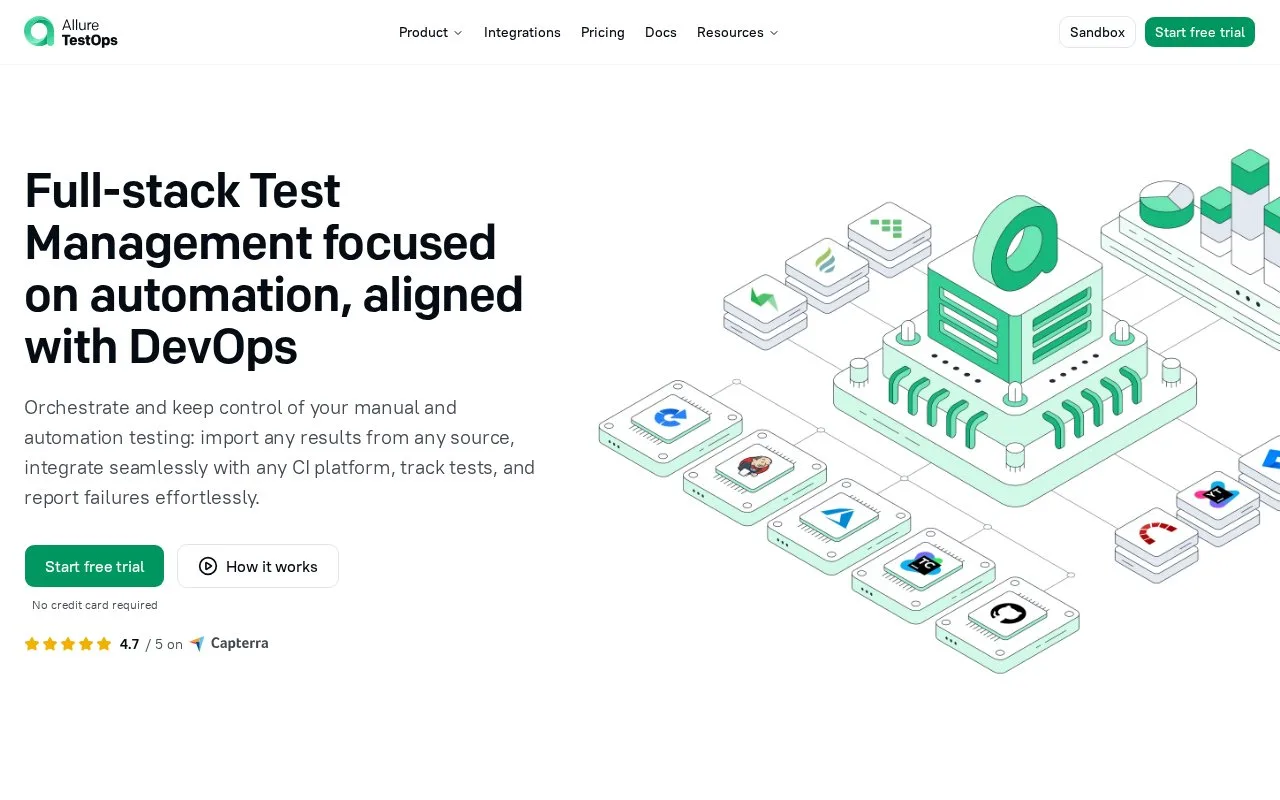
Allure TestOps centralizes manual test cases and automated execution results in a shared QA workspace. It accepts results from integrations and CI workflows, groups them into launches, preserves history and environment context, and provides analytics for test status, flaky behavior and failure triage. Cloud hosting and self-hosted deployment are available; Allure TestOps is the commercial management product, distinct from the free Allure Report utility.
Bring existing test runs into one QA view
Connect a supported CI or test-framework integration, or use the maintained allurectl tool to upload results from a pipeline. TestOps turns incoming jobs into launches that can be reviewed alongside manual cases, plans and previous runs. Teams can combine runs across environments, inspect attachments and history, and use dashboards or failure grouping to focus on unstable and newly failing tests.
For an initial evaluation, create a project, invite collaborators and send one automated run or execute a manual case. The product is a results and test-management layer, not a substitute for the team's test framework. The Cloud product is subscription-based; teams that choose self-hosting must operate the required service and supporting infrastructure in their own environment. Allure Report remains a separate report-generation tool and can be used without TestOps.
Strengths
- Manual cases and automation results can be managed and analyzed in one workspace.
- Integrations connect CI systems, issue trackers and testing tools, while the maintained CLI supports upload and selective execution workflows.
- Launch history, environment information, attachments and flaky-test analysis provide context for triaging failures.
Watch out for
- Automation results must come from an existing framework or supported integration; the platform manages and analyzes those runs rather than replacing the test runner.
- Self-hosted deployments require the team to operate Allure TestOps and its supporting services.
Best for
- QA teams that need to combine manual test management with automated results from multiple pipelines.
- Teams reviewing test history, flaky tests and failures across environments or release launches.
- Organizations choosing between a hosted test-management service and self-hosted deployment.
Sources
- Full-stack Test Management | Allure TestOps (Oct 25, 2026)
- Allure TestOps Documentation (Oct 25, 2026)
- Integrations with external systems (Oct 25, 2026)
- API of Allure TestOps (Oct 25, 2026)