
What it does
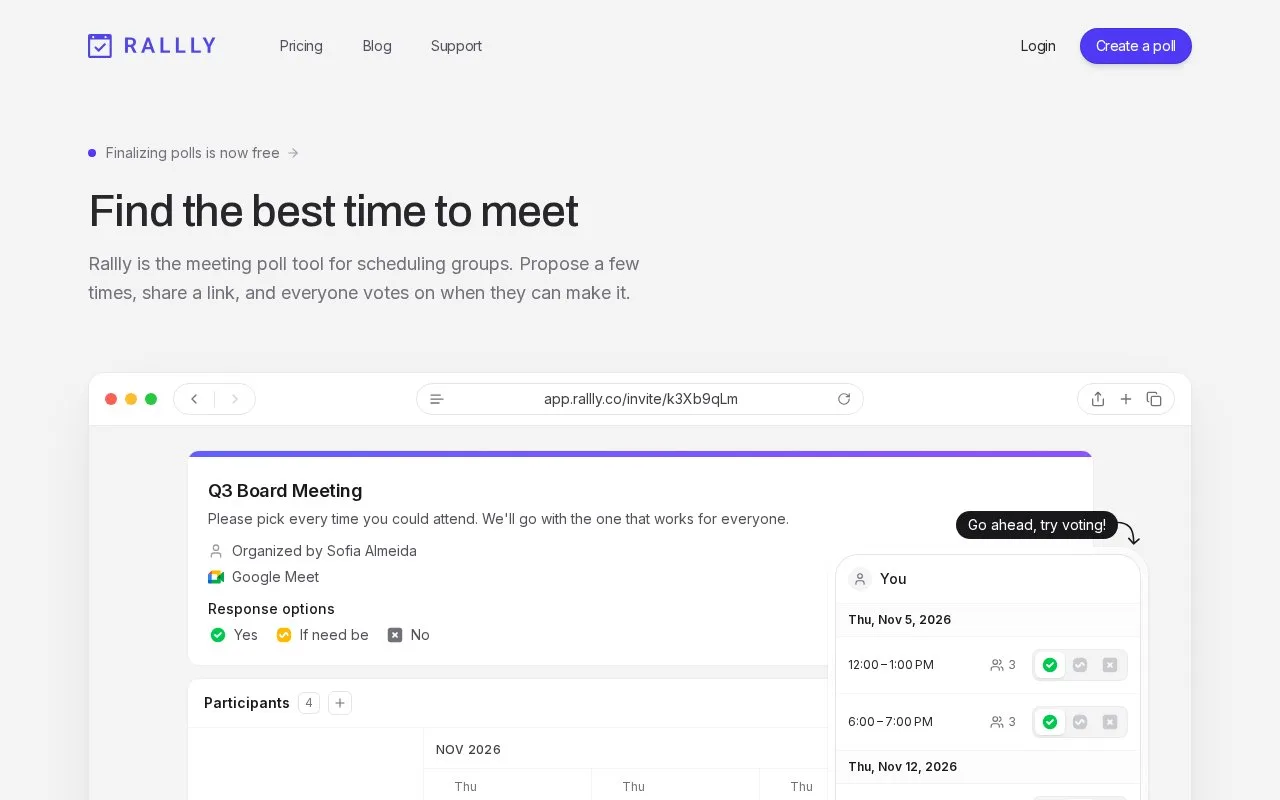
Rallly is a group availability poll for deciding when to meet. The organizer proposes candidate slots and shares a poll link; participants vote on times that work, and the results make a common choice visible. It is suited to coordinating a group decision, not to maintaining a continuously updated personal calendar or offering customer booking slots.
Use a poll when the group has to decide
Rallly’s official overview describes a simple group-scheduling flow: create a poll with possible dates and times, share its link, and ask participants to mark their availability. The page says an account is not needed to create a basic poll and participants can respond without signing up. Results show which options work for the group.
This format is useful when no single host should dictate the time, such as a committee meeting or club event. It differs from a booking page: the organizer collects votes on proposed options instead of publishing a rolling set of live availability. The page includes a pricing link and discusses time-zone behavior in its FAQ, but those details were not opened or confirmed here.
The Rallly homepage calls the service free and presents group polls as the core workflow. No poll was created or shared during this research; the described flow comes from the official product page.
Strengths
- Participants can compare several candidate meeting times in one poll.
- The page states that a basic poll can be created without an account.
- The poll is distinct from a booking calendar and suits group choice.
Watch out for
- It collects votes on proposed options rather than continuously exposing a host’s bookable availability.
Best for
- Committees and teams finding a time that works for many participants
- Clubs or groups coordinating one-off meetings without booking a host calendar
Sources
- Rallly: Free Group Meeting Scheduling Tool (Oct 25, 2026)