
What it does
React is a JavaScript library for describing user interfaces as components. Components accept inputs, render UI, and can hold state for interactive behavior. The official learning path covers JSX, props, lists, events, and state; React is most useful when a project needs reusable interface pieces and the team is prepared to choose the surrounding application and deployment tools.
The React learning guide starts with the shape of a component, then moves through JSX, props, lists, events, and state. That progression is useful for a small task such as turning a repeated product card into one component that receives a title and status, then adding state for an interactive control. The examples are documentation exercises, not work performed for this listing.
Decide how much of the stack you need
React is the UI library, not a complete application platform. Its current guide recommends starting a new app with a framework because a production app commonly needs routing, data loading, and deployment decisions around the component layer. If you already have an application or unusual constraints, React's docs also explain adding React to an existing project or building from scratch. That choice is more useful than treating a framework recommendation as an installation command for every situation.
The repository is the home for the library source, while react.dev provides the learning and API material. The repository publishes React under the MIT License. If the goal is only a static page or a prebuilt design system, the extra JavaScript application layer may not be needed; React becomes valuable when component state and updates are part of the problem.
Strengths
- The learning materials cover component composition, props, event handling, and state as separate skills.
- React can be integrated into an existing project as well as used with a framework for a new application.
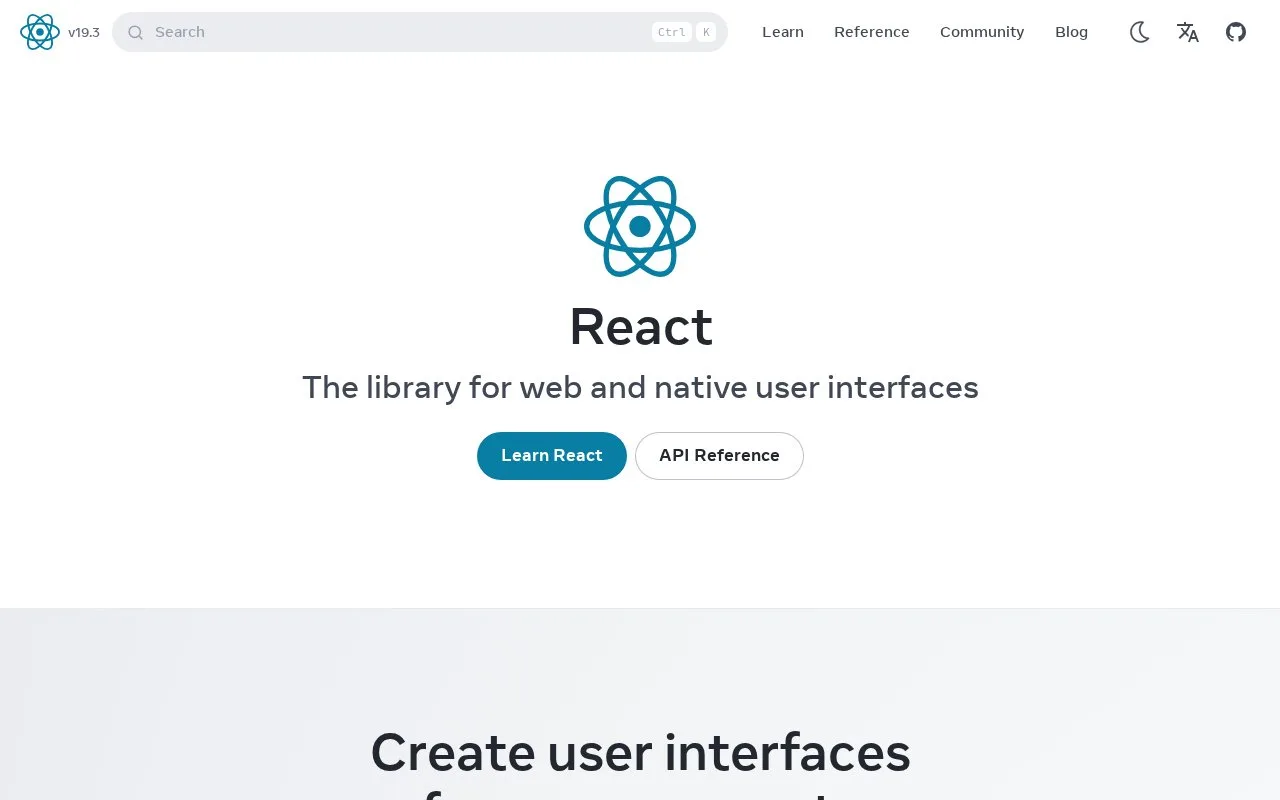
- The official site describes React for web and native user interfaces.
Watch out for
- React is a UI library rather than a complete application stack, so app structure and production concerns require additional tools or framework choices.
Best for
- Applications that need reusable, interactive user-interface components.
- Teams adding component-based UI to an existing JavaScript application.
- New app projects willing to select a surrounding framework for routing and production setup.
Sources
- React (Oct 25, 2026)
- Quick Start - React (Oct 25, 2026)
- Creating a React App (Oct 25, 2026)
- React (Oct 25, 2026)
- MIT License (Oct 25, 2026)