What it does
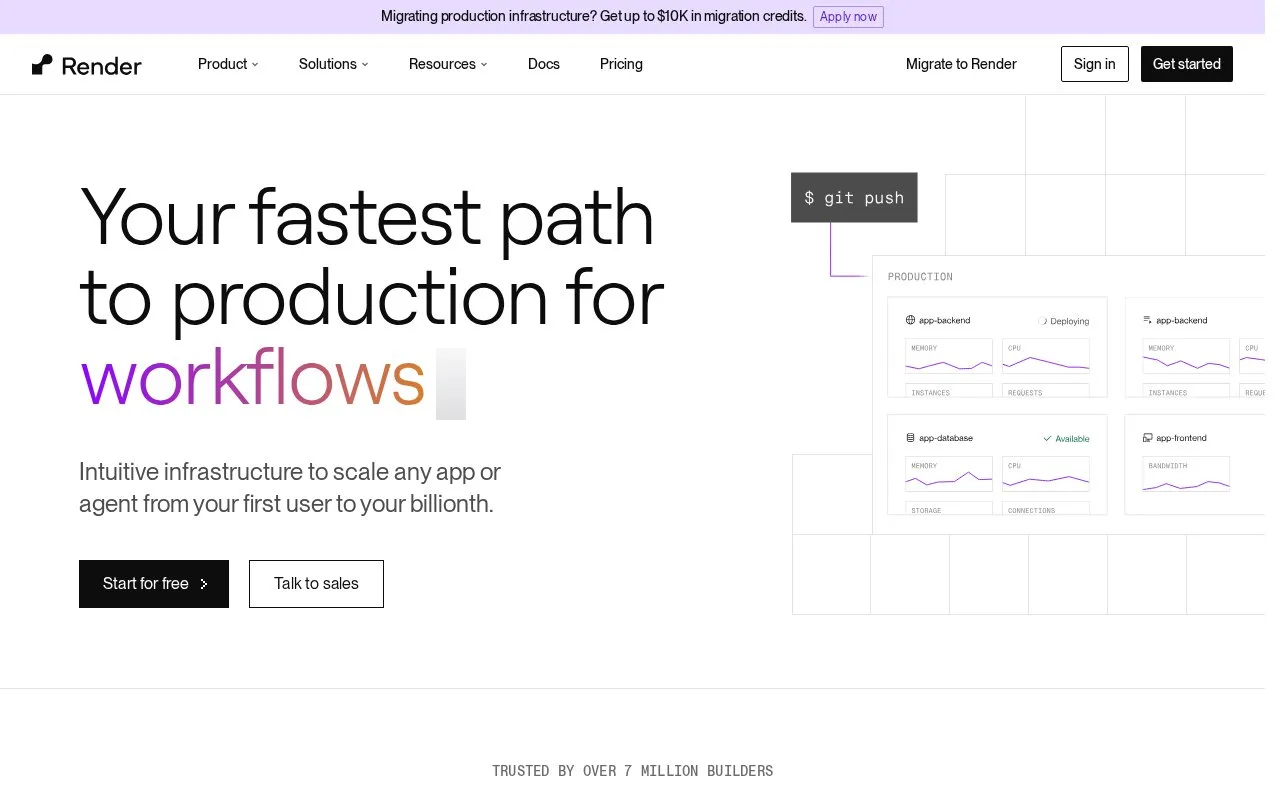
Render combines application hosting and managed data services in a hosted dashboard. A Git-linked service can rebuild when its configured branch changes, while image-based and public-repository deployments follow a manual path. Teams can choose static sites, web services, private services, background workers, cron jobs, Postgres, or Redis-compatible Key Value rather than maintaining a separate virtual machine for each role.
Render fits teams that want a deployment platform to handle the build and service lifecycle instead of provisioning a VPS. The workflow starts by choosing a service type and connecting a repository branch. By default, a push or merge to that branch triggers a rebuild and redeploy. The service's Deploys page records build and live-deploy history. A service based on a prebuilt Docker image or a public Git repository URL is deployed manually instead, so the deployment trigger depends on how the service is defined.
What happens during a deploy
Render builds the new version before switching a web or private service over. If the build fails, the existing instance continues serving; after a successful build, Render starts the replacement and then updates the deployed commit. Health checks can help confirm that a replacement is ready. This managed handoff reduces routine server work, but the application still needs a suitable health check and a valid build configuration.
Cost and storage choices
The Hobby workspace tier is listed at no workspace charge, with compute billed separately. Treat it as a low-friction starting point, not a promise that every running service is free. A persistent disk is useful when a service needs local durable files, but Render documents that adding one disables zero-downtime deploys for that service. For a typical API, connect the repository and use a managed database for durable application data rather than assuming an instance filesystem is the database.
Strengths
- Pushes to a connected branch can trigger automatic builds and redeploys.
- The catalog includes different service types for static delivery, request handling, background work, and scheduled jobs.
- Web and private services keep the old instance serving while a replacement starts.
Watch out for
- Persistent disks disable zero-downtime deploys for the service.
- A free workspace tier still has separately billed compute.
Best for
- Deploying a web application from a Git provider without managing the host OS
- Running a background worker or scheduled task beside an application service
Sources
- Render | The cloud for builders (Oct 25, 2026)
- Deploying on Render – Render Docs (Oct 25, 2026)
- Pricing | Render (Oct 25, 2026)