
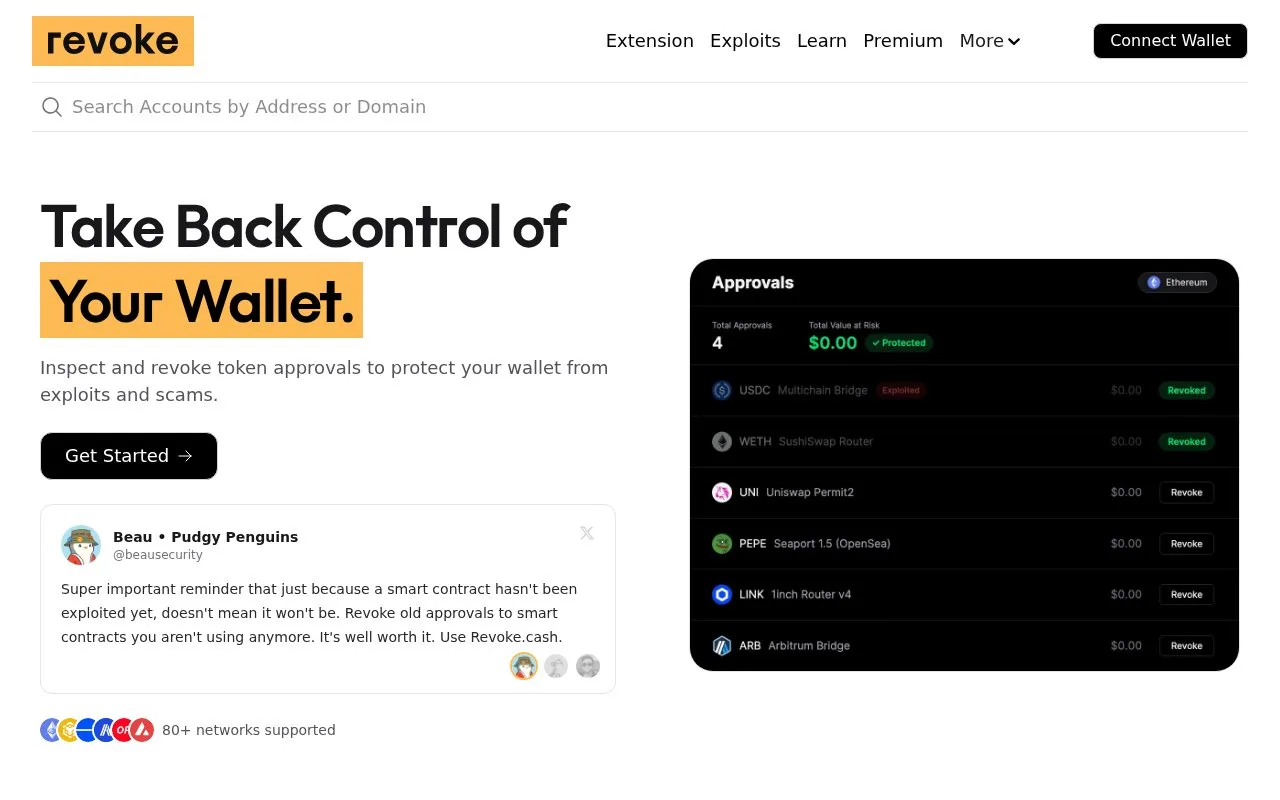
What it does
Revoke.cash inspects the permissions that contracts retain over a wallet’s tokens. Address lookup and individual revocations have no service fee, although revoking requires a network transaction fee; paid plans add multichain management and optional automation.
Enter a wallet address or supported address-name alias, choose a network and wait for its approval list. Inspection does not require connecting that wallet. Search by approved spender, apply filters or sort Newest to Oldest when reviewing a recently granted permission.
Revoke removes an allowance; the pencil beside the approved amount can instead reduce it. Making either change requires the wallet to authorize a transaction. A wallet prompt may still use the word approve because setting an allowance to zero uses the same contract function as granting it. Inspect the amount and transaction details before confirming.
Disconnecting an application leaves its on-chain approvals active. Revoking does not recover assets already stolen, and it cannot repair an exposed recovery phrase. It also does not remove deposited or staked tokens, though adding to a position later may require a new approval.
Costs and automation
Free users work one chain at a time and pay a $1.50 service fee for a batch revocation, in addition to network costs. Premium is $99 per year for ten wallets and removes batch service fees. Ultimate is $199 per year, adding automated revocation. Annual access is prepaid in USDC or USDT and does not renew automatically.
Automation requires a supported wallet upgraded to a smart account and a narrowly scoped revoke permission. Hardware-wallet accounts are excluded. Its $5 monthly gas allowance and $2 per-transaction cap can defer routine revocations; exploit-triggered actions get different treatment. Detection delays and network congestion can still leave funds exposed.
Strengths
- Approved Transfer Detection identifies which contract moved tokens
- Wallet-name aliases can be used instead of a hexadecimal address
- Approval history helps revisit permissions granted in the past
Watch out for
- Older nonstandard collectible approvals may be missing from the dashboard
- Automated revocation supports fewer networks and wallets than manual inspection
Best for
- Wallet owners reviewing permissions left by old applications
- Users comparing manual and automated approval management
Sources
- Revoke.cash approval dashboard and public address inspection (Oct 27, 2026)
- Revoke.cash network selection, sorting and allowance controls (Oct 27, 2026)
- Revoke.cash core costs, approval behavior and coverage limitations (Oct 27, 2026)
- Revoke.cash annual Premium and Ultimate plans (Oct 27, 2026)
- Revoke.cash automated permission scope, gas budget and limitations (Oct 27, 2026)