
What it does
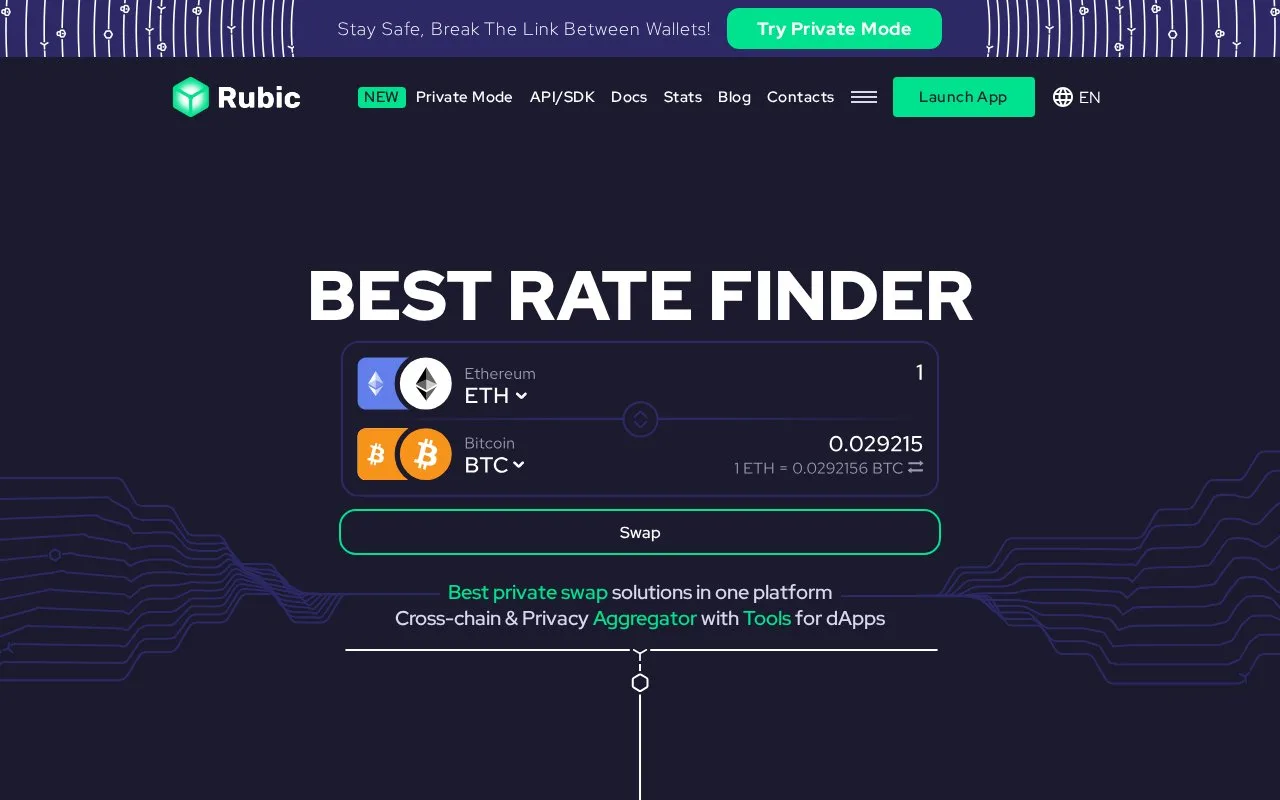
Rubic combines decentralized exchanges, bridges and other providers to quote token swaps on or between blockchains. Its app compares regular routes with Private Mode options, while developer tools expose route quotes and transaction data. Swaps have route-dependent costs, and the chosen provider matters for access and execution.
Private swaps and transfers
Rubic's Swap tab converts tokens on one network or between networks. Private Transfer moves an unchanged asset to another address on the same chain. Select Private routes only to filter, then Preview swap. Choose Use Wallet or Send Manually and enter your own receiving and refund addresses; exchange-account addresses are not accepted. Manual deposits must match the amount and countdown shown. Swap status tracks progress to payout.
Route costs reduce the receipt. Rubic says Private Mode is not anonymous: providers see deposits and payouts, and earlier wallet activity can link them.
Access and integration
Rubic's terms require adulthood, a minimum age of 18 and legal capacity under the user's local rules. The connected pools and providers determine token availability and transaction limits. A route quote does not guarantee that its rate will survive a market move.
For developers, the API provides three stages: request a quote, obtain execution data for the selected route, and track its status. Your application still executes the returned transaction data and supplies its own interface. The standard endpoint works without an API key at ten requests per minute. Higher access needs a key from Rubic's business team; the published pro limit is 400 requests per minute. Each request also carries a project referrer identifier.
Strengths
- Private and regular routes can be compared in the same swap form
- Developers can use the standard API without a key at ten requests per minute
Watch out for
- Private routes require self-controlled receiving and refund addresses
- Connected providers and pools determine the actual route limits
Best for
- Wallet users comparing token conversion routes across chains
- Developers who want route quotes and execution data for their own interface
Sources
- Rubic cross-chain aggregator (Oct 27, 2026)
- Rubic private swaps and transfers: user guide (Oct 27, 2026)
- Rubic Exchange terms of use (Oct 27, 2026)
- Rubic API overview (Oct 27, 2026)
- Rubic API referrers and request limits (Oct 27, 2026)