
What it does
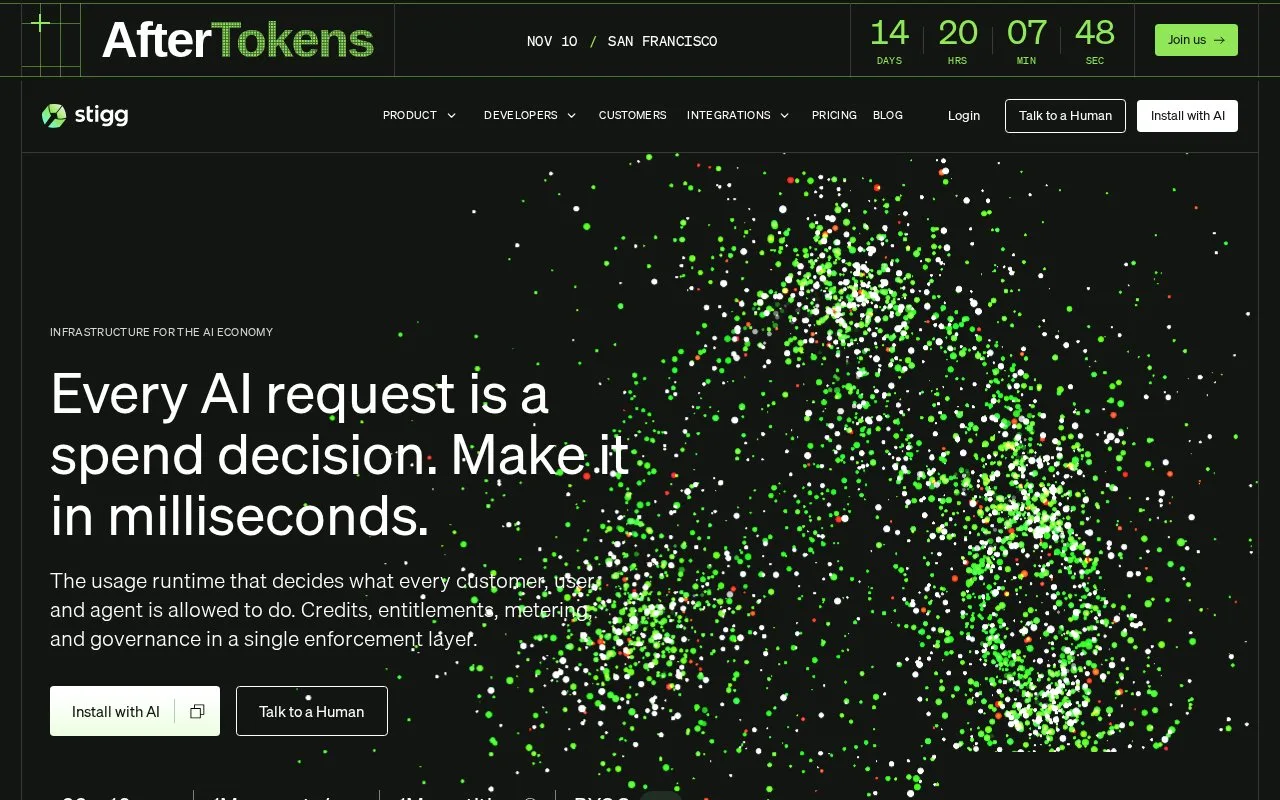
Stigg provides usage metering, credit balances, feature permissions and spending controls for software products. An application can check a customer's allowance before performing a billable action, then record the consumption. The Build plan is listed as free forever, with paid plans for higher usage and additional service requirements.
A product can check a customer's feature access and credit balance before performing a costly action. Stigg keeps those permissions, measured consumption and credit transactions together, so the application can make the access decision while work is happening.
Start with the product catalog: define a feature, attach a meter if it consumes usage, and package the allowance into a plan or add-on. The meter determines how events are counted or added. The entitlement is the permission and limit that the customer receives.
For an integration, sign into the Stigg app and open Integrations > API keys. Use the key for the intended environment. The programming interface (API) supports creating a customer, checking an entitlement and reporting usage. The practical sequence is to check permission, perform the action if allowed, then track what was consumed.
Stigg's server libraries keep a local copy of entitlement data, which can answer access checks without contacting the service on every request. Development and production environments keep separate configuration, data and keys. That separation is useful when testing a new allowance or pricing rule.
Credits have their own currency and transaction history. Grants, deductions, expirations and adjustments appear in the ledger, and consumption rules decide which credit block is spent first. Recurring allowances, prepaid packs and promotional credits can therefore coexist without being treated as the same balance source.
Listed plans
The pricing page still carries an Early Preview label, so confirm the terms offered to your account.
| Plan | Published starting terms |
|---|---|
| Build | Free forever; 10,000 managed entities and 5 million usage events monthly |
| Pro | Paid plan; confirm the selected entity, event and overage terms |
| Scale | Custom commitments and higher service limits |
| Bring Your Own Cloud | Custom deployment and commercial terms |
A managed entity is an account, user, agent or team for which Stigg makes an access decision. Sandbox, test and inactive objects are excluded. Build requires no payment card. Paid event allowances and overage terms should be confirmed before committing.
Stigg also offers invoicing and integrations with billing services. The feature controls still need to be connected to your application's behavior; defining a plan alone does not prevent an unguarded action.
Strengths
- Access checks can run from locally cached entitlement data.
- Credit transactions distinguish grants, consumption, expiry and adjustments.
- Separate environments isolate pricing experiments from live customer data.
Watch out for
- Product code must use the access checks and report consumption.
- Build uses community support and has entity and event allowances.
- Deployment in your own infrastructure is a separate commercial arrangement.
Best for
- Software products enforcing usage allowances before expensive actions
- Teams combining recurring, prepaid and promotional credits
- Developers separating feature access from billing-provider logic
Sources
- Stigg spend governance and billing integrations (Oct 27, 2026)
- Stigg listed Build, Pro, Scale and deployment pricing (Oct 27, 2026)
- Stigg catalog, meters and separate environments (Oct 27, 2026)
- Stigg credit grants, ledger and consumption rules (Oct 27, 2026)
- Stigg account keys and check-act-track API sequence (Oct 27, 2026)
- Stigg cached entitlement checks and SDK setup (Oct 27, 2026)