
What it does
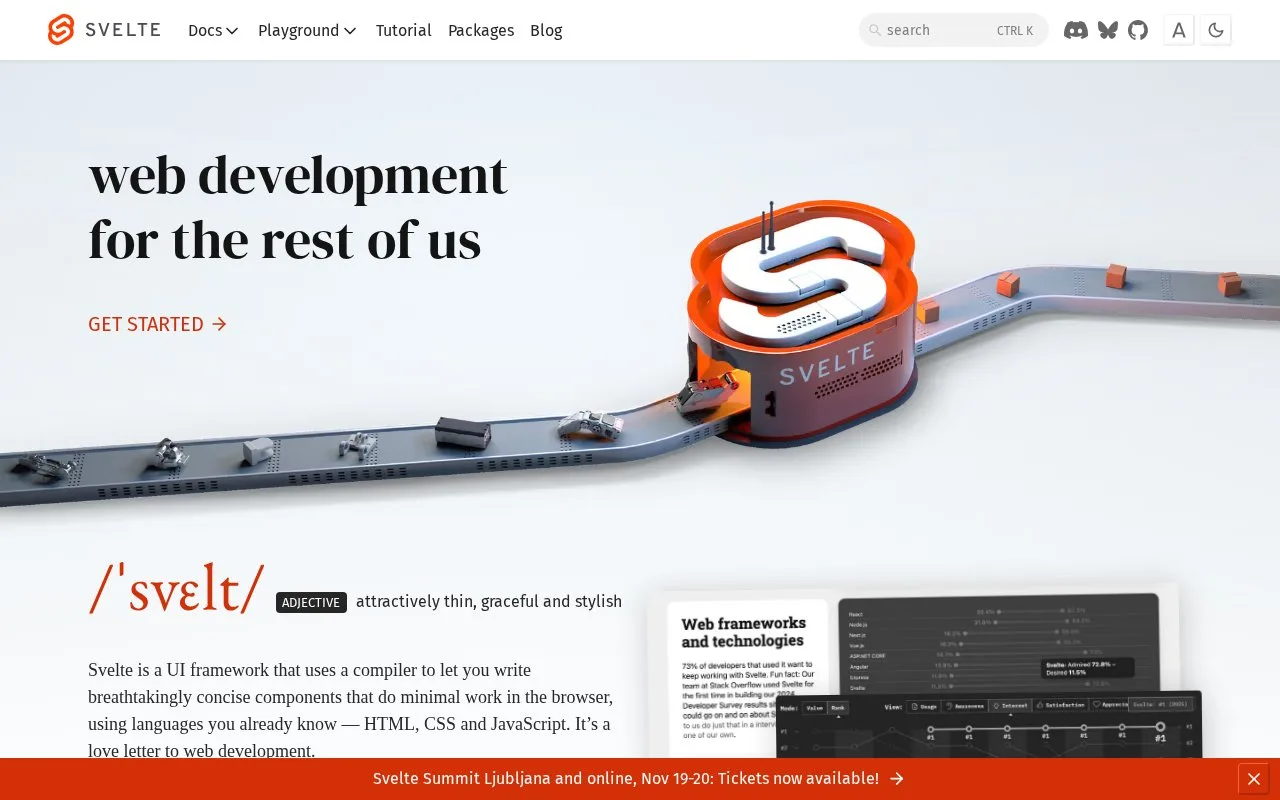
Svelte is a user-interface framework whose compiler turns declarative components into browser code. Its tutorial teaches the component syntax and reactive state model through editable exercises, while the reference documentation explains the compiler and APIs. Svelte suits developers who want to build interfaces using familiar web languages and are comfortable adding a compilation step to the project.
The interactive tutorial's state exercise is a useful first task: declare a counter with $state(0), connect it to an event, and let Svelte keep the DOM in sync when the value changes. The exercise demonstrates the current reactive model rather than asking a learner to write manual DOM updates. It is a guided learning exercise; no code was run for this listing.
Svelte components use HTML, CSS, and JavaScript in a declarative form, and the compiler transforms them for use in the browser. That design makes a small interactive widget easy to explore in the tutorial, but a maintained application still needs a project toolchain to compile and bundle its components. The official site links to a playground and to creating a new app for readers who want to move from an exercise to a project.
Svelte and SvelteKit are related but different projects: Svelte is the UI framework and compiler; SvelteKit adds application-level conventions. Choose the Svelte record when the component compiler is the subject, and evaluate SvelteKit separately if the task is routing, rendering, or full application structure. The Svelte repository's license grants open-source use; review the exact license text for redistribution obligations.
Strengths
- The compiler processes declarative HTML, CSS, and JavaScript components for browser use.
- The interactive tutorial demonstrates reactive state with a small, visible counter exercise.
- The official site provides a browser playground alongside a path for creating an app.
Watch out for
- Projects need a build toolchain to compile Svelte components before they are served to the browser.
Best for
- Frontend developers building interactive sites from component files.
- Learners who want to explore reactive state in a browser-based tutorial.
- Teams that prefer compiler-based UI components and can manage a JavaScript build pipeline.
Sources
- Svelte (Oct 25, 2026)
- Reactivity / State (Oct 25, 2026)
- Overview (Oct 25, 2026)
- sveltejs/svelte (Oct 25, 2026)
- Svelte project license (Oct 25, 2026)