
What it does
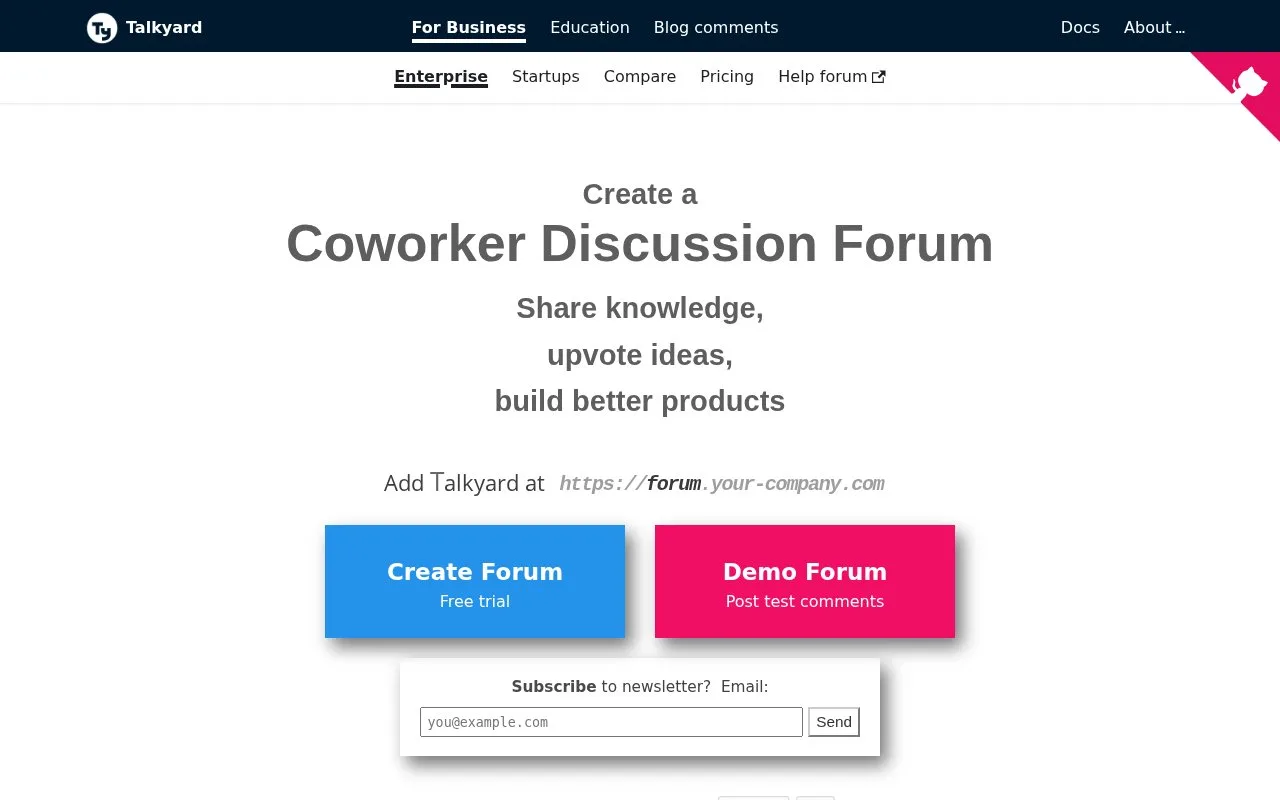
Talkyard combines blog comments with forums, Q&A and idea voting. Publishers can install the AGPL-licensed software free or subscribe to managed hosting. Administration needs an account, while reader guest comments can be enabled.
One member account covers both blog comments and the wider forum. That gives a publisher room to extend article discussions into member questions and ideas. Set how many of a new visitor's first comments need approval. Guest contributions can also be enabled. In a long thread, open the sidebar's Recent tab to find new replies.
Managed business hosting
| Plan | Monthly charge | Main difference |
|---|---|---|
| Standard | EUR 4 per active coworker | Shared hosting; 2,000 emails and 0.2 GB storage per coworker |
| Business | EUR 12 per active coworker, minimum EUR 300 | Dedicated server; 6,000 emails and 2 GB storage per coworker |
| Enterprise | Contact Talkyard | Adds configuration and usage guidance |
Coworkers include employees, contractors, administrators and moderators; external members are unlimited. Resource allowances are pooled. Prices exclude VAT. The first month needs no card, then payment is required to continue managed hosting.
For free self-hosting, follow the Docker installation on a supported Linux server. After configuration, open the site, click Continue and create the administrator account with the configured email address. Outgoing mail and off-site backups need setup too.
Talkyard describes its built-in chat as basic. Some anonymous-decision and anti-groupthink features remain partly implemented or planned.
Strengths
- Blog comments and wider discussions share member accounts
- Managed business pricing allows unlimited external members
Watch out for
- Self-hosting requires Linux and Docker administration
- Some decision-making features remain partly implemented or planned
Best for
- Publishers growing article comments into a member discussion and Q&A community
Sources
- GNU AFFERO GENERAL PUBLIC LICENSE (Oct 26, 2026)
- Talkyard Blog Comments (Oct 27, 2026)
- Talkyard (Oct 27, 2026)
- Talkyard Business Pricing (Oct 27, 2026)
- Installing Talkyard on One Server (Oct 27, 2026)